

- Blog
- Electric vehicles
- How much solar to charge EV
How much solar energy do I need to charge an electric car (EV)?
- Electric vehicles
- 5 min read
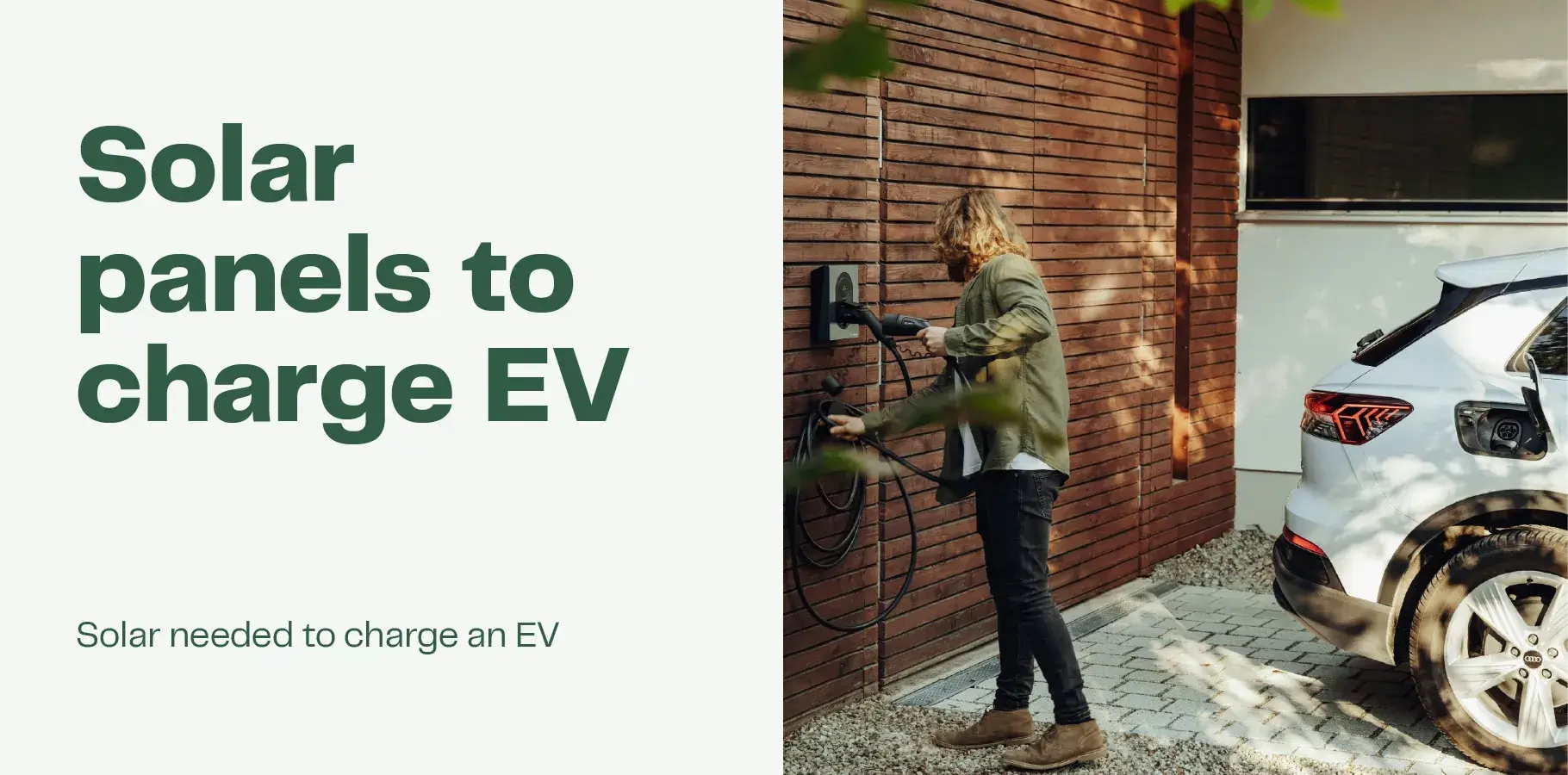
The average Australian car drives 12,100km per year, for an electric vehicle (EV), that means it requires around 1,800 kWh of electricity annually. In most parts of the country, an additional 1.5kW to 2kW of solar capacity will be enough to meet this requirement – that typically works out to be an extra 3 – 4 solar panels.
For the average Australian home, a 6.6kW to 8kW system is typically large enough to power the home and charge an EV.
Quick summary for charging an EV with solar
| EV + solar questions | Answers (using averages) |
|---|---|
| Average annual EV electricity use | ~1,815 kWh |
| Extra solar needed for an EV | 1.5 – 2 kW |
| Number of panels | 3 – 4 |
| Typical home + EV (one) | 6.6 – 8 kW |
| Typical home + 2 Evs | 8 – 10kW |
| Annual charging cost with grid electricity | ~$600 – 700* |
| Charging cost using solar power | Close to $0* |
* Depending on electricity rates, home solar generation and driving habits.
Why more Australians are home charging with solar
In 2026, one in every six new cars sold is an EV. Combine the increase in EV adoption with Australia’s strong solar uptake and it’s easy to see why home charging with solar is becoming more and more popular.
Studies suggest that Australians like to charge their EV at home. The Electric Vehicle Council (EVC) and University of Sydney’s EV Ownership survey 1 found that 93% of owners can charge their EV at home, while 85.3% actually did in the week prior to the survey. The survey also confirmed a strong link between EV home charging and solar ownership; 80% of respondents that charge from home own rooftop solar.
Calculating how many solar panels you need to offset your EV charging is easier than you might think — it all comes down to understanding a few key variables and how they work together.
There are four key variables to calculate how much solar is needed to charge an EV:
- Size or battery capacity of the car
- Average vehicle usage
- Energy required to charge the car
- Solar generation potential at the charging location
Average EV battery capacity
The table below displays the ten highest-selling electric vehicles (EV) in Australia for 2026. All models offer at least two, and often more, battery capacity options that will affect the purchase price. Just like more power in an ICE (Internal Combustion Engine) vehicle, larger batteries are viewed as a “premium” feature and will inherently cost more than the entry-level vehicles with smaller batteries.
Most popular EVs in Australia in 2026
| Model | Smallest battery | Largest battery |
|---|---|---|
| Tesla Model Y | 60 kWh | 75 kWh |
| BYD Sealion 7 | 82.6 kWh | 82.6 kWh |
| Geely EX5 | 60.2 kWh | 68 kWh |
| Omoda Jaecoo J5 | 58.9 kWh | 58.9 kWh |
| Zeekr 7X | 75 kWh | 100 kWh |
| BYD Atto 2 | 51.1 kWh | 51.1 kWh |
| BYD Atto 1 | 30.08 kWh | 43.2 kWh |
| Tesla Model 3 | 60 kWh | 75 kWh |
| BYD Atto 3 | 50.1 kWh | 60.4 kWh |
| Kia EV5 | 64.2 kWh | 88.1 kWh |
How driving habits affect EV efficiency
How often and how you drive your electric vehicle both play a significant role in determining your energy consumption and charging requirements.
Just like an ICE vehicle, the way you drive – acceleration behaviour, brake behaviour, commute speed, etc. – all play a significant role in determining your car’s energy (kWh) consumption.
ICE vehicles tend to have predictable fuel consumption patterns. As a general rule, stop-start traffic decreases fuel efficiency.
EVs, on the other hand, excel in stop-start traffic, which is part of what makes them such an appealing proposition for city-dwellers and peak hour commuters. Stop-start traffic allows EVs to use regenerative braking to convert braking energy back into usable electric energy.

EV owners with a city commute are far more likely to get closer to the advertised WLTP (Worldwide Harmonised Light Vehicle Test Procedure) range than EV drivers who spend most of their time at higher speeds on the highway.
Charging method
For our analysis of solar EV charging, we assume a standard electrical socket or dedicated home charger is used so that solar panels can power the charge. How long it takes to charge an EV will depend on which method is used, an electrical socket (25 – 40 hours) takes much longer while a dedicated home charger (5.5 – 8 hours) is much faster.
How much electricity an EV uses
Australia’s best-selling EV, the entry-level Tesla Model Y with a 60-kWh battery, has an advertised WLTP range of 466km, indicating an operating efficiency of 12.88 kWh / 100km. Like ICE fuel consumption figures quoted by manufacturers, WLTP figures are notoriously optimistic. Still, most drivers will report around 12 – 15 kWh / 100km of energy usage, which is vastly more efficient than when EVs first came onto the market.
The most recent data from the Survey of Motor Vehicle Use by the Australian Bureau of Statistics from 2020, shows that the average yearly distance travelled by Australian motorists is 12,100km.
If we take a conservative average kWh / 100km consumption figure of 15 kWh / 100 km and say that the average EV battery size is 60 kWh, then a full charge would deliver around 400 kms of driving range, which would require 30.25 full battery charges each year (12,100 / 400).
| Variable | Figure |
|---|---|
| Average annual travel | 12,100 kms |
| Battery capacity | 60 kWh |
| Energy consumption | 15 kWh |
| Calculation | Result |
|---|---|
| How many kWh to travel 12,100 kms | 1,815 kWh |
| How many battery charges | 30.25 |
So then, for the sake of very simple science, if we take all variables out of the equations (partial charges, use of public charges, changes to consumption) and we say that an EV with a 60 kWh battery needs to be charged from 0-100% 30.25 times each year to reach the national average of 12,100km, we would require 1,815 kWh (30.25×60) of energy to achieve this.
Average solar system output by size
The size of your solar system is the biggest determining factor in its potential for energy production. However, when we look at “average solar system output by size”, there are two other important variables that we need to consider:
- Average sunshine hours at your location
- Property specific conditions
The table below shows the average daily energy produced by different solar systems in one of Australia’s lowest producing states, Victoria (VIC), and one of its highest producing states, Western Australia (WA).
| System size | VIC (kWh) | WA (kWh) |
|---|---|---|
| 3kW | 10.8 | 13.2 |
| 5kW | 18 | 22 |
| 6.6kW | 23.8 | 29 |
| 8kW | 28.8 | 35.2 |
| 10kW | 36 | 44 |
| 13kW | 46.8 | 57.2 |
Again, it’s important to reiterate that these are average figures. Energy consumption could be higher or lower depending on your solar system and weather conditions.
Solar system size to charge an EV
Based on the average EV requiring 1,815 kWh to cover the national driving average of 12,100km per year or 33.2km per day (12,100 / 365), a 1.5kW panel system is enough to power the EV alone. The table below shows output for a 1.5kW system in Melbourne, Victoria:
| Energy | |
|---|---|
| 1.5kW System output | 1,971 kWh |
| Average energy to power EV | 1,815 kWh |
These calculations are based on average figures. During winter months with lower sunshine hours, your system will not produce as much energy.
Solar system size to power your home and charge an EV
Of course, you will also want to power your household electricity usage with solar energy. In Victoria, a 5kW solar system generates around 18 kWh per day, or approximately 6,570 kWh per year, which is enough to cover the average household electricity usage of 15.3 kWh per day.
Therefore, adding an extra 1.5kW to this system should be enough to power your home’s electricity needs and charge an EV. For average usage, a 6.6kW system is about right.
| System size | To power |
|---|---|
| 1.5kW | To charge an EV |
| 5kW | To power the home |
| 6.6kW | Cover both |
Even after accounting for other household energy needs, an appropriately sized solar system can comfortably cover the energy required for EV charging, dramatically reducing or even eliminating reliance on the grid for vehicle charging.

Everyone’s needs are different
We have based our calculations on average usage and solar production figures. We recommend you perform your own calculations. For the solar component, our solar panel calculator will give you the figures you need.
Then factor in roughly 1.5kW – 2kW per EV that you want to charge.
Number of solar panels required to charge an EV
The number of solar panels required to charge your EV will depend on the size of system that you opt for. Using the example above where a 6.6kW system generates enough electricity to cover both EV and average household usage, 14 to 17 solar panels would be required to charge an electric vehicle (EV). For just charging the EV component, 3 – 4 solar panels would be required.
| System size | Number of panels |
|---|---|
| 1.5 kW | 3 to 4 |
| 5kW | 11 to 13 |
| 6.6kW | 14 to 17 |
| 8kW | 17 to 21 |
| 10kW | 21 to 26 |
| 13kW | 27 to 34 |
Offsetting your commute
Offsetting your electric vehicle (EV) with solar is easier and cheaper than you think. The average cost of a 6.6kW solar system across Australia is around $6,500 – depending on your location and your chosen system. Purchasing an electric car is a larger investment, but there are plenty of EV incentives available that reduce the upfront cost.
It costs between $17.25 – $22.50 to charge a Tesla at home, these costs can almost entirely be offset by using solar energy. Bear in mind, it takes between 6 – 9 hours to charge a Tesla using a home EV charger. For EV owners, solar is a smart way to offset your environmental impact and maximise your savings.
Sources:
1 EV Ownership Survey 2025, 2nd Edition
 written byBy Michael Henderson