


Solar panels Gold Coast
A guide to solar installation on the Gold Coast.
Looking to install solar panels on the Gold Coast? You’re in good company.
As of 2026, over 51% of residential properties on the Gold Coast have rooftop solar.
This guide covers how much solar panels cost on the Gold Coast, available rebates (including what's changed with the federal battery program), solar payback periods, and how to pick a quality installer from the hundreds of accredited solar installers on the Gold Coast.
Is solar on the Gold Coast worth it?
Yes, for most properties, investing in solar panels on the Gold Coast is worth it.
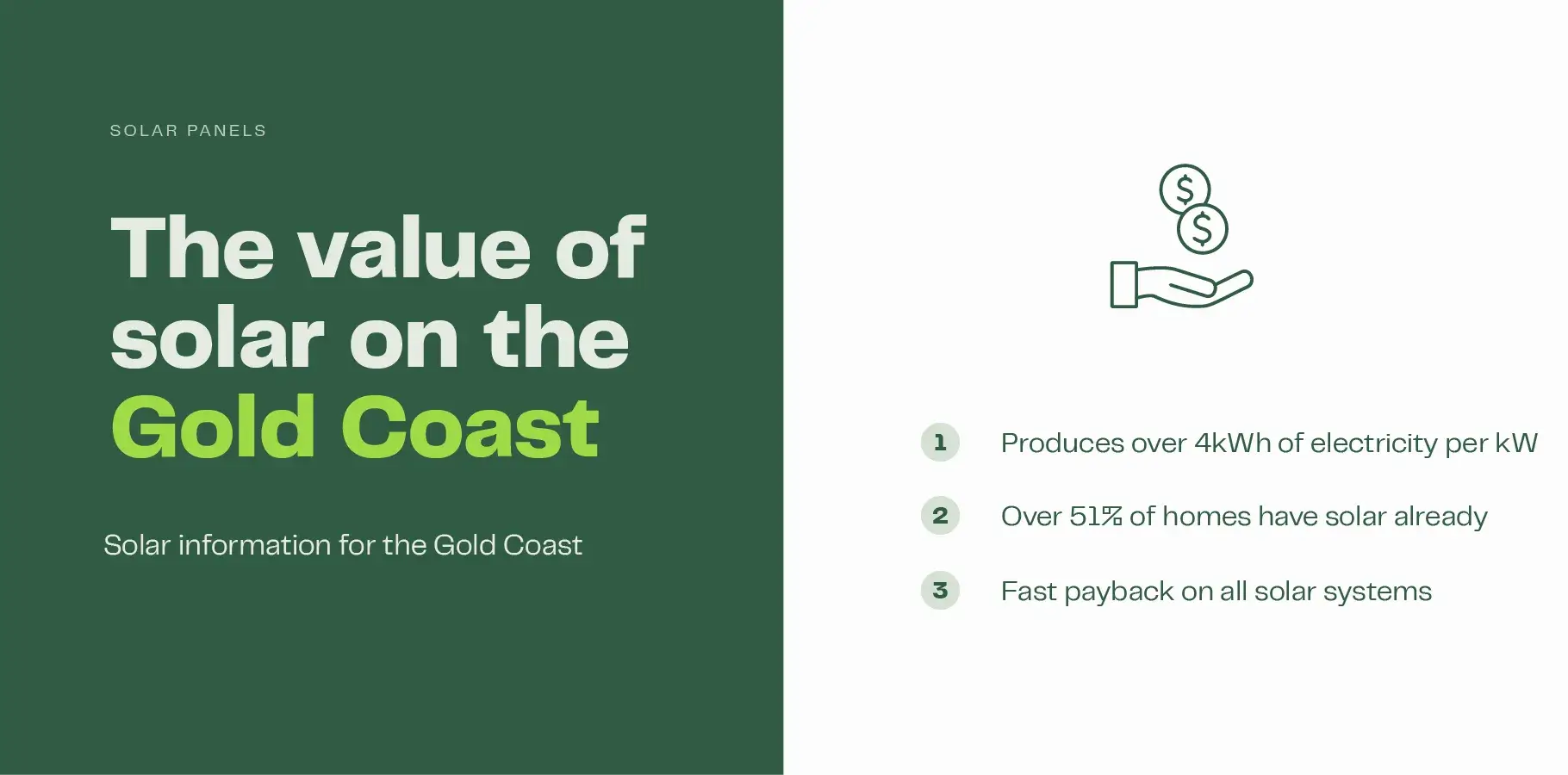
Solar is particularly attractive on the Gold Coast due to: the high number of sunshine hours, relatively high electricity rates and a host of solar companies that perform quality installs.
Homes with solar on the Gold Coast
Our analysis of data from the Clean Energy Regulator1 and the latest Australian Census2, shows that approximately 51.6% of homes across the Gold Coast have already installed rooftop solar.
| Year | Solar installs |
|---|---|
| Pre-2021 | 92,403 |
| 2021 | 11,619 |
| 2022 | 9,674 |
| 2023 | 9,074 |
| 2024 | 9,054 |
| 2025 | 7,576 |
| 2026 | 3,037 |
| Total | 142,437 |
Warmer climate aligns cooling use with summer months
Cooling systems are the dominant form of climate control for residents on the Gold Coast, heating is only needed on cooler nights during winter. The humid summer months see the highest drain on energy use for cooling, fortunately though, this is when daylight hours are longer and solar can be used to directly power air conditioning appliances The climate conditions are far more favourable than a city like Melbourne.
Sources:
1 Clean Energy Regulator - installation postcode data.
2 Australian census 2021 – Gold Coast private dwellings 270,261 with estimated growth rate of 2% brings total to 276,059 in 2026.
How much do solar panels cost on the Gold Coast?
The average cost of solar panels on the Gold Coast averages around $1,000 per kilowatt (kW). A 6.6kW system on the Gold Coast and comes with an average price tag of $6,380, while a larger 10kW solar system averages $9,666.
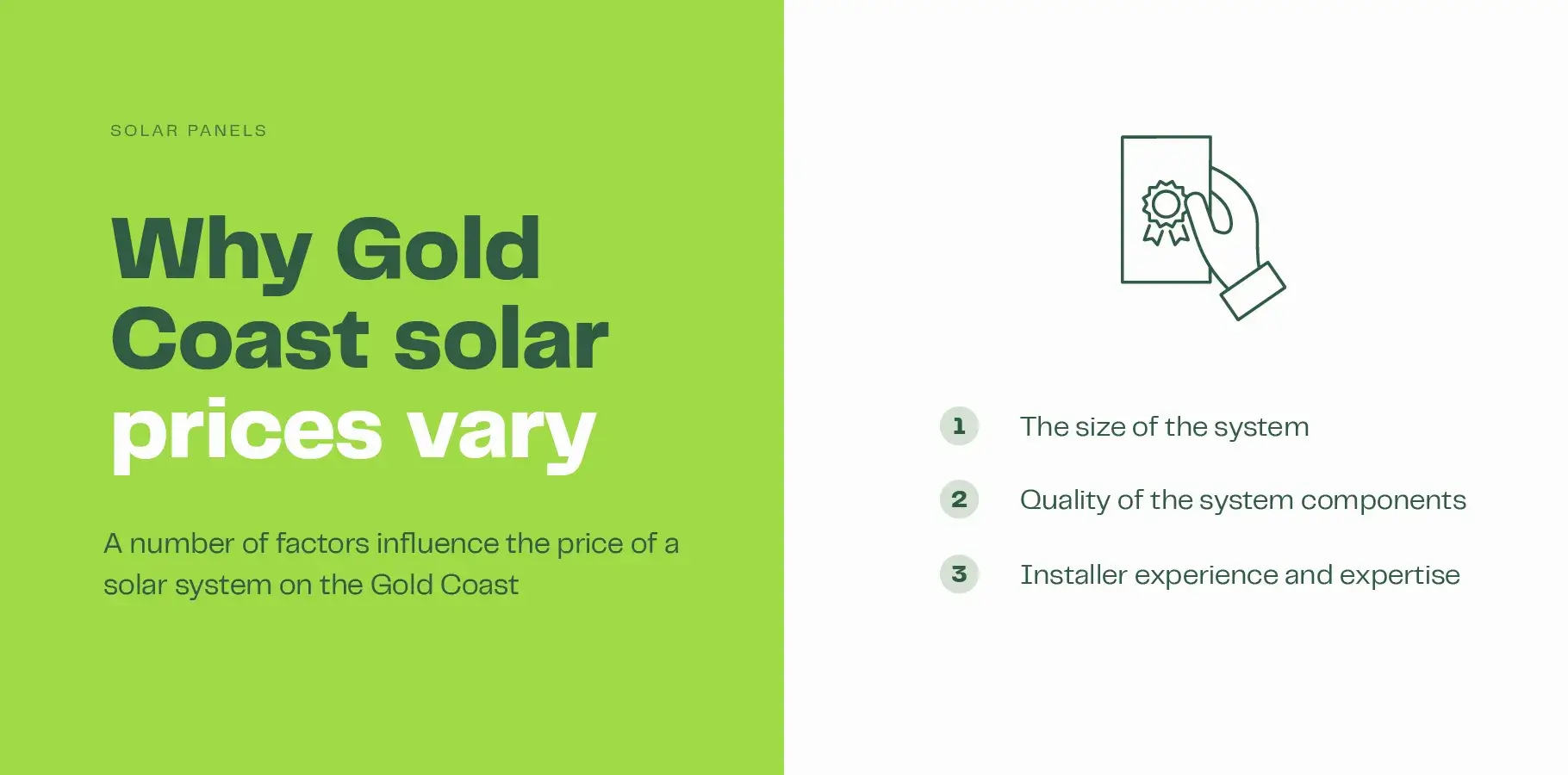
It’s important to understand that the cost of solar panels on the Gold Coast can vary dramatically between different installers.
When we think about solar costs, the three key levers that influence price, include:
- 1. System size
- 2. Solar panel quality
- 3. Inverter quality
- 4. Quality of installation and expertise of installer
Points one, two and three are self-explanatory:
- Larger units are more expensive than smaller units.
- High quality solar panels and inverters come with longer warranties and generally perform better than cheaper, lesser-known brands.
Quality of installation is of utmost importance
Point 4 – quality of installation and expertise of installer – is an underestimated factor when comparing solar choices on the Gold Coast.
The quality of installation and the expertise of the installer doesn’t just refer to correctly installing your solar panels. Rather, it comes down to how solar panels are positioned on your roof. Small differences in panel angle, orientation and string configuration can mean hundreds of kilowatt-hours a year in lost generation – money you'll never recover over the life of the system. A good solar installer will assess your roof's pitch, identify shading from trees, neighbouring buildings, and design a layout that maximises output rather than just fitting the panels in the easiest spots.
It's also peace of mind, a good installer will deliver a foolproof and safe installation with a workmanship warranty.
Gold Coast solar rebates and incentives [Updated 2026]
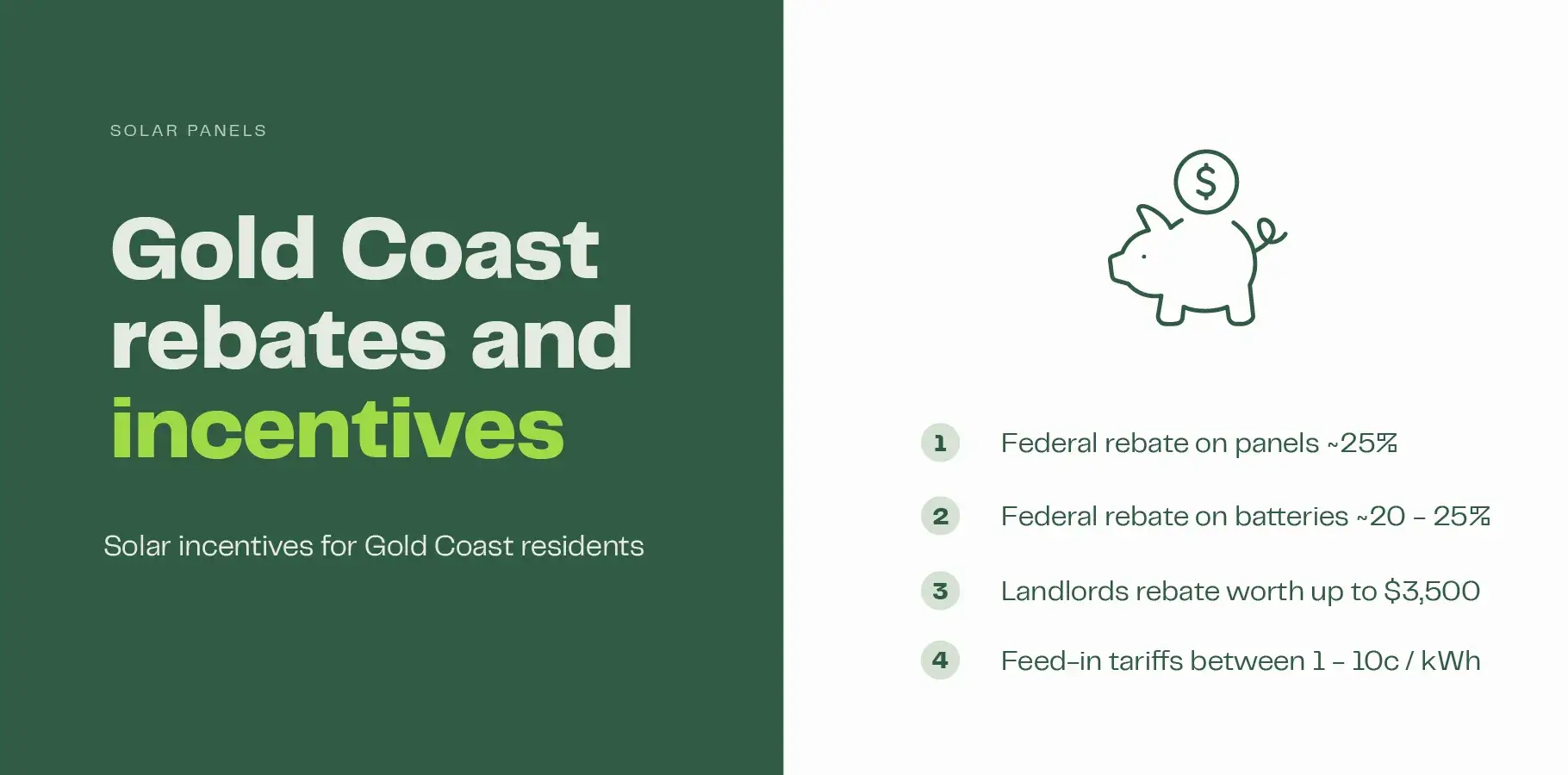
1. Federal STC rebate (Small-scale Renewable Energy Scheme)
The federal STC rebate is the main incentive for new solar panel installations on the Gold Coast. Under the federal STC rebate, Small-scale Technology Certificates are issued to eligible Gold Coast residents based on your system's predicted output through to the end of 2030. The rebate can reduce system cost by up to a quarter, and your installer claims it on your behalf – you only pay the net amount.
The federal STC rebate is calculated by system size, ranging from around $1,800 for a 6.6kW system up to $3,560 for a larger 13kW system. An 8kW system attracts a rebate of approximately $2,200, while a 10kW system increases the rebate to around $2,760.
Eligibility criteria
- Use Clean Energy Council (CEC) approved components
- Install via an SAA accredited installer
- System must be under 100kW
- Install within 12 months of STC creation
- Scheme ends 31 December 2030 – rebate value diminishes each year between now and then.
2. Federal solar battery rebate (Cheaper Home Batteries Program)
Eligible Gold Coast residents can apply for the Federal Government’s solar battery rebate AKA “Cheaper Home Batteries Program”.
The Cheaper Home Batteries Program was first introduced back in July 2025 and is available to Gold Coast households installing a new battery alongside an existing or new solar system install. From May 2026, the Cheaper Home Batteries Program rebate is worth approximately $252 per kWh of battery capacity, meaning that the average 10 kWh battery attracts a rebate of around $2,516.
Eligibility criteria
- Battery must be between 5 kWh and 100 kWh in capacity
- Must be installed after 1 July 2025
- Battery must appear on the CEC Approved Batteries list
- Have Virtual Power Plant (VPP) capability
- Be installed by an SAA accredited installer
3. Supercharged Solar for Renters (Gold Coast landlords)
The Queensland Government's Supercharged Solar for Renters program offers GC landlords an additional rebate of up to $3,500 on top of the federal STC scheme. Combined with the STC rebate, the Supercharged Solar for Renters program can reduce the price of a good quality 5kW by as much as 70%.
Eligibility criteria
- System must be larger than 3kW
- Rental property must be located in QLD
- Weekly rental income cannot exceed $1,000
- Components approved by the CEC
- Install completed by an NETCC Approved Seller
- Install quote must be dated after 12 December 2025
4. Solar feed-in tariffs (South-East Queensland)
Unlike the other rebates & incentives on this list, solar feed-in tariffs are not set at a federal or state level – they are specified by your energy provider. Queensland feed-in tariffs typically range from 1c to 10c per kWh but there is no mandated minimum – prices are set by your energy provider. As such, it’s important to shop around and choose an energy retailer that offers the best feed-in tariffs for your needs.
Eligibility criteria
- Grid-connected solar system installed at the property
- System capacity must be under 30kW
- Only one system per household is eligible
- Must register the system with your electricity retailer
Average solar power output on the Gold Coast
The average solar output for a typical 6.6kW system with a 5kW inverter is around 27.7 kWh of electricity per day on the Gold Coast.
According to the Bureau of Meteorology, Gold Coast residents enjoy between 2,555 – 2,920 hours of sunshine annually, with an average of 4-5 hours of daily peak sunshine – almost identical to residents in Brisbane.
The Gold Coast also enjoys greater solar output in summer than further up north in Cairns.
With the average 3-person household on the Gold Coast using around 16.9 kWh per day, a 6.6kW system paired with a battery is more than enough to cover household power requirements and drive electricity bills close to zero.
Average solar output by system size on the Gold Coast
The table below shows the average solar output by system size on the Gold Coast:
| System size | Solar output |
|---|---|
| 3kW | 12.6 kWh |
| 5kW | 21.0 kWh |
| 6.6kW | 27.7 kWh |
| 8kW | 33.6 kWh |
| 10kW | 42.0 kWh |
| 13kW | 54.6 kWh |
| 20kW | 84 kWh |
Average solar payback period on the Gold Coast
The average payback period for a 6.6kW system on the Gold Coast is around 4.8-years delivering an annual electricity bill saving of $1,296.
The average electricity bill on the Gold Coast is around $200 per month which equates to about 15.75 kWh of daily usage. Using these figures as a guide, larger system sizes deliver greater annual savings without significantly extending the payback period. However, you look at it, the Gold Coast has one of the shortest solar payback periods of any major city in Australia.
Average payback time by system size on the Gold Coast
| System size | Usage (kWh) | Annual savings | Payback | New bill |
|---|---|---|---|---|
| 6.6kW | 15.75 | $1,296 | 4.9 years | $91.67 |
| 8kW | 20 | $1,600 | 4.8 years | $108.33 |
| 10kW | 25 | $2,000 | 4.8 years | $126.67 |
Choosing the right solar installer on the Gold Coast
The Gold Coast solar market is extremely competitive. For consumers, that’s great news. It means potential solar owners benefit from a greater choice of qualified installers, and competitive pricing. Hundreds of solar installers service the Gold Coast area, here is what we recommend looking for when choosing the right installer for your home.
1. Experience
Longevity in business, is a great benchmark to compare solar panel installers on the Gold Coast. Companies that have survived the ups and downs of the solar business are best served to honour warranty claims and service any performance issue with the system.
Many of the installers in the Solar Calculator network have been installing systems for over 10 years. Experienced companies with a proven track record. It’s also worth making sure the company ethos and selection of brand components align with your expectations.
2. Accreditation
Choosing an installer that has the necessary SAA accreditation is a must. Not only is it essential to ensure you receive the solar rebate, it also means your solar installation meets Australia’s stringent standards.
3. Customised approach
While there are many solar companies that service the Gold Coast, it’s important to find an installer that will work with you to assess your property and suggest the most suitable solar system. A good consultant will take time to understand your energy requirements and properly assess your property to maximise solar generation.
4. Quality components
Not all panels and inverters are equal. Side-by-side, two 6.6kW units should (in theory) produce the same output – but that’s rarely the case. Ensure your installer uses quality parts from reputable solar manufacturers, like Jinko Solar. Quality components don’t just translate to greater solar generation, it means your system is likely to last longer.
5. Warranty & after sales support
When you purchase solar from a reputable installer, you’ll get a product, performance and a workmanship warranty. The product warranty comes from the panel manufacturers and typically lasts anywhere from 10 - 40 years. The workmanship warranty is set by the installer and can last anywhere from 5 - 15 years. NETCC approved sellers typically provide a minimum 5-year workmanship warranty.
- Selecting the best solar panels
- Cost of solar panels
- Solar panels Adelaide
- Solar panels Brisbane
- Solar panels Cairns
- Solar panels Gold Coast
- Solar panels Melbourne
- Solar panels Newcastle
- Solar panels Perth
- Solar panels Sydney
- Solar panel warranties
- Tier 1 solar panels
- SAA accredited installers
- Monocrystalline vs polycrystalline panels
- Jinko solar panels
Are you ready to compare solar quotes?
Get 3 free quotes and start your solar journey today.
Get free quotes