


Solar panel warranty
and workmanship
Learn what matters when it comes to solar panel warranties.
A solar panel warranty can provide protection against a system that does not perform as it should.
When it comes to buying and selecting solar components, warranties can provide a clue as to the relative quality of the system. However, there isn’t just one solar panel warranty, there are a number of solar and inverter warranties. These include:
- Solar panel product warranty (10 – 40 years)
- Solar panel performance warranty (25 - 30 years)
- Workmanship warranty
- Inverter warranty (5 – 10 years)
- Solar battery warranty
As an Australian consumer, you also have rights under Australian Consumer Law.
In this article we explain the different solar panel warranties and tell you how you can safeguard your system if a warranty claim arises.
Solar warranties in Australia
There is a warranty for each component of a solar system and then another warranty for the performance of the panels. There is only one warranty that ties the whole operation of the system together, and it's not offered by everyone.
Solar panel product warranty
The solar panel product warranty is one of the most important, it provides you with protection should your system underperform due to faulty modules. The solar panel manufacturer provides the product warranty, and they normally guarantee the module for at least 12 – 15 years. Better quality solar panels come with a longer product warranty typically 25 years. SunPower Maxeon leads in Australia the way with a solar panel product warranty of 40 years.
Some manufacturers vary the product warranty across their range, Jinko Solar warranties range between 12 - 25 years depending on the model.
A list of leading solar panel product warranties
| Solar panel manufacturer | Product warranty |
|---|---|
| SunPower Maxeon | 40 Years |
| Winaico | 30 Years |
| REC | 25 Years |
| Aiko | 25 Years |
| Longi | 25 Years |
| Trina Solar | 25 Years |
| Jinko | 25 Years |
| Canadian Solar | 25 Years |
Solar panel performance warranty
Most solar panels come with a 25-year performance warranty from the manufacturer. Some top brands now provide a 30-year performance warranty. All solar modules are subject to a level of degradation. The performance warranty protects you against panels that degrade way faster than what they should.
Most performance warranties guarantee that your panels will produce at least 80% of their rated output after 25 years. The best manufacturers are able to provide a much higher performance ratio, up over 90%.
The performance warranty is arguably the least important of all the warranties as it is difficult to prove that inferior performance is solely due to the solar panel module.
Performance vs product warranty
Tip: Don’t confuse the performance warranty with the product warranty, as this is one indicator that can separate better quality panels from lower-grade modules. The product warranty guarantees that the product will continue working, while the performance warranty provides that the system will deliver a percentage of its rated output after 25 years.
Workmanship warranty
Your solar installer company should provide you with a solar workmanship warranty. The workmanship warranty covers the installation and ensures the entire system works. It is sometimes referred to as an ‘installation warranty’ or an ‘entire system warranty’.
Workmanship warranties vary between 5 – 15 years, but not every solar retailer provides one. NETCC approved sellers must provide a minimum 5-year workmanship warranty.
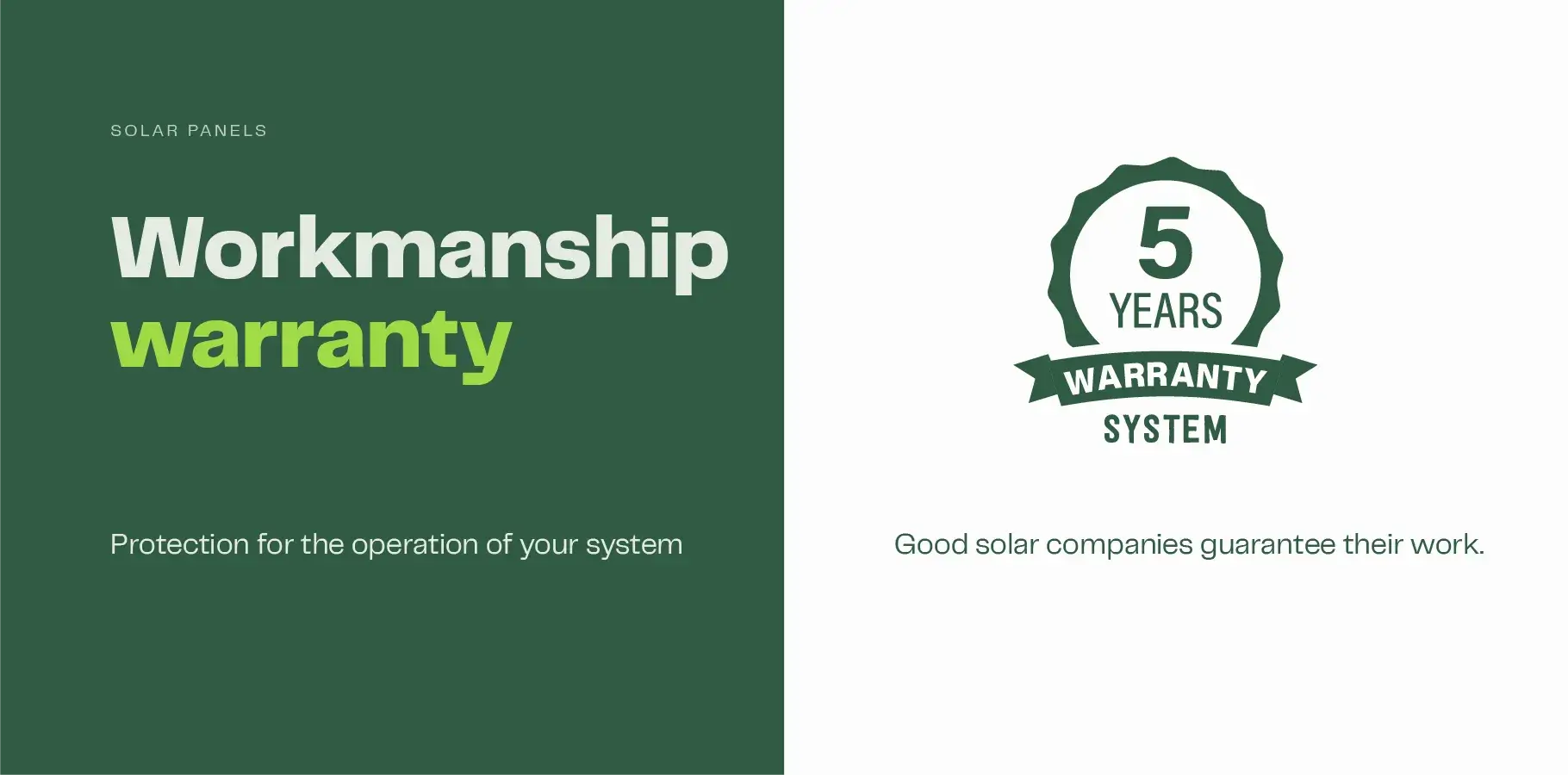
With a workmanship warranty, it is important to ask:
- What is covered by the installation warranty?
- Does the warranty lie with the retailer company or sub-contractor?
In the event a solar company sub-contracts the solar installation, it is essential to know who is providing the warranty. The solar retailer may advertise an installation warranty, but if they do not perform the install, they may well fall back on the sub-contractors warranty, which is likely to be far shorter.
Solar inverter warranty
Inverters don’t last quite as long as solar panels, so the warranties tend to be shorter. String inverters typically come with a product warranty of between 5 – 10 years warranty. In many cases, you can pay more to have the warranty extended.
Microinverters typically come with a minimum 10-year warranty.
The inverter warranty is as important as the product warranty because without a functioning inverter your system won’t work. The inverter does a lot of the grunt work of a system and performs at high temperatures. It is the system component most likely to fail.
Solar battery warranties
Solar batteries also come with a product warranty. Normally a battery warranty is 10 years. Some manufacturers tie their warranty to the number of cycles or throughput the battery has performed.
The best solar panel warranty
The best warranty you can get is a workmanship or entire system warranty from a reputable installer. It guarantees the operation of your system. It also stops the blame game - if there is an issue, a good installer will get to the bottom of it. The workmanship warranty is often an indicator of the quality of the installer.
Avoiding warranties
The best warranty is one that you don’t need to action. There are a number of ways to avoid warranties and ensure you buy a good system that lasts.
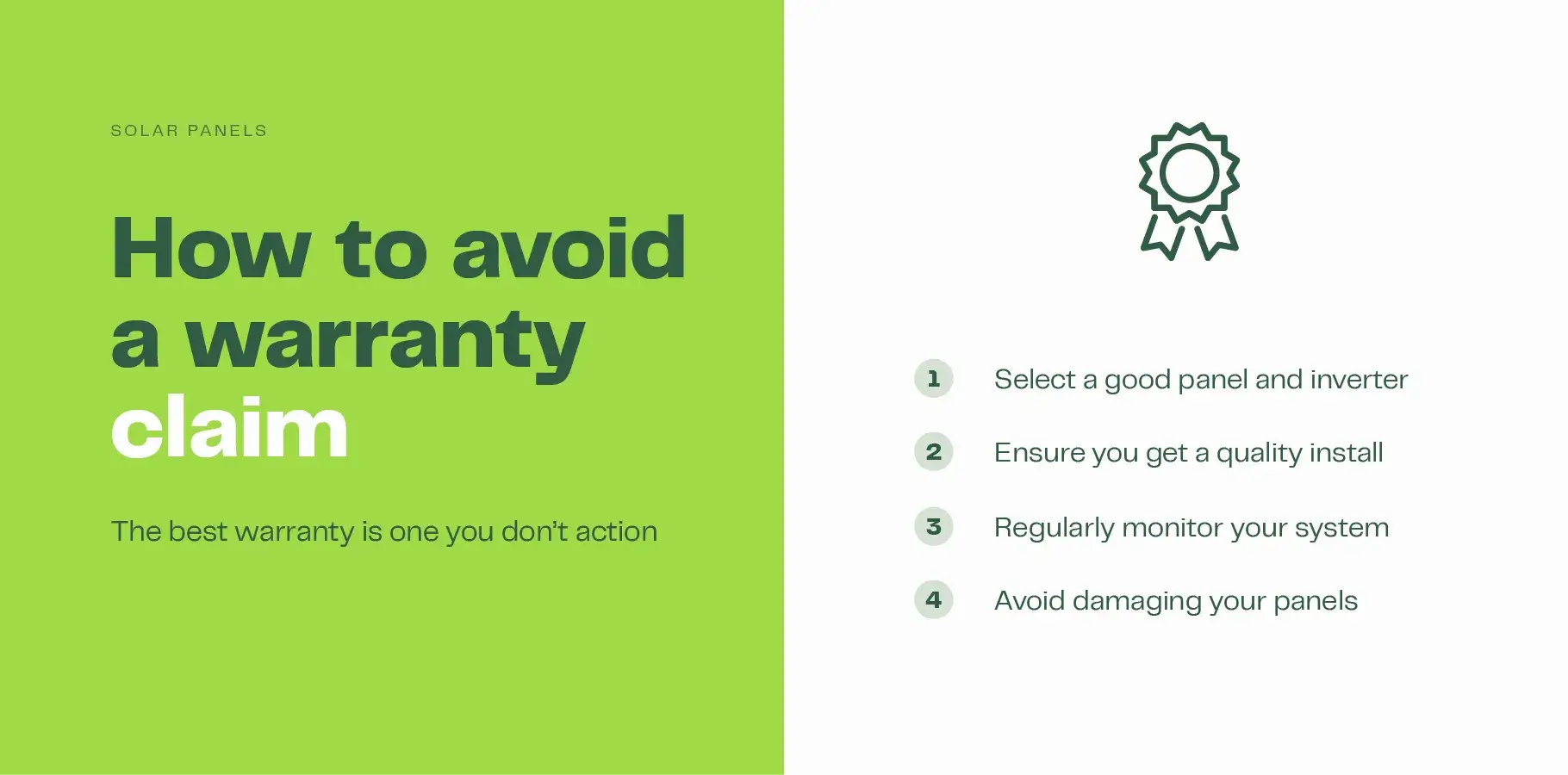
The better the components you select as part of your home solar system, the more likely they are to last.
Quality install
Getting a quality installation should go hand-in hand with selecting quality components. A good installation may help to avoid any potential claims.
If you do make a warranty claim, your install must meet the manufacturer’s requirements for the warranty to be valid.
Regular monitoring and maintenance
Once your system is up and running, you should monitor it regularly to detect any performance irregularities. Monitoring is an essential part of solar panel maintenance and can help you to identify issues before they become a real problem.
If you do need to clean your panels, we recommend using a professional technician. Untrained personnel may damage your panels while cleaning them, and potentially void any future warranty claims.
How to make a warranty claim
If you do need to make a warranty claim, start by contacting your installer. They may be able to identify the issue remotely via a monitoring device. If not, then they can carry out an inspection and identify any faults or defects.
If a warranty claim is made, you will need to provide information about the installer you engaged and details of the installation. A poor installation – not followed to manufacturer’s requirements – may void the warranty.
Australian Consumer Law
As a solar owner, you also have rights as a consumer under Australian law. Australian Consumer Law covers solar products and, provides that the product will function and last as it has been advertised or promised. If it doesn’t, then you have grounds for:
- Repair or replacement
- Cancellation of contract
- Compensation for damages or loss
Your rights for the repair, cancellation and compensation under Consumer law may be at the discretion of the installer or manufacturer. It is a good idea to consult a solicitor in this instance.
Unsolicited sales
We certainly do not recommend you purchase a solar panel system from a door-to-door salesperson or a telemarketer. If you do though, you’re entitled to a 10-day cooling off period after signing a contract.
- Selecting and buying solar panels
- Cost of solar panels
- Solar panels Adelaide
- Solar panels Brisbane
- Solar panels Cairns
- Solar panels Gold Coast
- Solar panels Melbourne
- Solar panels Newcastle
- Solar panels Perth
- Solar panels Sydney
- Tier 1 solar panels
- CEC accredited installers
- Monocrystalline vs polycrystalline panels
- Jinko solar panels
Are you ready to compare solar quotes?
Get 3 free quotes and start your solar journey today.
Get free quotes