


BYD Battery buying guide:
2026 Pricing, specs, performance
A BYD solar home battery buying guide.

BYD (AKA: Build Your Dreams) are a major participant in both the home battery and the electric vehicle markets.
For Australians, the BYD brand continues to gain traction. It's popular Sealion 7 SUV rivals the Tesla Model Y for the most popular new EV in the country.
The BYD brand is no newcomer though. Founded in Shenzen, China in 1995, BYD was solely a battery manufacturer before entering the automotive industry in 2003. In other words, BYD have taken the opposite route to Tesla who started with EVs before moving into home battery storage.
BYD now boasts over 1.5 million home battery installs worldwide.
The BYD home solar battery range features many benefits, including:
- Priced economically
- Battery backup
- Safe technology
- Modular and stackable
- Compatible with most hybrid inverters
But how do they stack up against better known rivals in the home-battery space like Tesla and Sungrow? In this article, we’ll take a look at BYD’s battery range available to Australians in 2026 and how they stack up with popular competitors like the Tesla Powerwall 3.
How long have BYD batteries been available in Australia?
BYD officially entered the solar battery market in Australia back in 2017 with the “B-Box”.
Since then, the B-Box has been rebranded as the BYD Battery-Box and now comes in a range of different sizes and configurations to suit a range of residential applications.
While BYD continues to make waves in the EV space, their solar battery offering has flown relatively under the radar to this point – particularly when you compare it to popular models from their EV rival Tesla like, the Tesla Powerwall 3 and recently discontinued Tesla Powerwall 2.
BYD solar home battery price
The price of a BYD home solar battery has reduced significantly with the federal battery rebate. On average, the HVM range of BYD home batteries cost between $650 - $850 per kWh of storage installed, slightly cheaper than average home battery prices that sit between $800 - $1,000 per kWh.
The smaller, HVS batteries are a little more expensive at around $1,100 - $1,400 per kWh.
The table below shows the typical price for a BYD home solar battery including the battery rebate and full installation when purchased in conjunction with new solar panels:
| Brand | Model | Size (kWh) | Price |
|---|---|---|---|
| BYD | Battery-Box HVM 8.3 | 8.3 | $7,537 |
| BYD | Battery-Box HVM 13.8 | 13.8 | $10,322 |
| BYD | Battery-Box HVM 22.1 | 22.1 | $13,407 |
| BYD | Battery-Box HVS 5.1 | 5.1 | $6,850 |
| BYD | Battery-Box HVS 10.2 | 10.2 | $12,138 |
The federal home battery rebate is set to decrease from January 1 2027. Thereafter, the rebate will reduce every 6 months until its planned end date in 2030.
Battery prices vary by state and the complexity of the install. For example, if a switchboard upgrade is needed, this will increase the price.
BYD home battery warranty
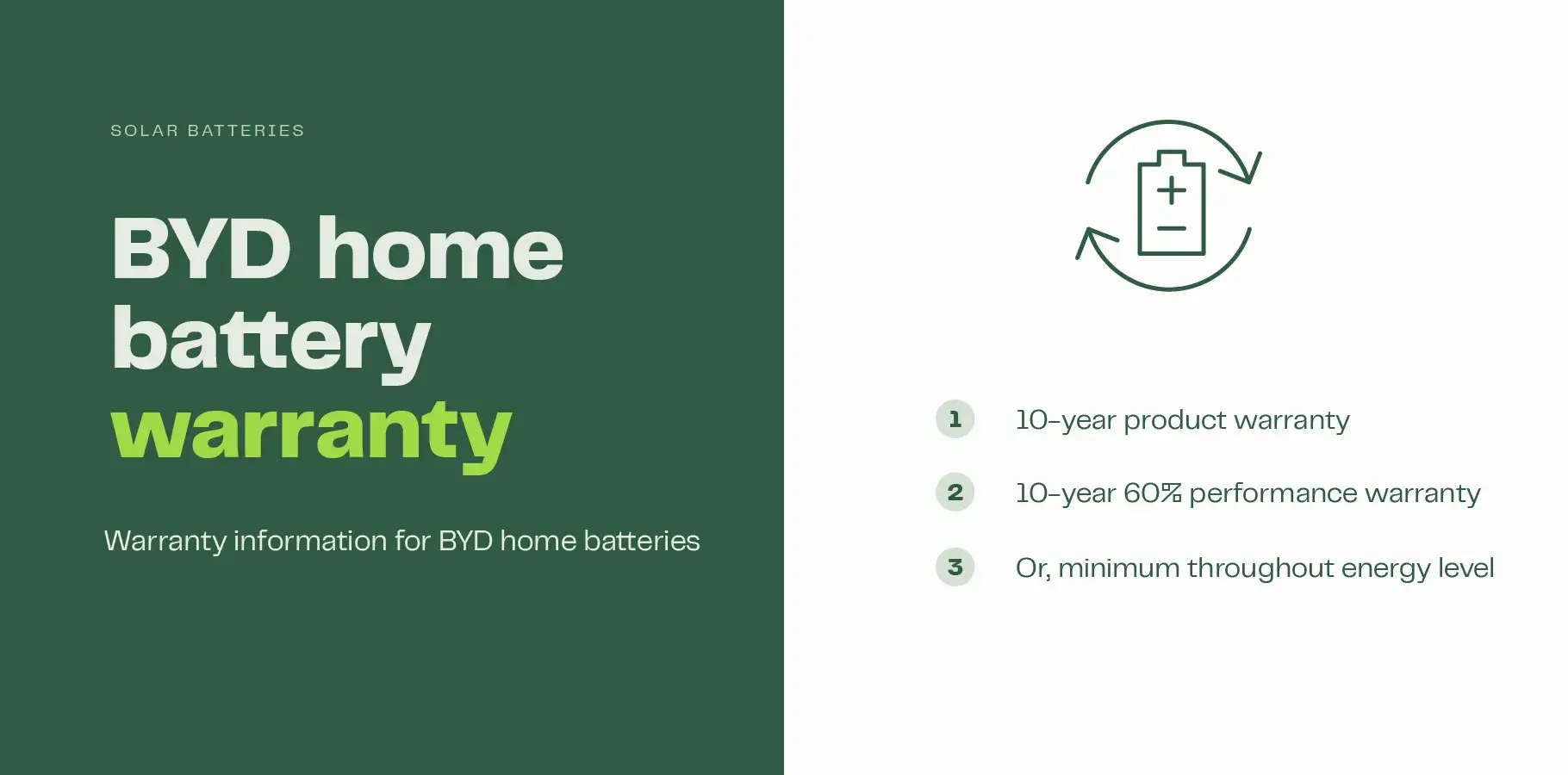
BYD home batteries come with a 10-year product warranty. The performance warranty for BYD solar batteries works differently, it's either:
- 60% of the battery’s usable energy after 10 years
- Battery reaches its minimum throughput energy
BYD states that the performance warranty applies to whichever comes first, 10 years of operation or when the minimum throughput energy level is reached.
While the useful life of the battery may exceed 10 years, the warranty will cease at this point.
High voltage BYD Battery-Box Premium range
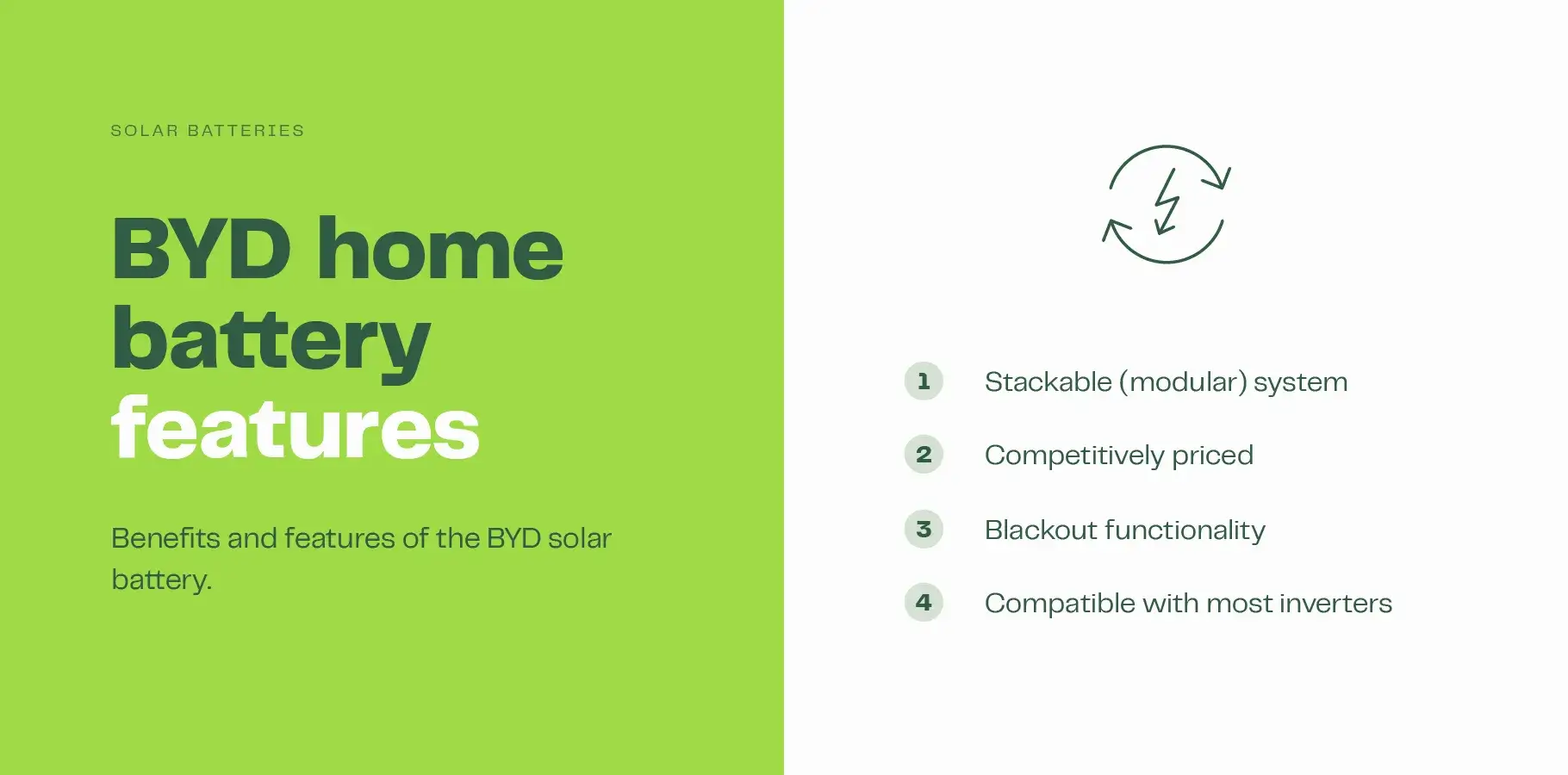
The BYD Battery-Box Premium is BYD’s flagship range of home solar batteries in Australia.
Much like other popular battery manufacturers like Sungrow, the BYD Battery-Box Premium is a “stackable” modular system that allows users to add capacity over time as and when their storage needs may change.
BYD Battery-Box Premium HVS
The BYD Battery-Box Premium HVS is a smaller capacity battery designed for high power usage. It is made up of between 2 to 5 stackable HVS battery modules that connect in series to achieve a usage capacity of 5.1 kWh (smallest 2 module system) up to 12.8 kWh for the 5-module battery system. The 2 module 5.1 kWh HVS5.1 model costs around $6,000, while the range topping 12.8 kWh HVS 12.8 with 5 modules is closer to $10,000.
| Model | Number of modules | Usable capacity |
|---|---|---|
| HVS 5.1 | 2 modules | 5.1 kWh |
| HVS 7.7 | 3 modules | 7.7 kWh |
| HVS 10.2 | 4 modules | 10.2 kWh |
| HVS 12.8 | 5 modules | 12.8 kWh |
BYD Battery-Box Premium HVM
The BYD Battery-Box Premium HVM is the “mid” range offering from BYD and is available in configurations ranging from 3 modules in the HVM 8.3 which provides 8.3 kWh of usage energy, right through to the 8 module HVM 22.1 with 22.1 kWh of usage energy.
| Model | Number of modules | Usable capacity |
|---|---|---|
| HVM 8.3 | 3 modules | 8.3 kWh |
| HVM 11.0 | 4 modules | 11.0 kWh |
| HVM 13.8 | 5 modules | 13.8 kWh |
| HVM 16.6 | 6 modules | 16.6 kWh |
| HVM 19.3 | 7 modules | 19.3 kWh |
| HVM 22.1 | 8 modules | 22.1 kWh |
BYD Battery-Box Premium HVL US
The BYD Battery-Box Premium HVL US is the top of the range offering from BYD in Australia with stackable modules ranging from 3 to 8 modules. At the bottom end of the table, the HVL 12.0 with 3 modules stores up to 12.0 kWh of usable energy, while the range topping HVL 32.0 with 8 modules boasts an impressive 32.0 kWh of usable energy storage. The entry level model in the BYD Battery-Box Premium HVL US range is the 3 module HVL 12.0 with 12 kWh of usable battery starting at around $12,000, right through to the 8 module HVL 32.0 with 32 kWh of battery coming in at around $21,500 in Australia.
| Model | Number of modules | Usable capacity |
|---|---|---|
| HVL 12.0 | 3 modules | 12.0 kWh |
| HVL 16.0 | 4 modules | 16.0 kWh |
| HVL 20.0 | 5 modules | 20.0 kWh |
| HVL 24.0 | 6 modules | 24.0 kWh |
| HVL 28.0 | 7 modules | 28.0 kWh |
| HVL 32.0 | 8 modules | 32.0 kWh |
Low voltage BYD Battery-Box Premium range
The low voltage range of BYD home batteries are slightly less efficient and deliver lower levels of power than the high voltage modules.
BYD Battery-Box Premium LVS
The BYD Battery-Box Premium LVS is part of the company’s low voltage range and features a lithium iron phosphate (LFP) battery pack that is designed for use with an external inverter. Models range from the single module unit LVS 4.0 with 4.0 kWh of usable energy storage which starts at around $2,900, through to the 6 module LVS 24.0 with 6 modules and 24 kWh of usable capacity which costs around $15,600 in Australia.
| Model | Number of modules | Usable capacity |
|---|---|---|
| LVS 4.0 | 1 module | 4.0 kWh |
| LVS 8.0 | 2 modules | 8.0 kWh |
| LVS 12.0 | 3 modules | 12.0 kWh |
| LVS 16.0 | 4 modules | 16.0 kWh |
| LVS 20.0 | 5 modules | 20.0 kWh |
| LVS 24.0 | 6 modules | 24.0 kWh |
BYD Battery-Box Premium LVL
The BYD Battery-Box Premium LVL range is intended for commercial use with an external inverter. The BYD Battery-Box Premium LVL features 15.4 kWh of usable capacity and can be scaled up to 64 batteries using parallel interconnection to provide up to 983 kWh of usable storage in commercial applications.
| Model | Number of modules | Usable capacity |
|---|---|---|
| LVL 15.4 | 1 battery | 15.4 kWh |
| 2 × LVL 15.4 | 2 batteries (stacked) | 30.8 kWh |
Are BYD batteries worth it?
Two great strengths of the BYD home battery range are its affordable prices and wide range of models. The economics of the batteries compare favourably to the Tesla Powerwall 3, because the batteries are cheaper - making it a viable alternative for thrifty consumers.
Battery returns vary by state, but our analysis finds that most new panel and battery systems payback between 5.8 - 9.6 years.
BYD's modular system
For many, BYD's stackable, modular battery system provides the flexibility for their home solar energy system to grow with increasing electricity demand - a plus when compared to some brands.
Tesla's advantage
The Tesla Powerwall 3 battery provides a relatively simple plug-and-play backup function compared to the BYD battery range. Back up is possible, but it is reliant on having a compatible inverter.
The other advantage Tesla enjoys over BYD is with its built-in inverter. It is a more suitable battery system for households that already have solar panels and just want to add a battery.
For many households though, the flexible range combined with great value prices is enough reason to install a BYD battery with confidence.
Are you ready to compare solar quotes?
Get 3 free quotes and start your solar journey today.
Get free quotes