


Solar rebates and incentives
in WA
Last updated: May 2026
Reading time: 5 minutes
With an abundance of sunshine and generous incentives, it’s no wonder that over 565,000 Western Australians have already installed solar panels. The percentage of households with solar in WA is now at 49.16% 1.
The solar panel rebate available in WA is one of the key reasons why solar has proved so popular. Western Australia's high number of sunshine hours produces high-value rebates, which in turn keeps panel prices in places like Perth, highly competitive.
As a further incentive, residents can access the WA home battery rebate in addition to the federal battery rebate.
The rebates should see an increase to the 19.4% 2 of the state’s electricity that is currently generated from renewable sources.
We explore all of the incentives available in WA, calculate how much you can save and explain how you can claim the rebates.
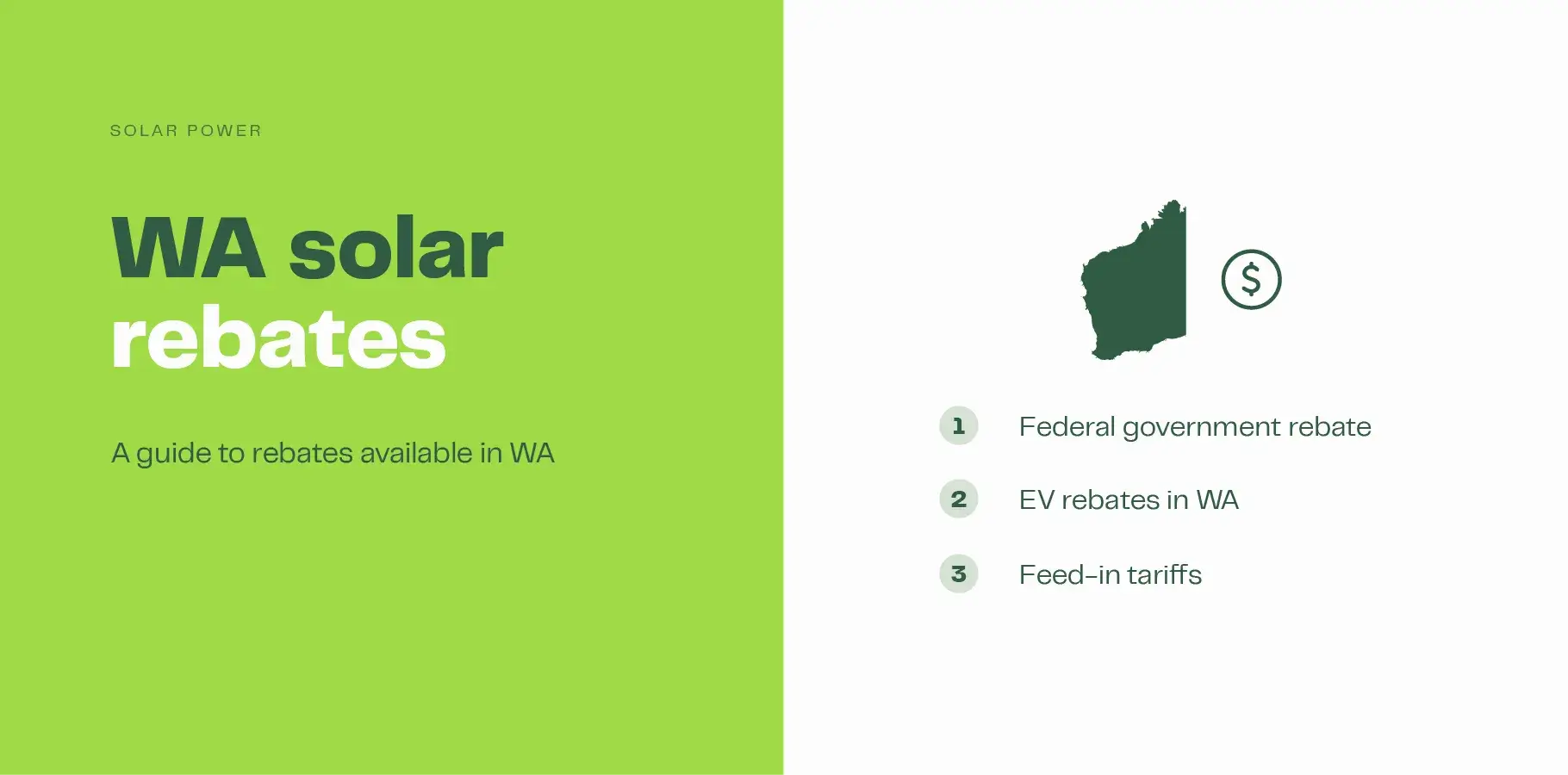
How the WA solar rebate works
The federal solar rebate is available to all WA residents that purchase new solar panels, provided they meet the eligibility requirements. When you engage an installer to supply and install a solar system, they will quote you the net price of the system that includes the solar rebate.
The size of the rebate you receive depends on two things:
- Your location, and
- The size of the system you install
Most of Western Australia benefits from a high number of sunshine hours, so the rebate is higher than it is in some other states, like Tasmania. Your location falls into a rebate zone, where you are allocated a certain number of certificates based on sunshine hours. This number is then multiplied by the size of the system you select.
Once the solar panel system is installed, your solar company will trade your certificates (STCs) on your behalf.
How much is the rebate worth in WA?
The WA solar rebate can reduce the cost of a new system by around 25%.
The table below shows the net price of a 6.6kW system after applying the rebate in southern WA.
WA STC solar rebate value for a 6.6kW system
| Gross system cost: | $8,140 |
| Solar panel rebate: | ($1,800) |
| Net system cost: | $6,340 |
To get a more accurate estimate for your location and preferred system size, use our free solar rebate WA calculator.
How to claim the WA solar rebate
Claiming the solar rebate in WA is simple. Though, you must meet the eligibility requirements, this can be achieved easily if you engage a good solar company. We outline the process below:
- Engage a good solar company
- Select your system type and size
- Use a Solar Accreditation Australia accredited installer
- Install CEC approved solar panels
- Install the system
- Pay your installer the net cost of the system
When does the WA solar rebate end?
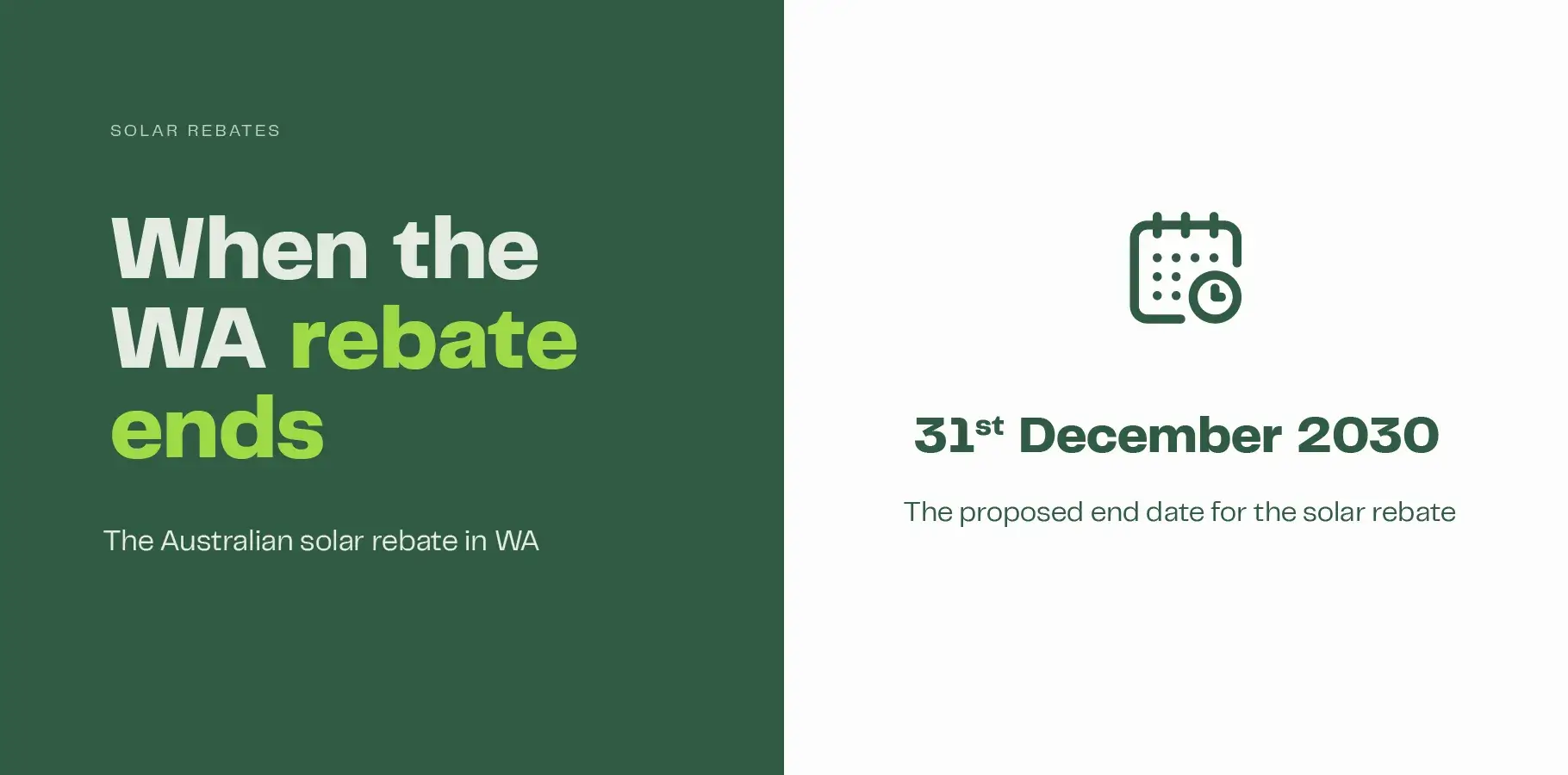
The solar rebate in WA ends on the 31st of December 2030. However, it reduces at the end of each calendar year, so if you’re weighing up purchasing, you will get a larger rebate by committing to buy before the end of each calendar year.
WA solar battery rebate
Western Australia is the only state to offer a battery rebate in addition to the federal battery storage incentive. The WA government will make available 100,000 rebates for solar batteries via its WA Residential Battery Scheme.
The scheme is running in conjunction with the federal government solar battery rebate.
Synergy customers can receive rebates of up to $3,816 while Horizon customers can receive a battery rebate of up to $6,316.
The WA portion of the rebate is up to $1,300 for Synergy customers and $3,800 for Horizon customers.
WA solar battery loan
The WA government is also providing interest-free loans of up to $10,000 for eligible households that install battery storage. The interest-free component is seen as a way to reduce the upfront cost of installation and is similar to the Victorian government's approach to solar incentives.
The loan is means-tested and is only available to households whose income is less than $210,000 per year.
Local WA battery rebates
If you reside in one of the participating local councils that partner with the Switch Your Thinking initiative, you may be able to claim between $150 - $750 off the upfront cost of a new solar and battery system.
The local battery rebates are only available with select installers as part of the Switch Your Thinking initiative.
Solar feed-in tariffs in WA
Another incentive available to solar system owners in Western Australia is the solar feed-in tariff. Unlike the rebate, feed-in tariffs are an ongoing incentive available through the Distributed Energy Buyback Scheme (DEBS).
A feed-in tariff is a financial credit you receive for every kWh of electricity your system generates and exports back to the grid. The credit is applied to your electricity bill.
In WA, the rates for feed-in tariffs vary based on the time of day you export your surplus energy. Exporting during the late afternoon or evening, when electricity demand and costs are higher, will result in a higher tariff rate.
Solar feed-in rates in WA
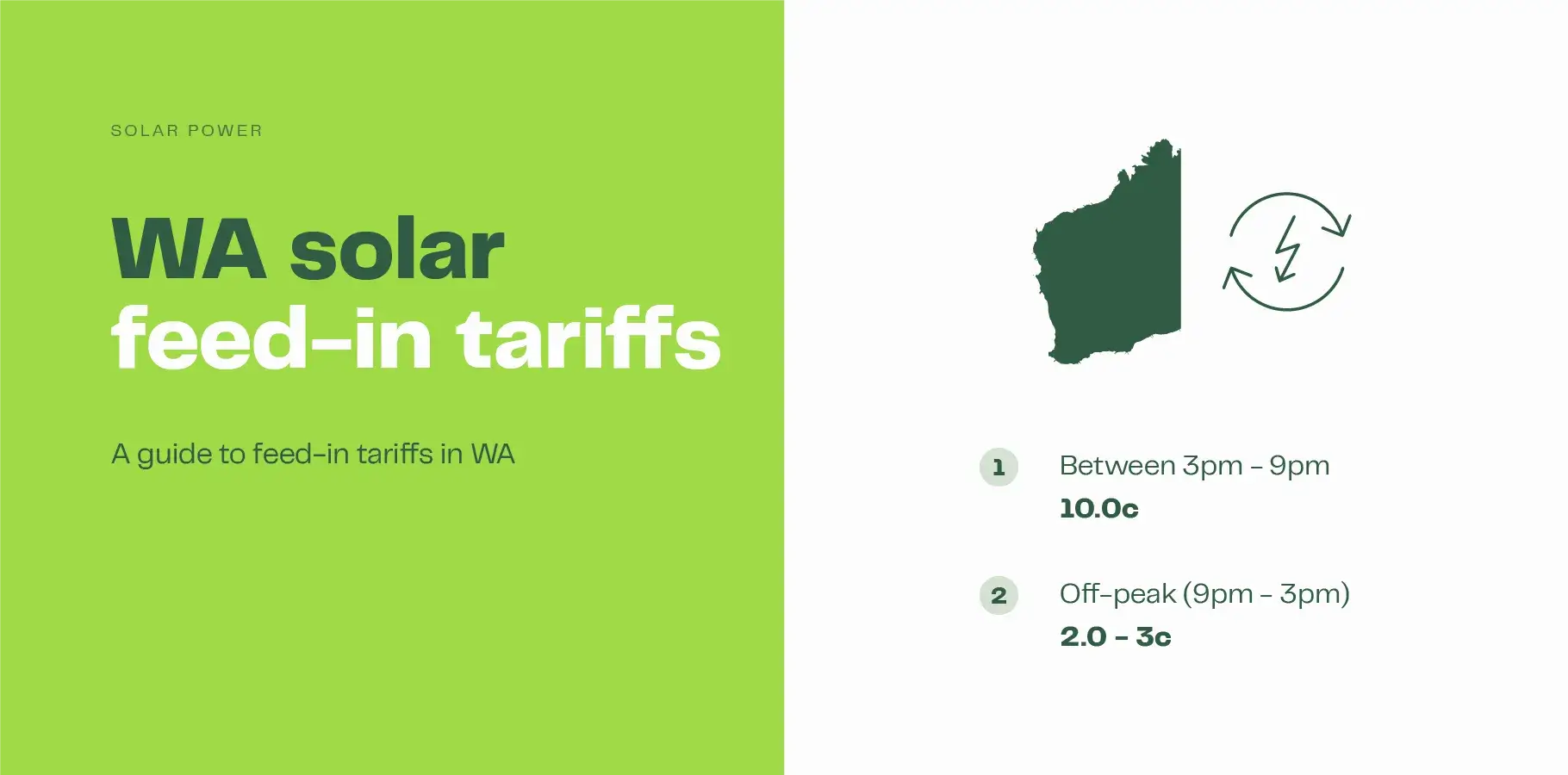
For solar households in Perth and the south-west region of the state, the DEBS rates provided by Synergy are as follows:
- Peak export rates (3 pm – 9 pm): 10 cents per kWh
- Off-peak export rates (9 pm – 3 pm): 2.0 cents per kWh
For solar households in regional WA, the DEBS rates provided by Horizon Power vary according to location. But for most customers, the rates are as follows:
- Peak export rates (3 pm – 9 pm): 10 cents per kWh
- Off-peak export rates (9 pm – 3 pm): 3.0 cents per kWh
You can apply to receive feed-in tariffs through the Synergy or Horizon Power websites.
Making the most of feed-in tariffs
The way the DEBS structures the feed-in rates in WA, it’s best to use the solar that you generate directly during the day. Between 3pm and 9pm, the feed-in tariffs are high and therefore it is a good time to export excess energy.
The Scheme unintentionally encourages west-facing solar panels, which tend to produce more energy in the afternoon than panels oriented to the north or east. It’s worth remembering the feed-in tariff rates are constantly under review and can change.
Our Solar System Size Calculator can help you determine the right system size for your needs so that you can find a good balance between using solar directly and exporting any excess back to the grid.
Former WA incentives
A number of WA energy and EV incentives has closed in the past few years. A summary of these incentives is provided below:
| Government | Incentive | Status |
|---|---|---|
| WA government | WA EV rebates | Closed |
| WA government | Commercial EV ‘Charge Up’ grants | Closed |
| Federal government | Electricity rebate 2025 / 26 | Closed |
| WA government | WA government $400 electricity rebate | Closed |
WA EV rebates
The Government of Western Australia closed its EV rebate on Saturday 10th May 2025. The rebate was worth up to $3,500 and helped to reduce the purchase cost of a new electric vehicle. The WA EV incentive was available as part of the Zero Emission Vehicle Rebate (ZEV) scheme.
The state government EV subsidy granted over $43 Million in rebates.
Commercial EV ‘Charge Up’ grants
The WA government's grants for businesses and organisations that installed new EV chargers has now closed. The grants covered up to 50% off the cost of an EV charger.
We will publish the details of any new funding releases should it reopen.
WA electricity rebate 2025 / 26
In a bid to ease cost of living pressures, the Australian government provided an electricity rebate worth $150 in the 2025 / 26 financial year.
The rebate has now been paid to all registered account holders and no more rebates are planned.
WA government $400 electricity rebate
Back in 2024, West Australian residents benefited from a $400 subsidy to reduce electricity bills. The subsidy was a one-off initiative which has now closed.
References
- Australian solar statistics by state, Solar Calculator.
- Western Australia renewable electricity generation, Solar Calculator.
Are you ready to compare solar quotes?
Get 3 free quotes and start your solar journey today.
Get free quotes