


How long do solar panels last?
Reading time: 5 minutes
Solar panels typically come with a 25-year warranty, but in reality, they will last beyond 25 years.
With over 4.3 million solar systems installed on rooftops, it seems Australians don’t need a lot of convincing that solar is a great way to save on electricity bills and cut carbon emissions. For those considering solar panels, or replacing an existing system, the expected longevity of the system is key to weighing up the financial and environmental benefits.
Typically, solar panels come with a 25-year warranty, but what does this mean? Do panels last as long in Australia’s harsh conditions?
If you buy good a good solar system and have it installed by a reputable installer, your panels should last around 25-30 years. In truth, they’ll probably last longer, as our research uncovers. In this article, we take an in-depth look at the lifespan of solar panels, explain degradation, provide tips for longer lasting panels and tell you when to consider replacing them.
The lifespan of solar panels
- Solar panels last between 25 - 30 years
- Solar panels degrade slightly each year
- Good panels perform better year on year
- Inverters typically last 10 years
Solar panels start their lifecycle when they are manufactured. The embodied emissions associated with making solar panels are the only carbon they will emit during their lifetime.
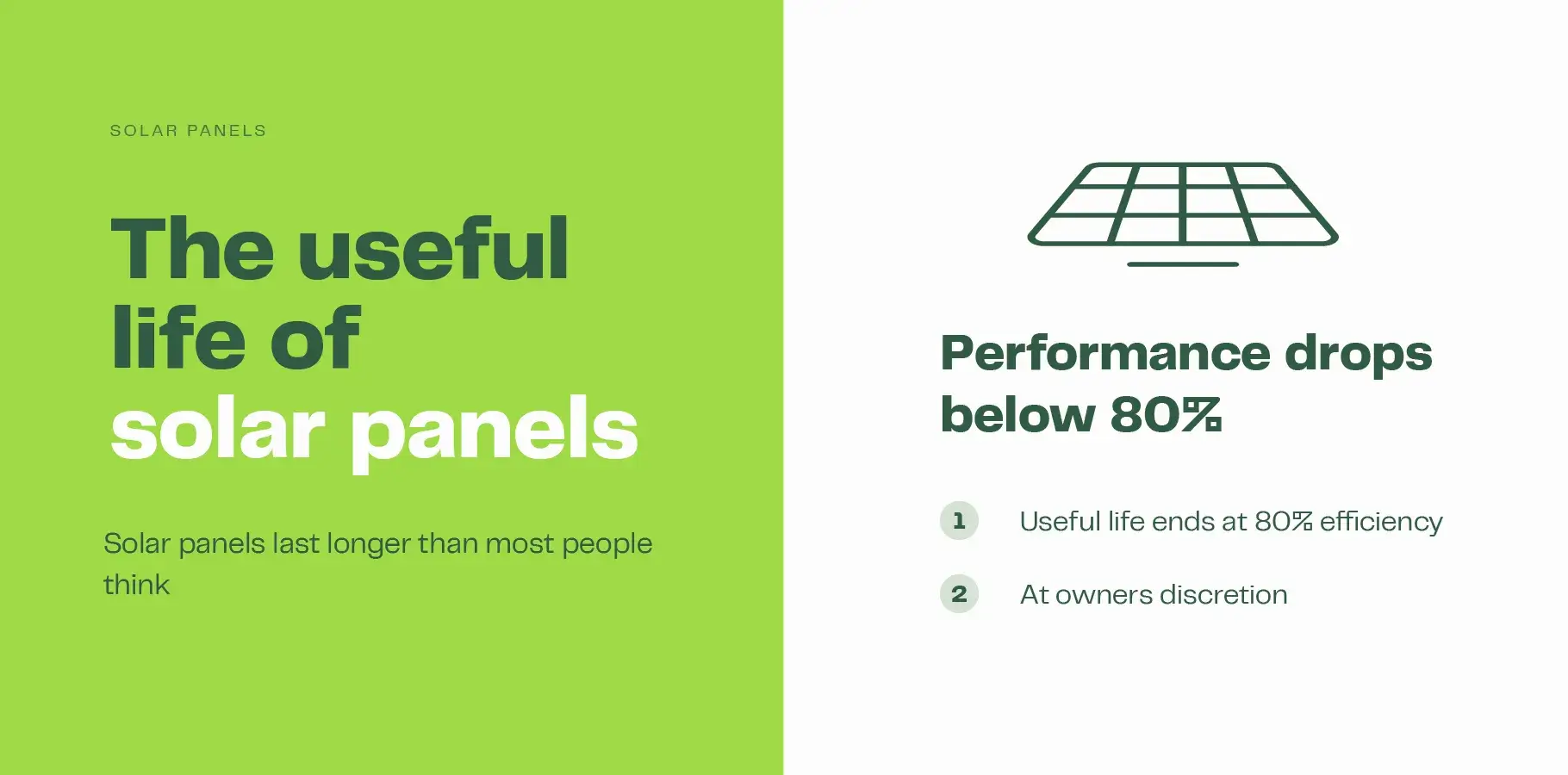
Once on a rooftop, solar panels can be expected to last at least 25 years. Some manufacturers even provide a 30-year performance guarantee. In most cases, solar panels don’t suddenly stop working, they typically degrade slowly over time. Their useful life ends once their performance dips below 80% of their rated output, but it is up to the owner of the panels. Better quality modules, degrade much slower, meaning it takes longer for their performance to dip below 80%, and therefore, they last longer.
When to replace panels
Once the solar output from panels drops appreciably, it is generally a good time to replace them. The decision to replace them rests with the owner.
Once removed, solar panels can be reused and recycled. As much as 95% of the components of a panel can be recycled.
Solar panel degradation
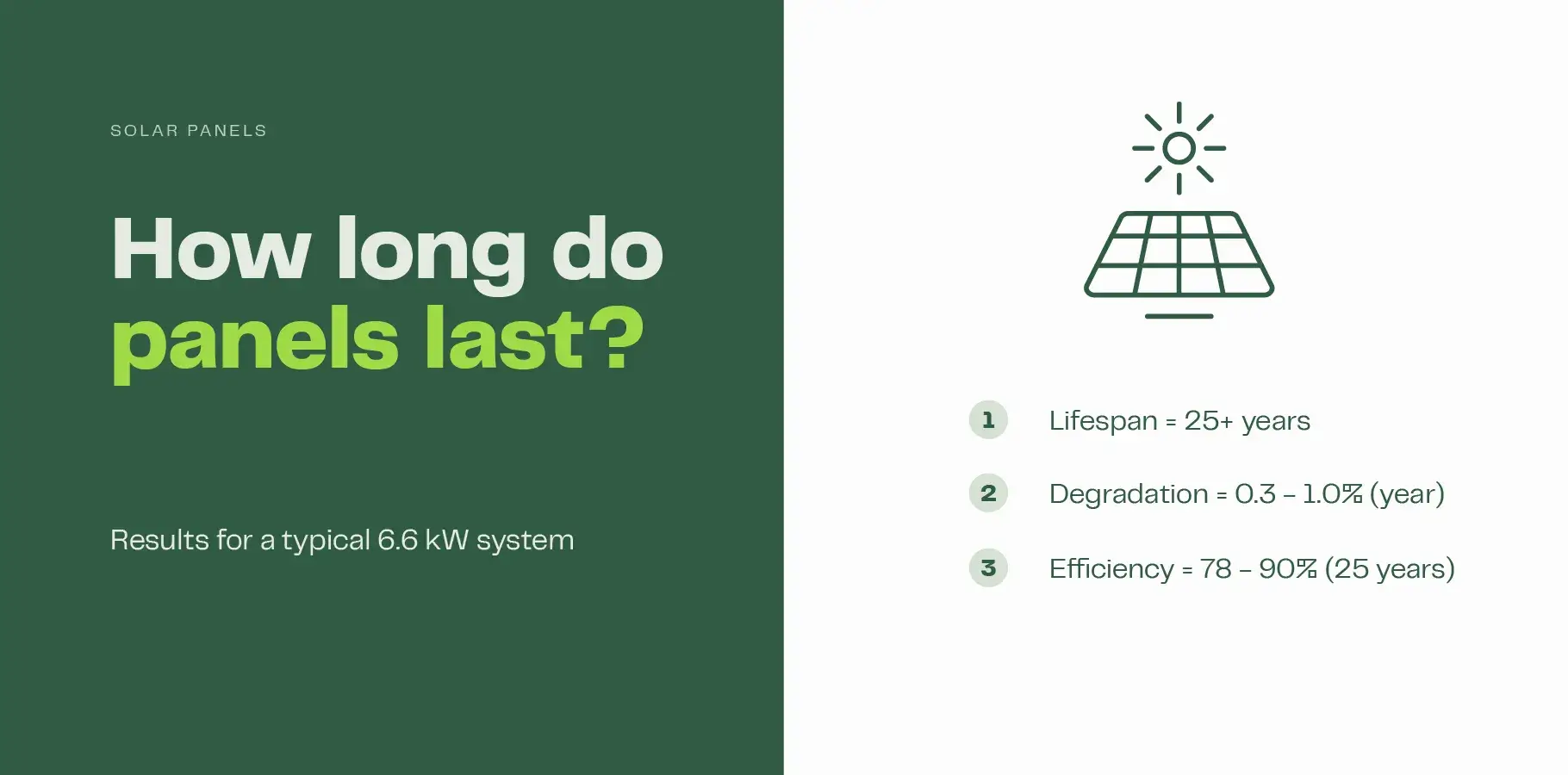
Once installed, solar panels degrade slowly over time. In their first year, panels suffer their greatest drop in performance as they degrade at just under 1%. Every year thereafter, panels degrade at a rate of between 0.25% – 1.0%. The rate of degradation is tested prior to labelling, so you can compare panels brands by analysing their expected rate of decline.
The faster the rate of decline, the earlier the panel reaches 80% of its label output. The table below shows the rate of degradation of popular panels in Australia:
| Panel manufacturer | Annual degradation |
|---|---|
| SunPower | 0.25% |
| REC | 0.25% |
| Aiko | 0.35% |
| Longi | 0.35% |
| Winaico | 0.40% |
| Trina Solar | 0.40% |
| Jinko | 0.40% |
| Canadian Solar | 0.50% |
Solar panel performance warranty
Most solar panels come with a 25-year performance warranty that guarantees your modules will produce a percentage of their rated output after 25 years. While this warranty can be hard to enforce, the performance ratio figure provides an insight into the anticipated degradation of the panel.
The best solar panels degrade at just 0.25% each year, meaning that after their 25-year warranted lifespan, they operate at over 90% efficiency when compared to their first year. Inferior modules degrade more quickly at rates up to 1% each year; after 25 years, these panels will produce just 78% of the electricity that they did when first installed.
Panel longevity in Australian conditions
While Australia is blessed with higher than average sunshine hours, conditions are not necessary ideal for solar panels.
Australia's harsh conditions include:
- High temperatures
- Exposure to salt air
- Extreme weather events
All of these factors can contribute to faster than expected degradation rates.
Solar panels perform well in Australia
The good news is that solar panels actually fare very well in Australian conditions. A strong regulatory framework is one of the reasons panels experience good longevity Down Under. Solar panel modules are approved by the Clean Energy Council in Australia, if they do not meet the set criteria, the household is not able to claim the solar rebate.
There are also strong controls around solar panel installation which help contribute to the overall longevity of the entire solar system.
Examples of long-lasting panels
While panels are typically declared inefficient once their performance drops below 80%, they can remain part of a system as long as the owner chooses – so long as they are still working. There are several examples of long-lasting systems around the world.
Swiss panels still working after 44 years
The Ticino Solare (TISO 10kW) system was installed in Switzerland in 1982. After 28 years, the system’s annual degradation rate was 0.38% 1, giving it a performance ratio of around 80%. However, after inspection and cleaning, the panels went on to record 90% of their nominal output.
When we checked in with the University of Applied Sciences and Arts of Southern Switzerland (SUPSI), it was reported that 48 of the original 288 panels are still working, some 44 years post installation.
Study finds panels last 30 – 35 years
Another Swiss initiative – a study testing panel output in different climates, found the average annual degradation rate was 0.24% 2. Most of the panels were still achieving 80% of their nominal output at 30 – 35 years.
France's oldest system
France’s oldest system is still producing 70.5% 3 of its nominal rated output 34 years after installation.
Sources:
1 TISO 10kW system - 30 years experience
2 Long-term reliability of photovoltaic modules
3 Solar modules installed in France in 1992
How long will your solar power system last?
Solar panels may have a lifespan greater than 25 years, but this does not necessarily mean your system will last that long. Why? There are many factors that influence the operation and performance of a solar power system.
Factors that influence the longevity of a solar system
- Solar panel quality
- Inverter quality
- Install practices
- Company selected to install your system
Inverter failure is a common problem with solar systems in their early years, this is particularly the case for cheap systems. Even if you buy a good inverter, it will typically need to be replaced around the 10-year mark.
If you buy inferior solar panels, you risk that they do not perform to their rated output, or worse, not function at all. Cheap solar modules are more susceptible to hot spots that lead to malfunction. Product warranties vary between panels, the top brands provide 20 – 25 years protection but the industry norm is down around 10 – 15 years. However, the risk is that if you select a panel from a manufacturer you haven’t heard of, they may not be in business long enough to honour your replacement claim!
System issues may also arise if the install company you select is not well-versed in the best install practices, this can all sorts of problems including: system failure and safety risks.
The best way to mitigate factors that may impact on your solar system’s lifespan is to select a reputable solar company to supply components and install your system.
Approved solar modules
One way to select a panel that should see it last at least 25 years is to ensure it is approved by the Clean Energy Council. The CEC approves solar modules for supply and install in Australia. If your modules are not approved, you are not permitted to receive the federal solar rebate.
Tips to increase panel longevity
There are four ways you can maximise the output of your solar panels and aid their longevity:
- 1. Select quality products
- 2. Use a good installer
- 3. Monitor and maintain your panels
- 4. Clean your panels
Quality products
Buying quality products: panels, inverter, batteries and cabling will help to ensure your system lasts as expected.
Selecting a good installer
There's no point buying good equipment to have them installed by a shoddy company. The quality of the install matters and will give your system the best chance of lasting longer.
Monitor and maintain
Once installed, it is important to monitor and maintain your system. A smart monitoring device can alert you to issues with your solar system’s performance while regular maintenance can reduce the likelihood of performance issues arising.
Clean your solar panels
The cleaner your panels are the better they will operate. It is unlikely you will need to clean your solar panels often but doing so will improve their efficiency. It's more important to remove any debris from the modules as this will reduce the risk of potential hot spot issues developing.
Buy well for longevity
If you buy well, your panels can be expected to last well between 25 - 30 years. If you choose to leave them on your roof once they dip below 80% of their rated nominal output, they’ll last even longer.
Don’t immediately seek to replace your panels, unless you want a much larger system in which case, it’s typically economically better to replace them.
When the time comes to replace the panels, look to reuse or recycle them.
Frequently Asked Questions
Are you ready to compare solar quotes?
Get 3 free quotes and start your solar journey today.
Get free quotes