


Buying solar panels for your home
Solar panels are a viable renewable energy source that can reduce your electricity bills and household carbon emissions.

Our guide to buying solar for your home will help you:
- Understand how solar works
- Determine if it is right for you
- Ensure you buy good products and get a foolproof installation
If you’re ready to buy solar, you can get 3 free quotes from accredited installers that we trust and ensure you get a quality panels with a proper installation.
Is solar really worth it?
There are many benefits to installing solar at your home. Solar panels can deliver great savings, pay themselves back within 4 – 7 years and go a long way to reducing your carbon footprint.
Buying solar panels is a long-term investment. Whether it’s financially worthwhile is dependent on the cost, savings, and payback of your system. In 2024, in most instances, solar panels are worth buying, due to the longevity of solar panels and the short payback periods that can be achieved in locations right around Australia.
Use our solar calculator
Our solar calculator displays accurate cost, savings and payback results, based on your electricity usage and property details. It is the perfect complement to this guide and will empower you to speak to any solar company with confidence. It is the best way to see if solar is financially worth it for your home or business.
Get accurate savings and payback figures for solar panels
Reduce your electricity bills. Cut your emissions.
Solar payback and savings
It’s not uncommon for solar panel systems to deliver annual savings in excess of $1,000 and payback within 4 – 7 years. Payback times vary according to several variables including system cost, electricity cost, your feed-in tariff and when you use your power.
The table below shows the typical system payback time for a 6.6kW solar panel system in major Australian cities.
Average system payback times:
| City | Payback time |
|---|---|
| Sydney | 6.6 years |
| Melbourne (with VIC rebate) | 5.8 years |
| Melbourne (no VIC rebate) | 7.3 years |
| Brisbane | 5.4 years |
| Perth | 5.3 years |
| Adelaide | 5.1 years |
| Hobart | 6.3 years |
| Canberra | 5.6 years |
| Darwin | 8.6 years |
You’ll receive a far more accurate assessment of what solar can do for you when you input your details into the our online calculator.
Solar power system prices
The below table indicates the average industry cost for the full installation of a solar power system. These prices are a good starting point before delving further into comparing the quality of different brands and installers. When you see quoted prices for systems, they usually include:
- The total cost of installation
- Supply of components
- GST and,
- The solar rebate
Average cost of solar panels
| System size | Cost |
|---|---|
| 3kW | $4,000 – $5,500 |
| 5kW | $4,500 – $7,500 |
| 6.6kW | $5,000 – $8,500 |
| 10kW | $9,000 – $13,000 |
The cost price range explained
Prices vary for solar panels depending on a number of factors. The two main variables are the quality of components (panels and inverters) and the company you select to perform the install. Outside of these factors, expect to pay a little more if:
- You need a switchboard upgrade
- Have a complicated roof structure
- Have a double storey house
- You need / want microinverters
- You add a battery
While the cost of installation is important, you should consider the annual savings that your investment in solar power can bring.
How many panels do I need?
The most most popular household system size in Australia is a 6.6 kW system, which on average produces 23 – 29 kWh of electricity per day. A system this size typically has between 15 – 20 solar panels is enough to power the average Australian home.
8kW solar systems are also popular. However, your personal circumstances will influence the best system size for you and your household.
System size considerations
There is a lot to consider when it comes to figuring out the optimal system size for your home, including:
- Your budget
- Your available roof space
- Electric vehicles
- Future electrification of your home
Bigger is better
It’s likely that our future electricity needs will increase with electric cars and the likely electrification of our homes. Therefore, we recommend that you install as large a system as your roof and budget can handle. There are also cost advantages associated with installing a larger system.
Start by considering a 6.6 kW system, if you can go bigger, then do so. If you don’t have the roof space or budget, then look to a 5 kW system.
Further reading and system size calculator: How many panels do I need? A detailed guide.
How much roof space do you need?
In terms of physical size, a 6.6 kW system can consist of between 15 – 20 panels. For household rooftops, the dimensions of each module, will be roughly 1.0 x 1.7m2. Therefore, you’ll need around 25.5 – 34m2 of suitable roof space to house a 6.6 kW system.
Rebates and incentives
There are three forms of solar incentives you should be aware of:
- Federal solar rebate
- Any state government rebate schemes
- Feed-in tariffs
Federal solar rebate
If you buy new solar panels, you will receive a solar rebate from the Australian government even if you have previously claimed the rebate for another energy system. All advertised prices, and those published on our website, include the solar rebate. Typically, your installer clams it on your behalf and you pay them the net cost of the system.
The federal rebate varies depending on where you live and the size of your system as it is calculated based on how much solar energy your system is estimated to generate. The table below shows the typical rebate value of different system sizes.
Solar rebates Australia
| System size | Rebate |
|---|---|
| 3kW | $960 – $1,300 |
| 5kW | $1,640 – $2,120 |
| 6.6kW | $2,160 – $2,800 |
| 10kW | $3,280 – $4,240 |
Rebates are being phased out
The federal solar rebate is slowly being phased out over the next seven years, meaning that the rebate reduces at the end of each calendar year. To receive the government rebate:
- Your system components need to be approved by the Clean Energy Council and,
- Your system needs to be installed by a Solar Accreditation Australia (SAA) accredited installer.
State rebate schemes
In addition to the federal government rebate, you may be able to secure a further rebate from your state government. If you live in Victoria, and you meet the eligibility requirements, you can receive a $1,400 rebate on the purchase of a new solar system.
We closely monitor rebates schemes from other states too, and you’ll find this information is regularly updated:
Solar feed-in tariffs
Once your system starts generating solar power, you’ll receive a financial credit from your electricity retailer for any excess energy that you export back to the electricity grid. The financial credit is called a feed-in tariff and should not be confused with the solar rebate. The credit amount is subject to state regulation but is ultimately determined by your electricity retailer. We list the average feed-in tariff by state below:
Average feed-in tariffs by state
| State | Feed-in tariff |
|---|---|
| NSW | 7.0c |
| VIC | 5.0c |
| QLD | 5.5c |
| SA | 6.0c |
| WA | 3.0 – 10.0c |
| TAS | 10.9c |
| ACT | 8.0c |
| NT | 9.7c |
Feed-in tariffs play a crucial role in determining your solar savings. The more you can self-consume your solar energy, the greater your savings will be.
Your rooftop and property
Location and property-specific factors impact the amount of solar energy that your system can generate for your home or business. While these variables may not impact on your purchase decision, they will affect the output of your solar panels.
What impacts solar power output
Factors that affect the amount of electricity a solar power unit can produce, include:
- Panel orientation
- Panel angle
- Panel temperature
- Shading or obstruction
1. Panel orientation
A northern orientation is best in the southern hemisphere for maximising solar output. However, a rooftop will still likely be suitable even if it doesn’t face north. Consider your roof’s orientation in conjunction with your consumption habits. An east / west orientation may suit your household if you use power at either end of the day, as the east facing modules generate electricity in the morning while the west facing panels do so in the late afternoon.
The table below shows output losses based on panel orientation for a typical Australian rooftop (25° pitch):
Panel output losses due to orientation
| Orientation | Output loss |
|---|---|
| North | 0% |
| East | 12 – 17% |
| West | 13 – 15% |
| South | 26 – 33% |
2. Panel angle
The pitch or angle of your rooftop is also a factor that affects solar output. Year round, the optimum panel angle is equal to the latitude of your location, e.g. Sydney 33.87°. However, so long as your rooftop is pitched, it will be suitable. To give you some idea, if your rooftop is 15° out from the optimum angle, you’ll only forgo between 1 – 1.5% of output.
It’s really only if you have a flat roof that you need to install panels on an incline to achieve better output and to ensure your panels don’t suffer from water ingress.
3. Panel temperature
The hotter your system gets, the less efficient it becomes. Higher quality panels are more effective at dealing with the effects of temperature.
4. Shading or obstruction
If your system is subject to shading or obstruction throughout the day, solar output will be impacted. If only some of your modules are obstructed from sunlight, the use of micro inverters or power optimisers will allow your system to perform better when some panels are shaded.
The different types of solar systems
There are different types of solar power systems available for domestic and commercial use:
- A solar panel system
- A hybrid system (panel and battery system)
- A battery ready system
- A stand-alone system
If you already own a solar panel system, you can upgrade by adding a battery to form a hybrid system.
How to select the best solar energy system for you
For most people, choosing a system type is based on consumption and usage habits, savings goals and of course, budget. We review each of the solar power systems:
1. Solar panel system
A grid-connect solar panel system is still the most suitable and viable system for most consumers. A 5kW solar system costs between $5,000 – $7,500 and is typically enough to power the average Australian household. Any excess energy is exported back to the grid where you will receive a feed-in tariff credit. With the lower cost of installation and higher feed-in tariffs, grid-connect systems can pay back within 4 – 7 years.

Solar panel lifespan
Importantly, all solar panels are expected to have a lifespan of 25+ years; however, the inverter, components used and the quality of the install can seriously impact on the performance of the system.
2. Panel and battery systems (hybrid systems)
Hybrid systems, also called, panel and battery systems, are grid-connect units that include solar panels, an inverter and a battery. Excess energy charges the battery so that it can supply electricity to your property when the sun is not shining.
Hybrid systems are far more expensive
Hybrid systems are far more expensive due to the high cost of solar battery storage in comparison to solar panel systems. As a guide, a 6.6kW solar system with a 10kWh battery may cost between $15,000 – $20,000. Payback on panel and battery systems is often around the 10-year mark; longer than for solar panels and payback time varies significantly depending on how much electricity you consume when you use it. Bear in mind, the battery storage component of the system will likely only last ten years.
Backup power
Hybrid systems can provide backup power in the event of a blackout. Backup capability typically adds to the cost of the system.
Adding a battery
If you already have solar installed, you can add a storage solution to it and convert it to a hybrid system. We have developed a solar battery storage calculator that calculates the energy and financial effectiveness of adding a solar battery to your existing system.
3. Battery ready systems
Battery ready systems are for consumers that intend to install solar battery storage within 2-3 years. Battery ready systems are slightly more expensive than a straight solar panel system as a hybrid inverter is needed to accommodate a solar battery at a future date.
4. Off-grid systems
An off-grid system is a stand-alone unit that does not have a connection to the electricity grid. Typically, off-grid systems involve solar modules and a large amount of battery storage, as they need to power your entire home in even during winter seasons. Off-grid systems are significantly more expensive, and we only recommend you go off-the-grid if the cost of connecting your property to the grid is prohibitive. As a guide, it may cost anywhere between $30,000 – $50,000 for an off-grid system to power the average household.

Solar power systems: Batteries and components
Is it worth getting a battery?
One of the key decisions to make when purchasing a solar power system is whether to add a battery. Due to the current high cost of solar batteries, for most consumers, it makes economic sense to opt for solar system without a batteries. However, for households that use a lot of power in the morning and evening peak periods, and can afford the upfront cost, a hybrid system can generate good financial savings, paying off within ten years.
The 10-year payback period is key to hybrid systems, because the batteries aren’t likely to last beyond ten years.
Hybrid systems are suitable for:
- High evening and morning peak energy users
- Users that are prepared to pay more than $15,000 for a system
- Users motivated to minimise reliance on grid power
Other system components
We take a look at other system components that you may select when purchasing a system:
- Solar batteries
- Inverters
- Microinverters
Solar batteries
Solar batteries allow you to store energy produced by your solar power system for later use. Sizes start from as little as 1.2kWh and go up to 14kWh for domestic use, though you can combine multiple batteries for greater capacity.
Inverters
Inverters are a necessary component of every type of solar system. They convert the direct current (DC) generated from photovoltaic modules into alternating current (AC) that you can use in your home or business. The quality of the inverter you select can have an impact on the performance and longevity of your system. As such, there can be significant price discrepancies between cheap inverters and top of the line models. A good inverter will generally last about 10 – 15 years.
Microinverters
If shading is an issue at your property, or you want a multi-orientation installation, you should strongly consider microinverters or power optimisers. A typical string inverter will shut down if one panel in a series stops generating power, whereas microinverters allow each module to operate independently. Microinverters are more efficient, but also more expensive, and you can expect to pay around 15 – 20% more for the system.
Buying solar power
Once you have an idea of the expected costs, the system type and size you need; the next step is obtaining different quotes so you can compare prices, brands, warranties, and select a good reliable solar installer. Here are the steps to follow:
1. Get quotes
We recommend comparing quotes from different solar companies before making a purchase decision. We provide a quote service and ensure that the Clean Energy Council accredits all installers. We vet all of the installer companies that offer quotes to customers through our website and turn many companies away.
2. Paying for your solar system
Investing in a solar power system can involve a significant financial outlay. If you’re not in a position to pay cash upfront for a unit, it’s possible to lease a system or take out a solar loan.
Both leasing and financing will add to the overall cost of the system, and increase your payback period and reduce your savings slightly, so it’s important to consider how you plan to buy the system in the solar power evaluation stage.
Leasing and financing
Solar leasing involves paying a monthly fee to the system owner so that you can benefit from its output. Solar financing allows you to own the system right away, but you’ll pay interest on the amount of the loan.
Solar panel installation: Obtaining quotes
The installation of your solar power system is the most important step in the process. Finding and selecting a reputable installer company is critical to the safety and ongoing performance of your system. We recommend getting several quotes from installer companies before committing to a purchase. All suppliers you approach should be fully accredited by the Clean Energy Council.
Quality of the installation
The quality of the solar installation is also of great importance. Installing a solar system is not as simple as connecting a new TV. Installation involves connecting a live power plant to your roof that is expected to perform without fail for 25 years. The Clean Energy Regulator carries out routine inspections of solar installations; their recent report reveals that 24.42% of systems inspected were substandard.
Safety
Poor installation increases the safety risk. The Clean Energy Regulator reports that of the systems they inspected for the 2023 - 2024 financial year, 0.45% were found to be unsafe, down from 3.4% in 2018. The most common safety risk is water infiltration of the DC isolator, which can cause a fire.
What should be on your quotation
When you see prices quoted for a solar energy system, this quote should include the panels, inverter, your applicable solar rebate, GST and the cost of installation. State rebates may be separate to your quote.
It doesn’t just come down to price
Comparing solar quotes is not strictly a price comparison exercise; you are comparing: different products, warranties, reputation, accreditation and the quality of the craft of install.
The price of each quote will likely differ depending on:
- The quality and size of the system
- The quality and size of the inverter
- Type and quality of other components, i.e. mounting, cabling, etc.
- Height and accessibility of the rooftop
- The type of roof, i.e. tiled, tin, slate etc.
- Performance, product, service and entire system warranties
- After sales service and code of conduct
Best value for money
When comparing solar quotes, you will need to factor in the price, but more importantly, you should consider value for money. A cheap system may have a faster payback, but the risk of it failing within five years may be far greater, and; it is likely to deteriorate faster. Better value for money is likely in the long term with a good quality system installed by a reputable company.
An accredited solar PV installer
The solar company you select to supply and install your solar power system is just as important as the system itself. You should ensure that Solar Accreditation Australia accredits the people installing your system. If you don’t use SAA accredited installers, you won’t be entitled to a government solar rebate.
Consider the system warranty
When comparing solar quotes, you must pay careful attention to the different warranties within the quotation. What is the process if the system stops functioning as it should? The solar company should also provide you with some comfort as to the longevity and sustainability of their own business; if they’re no longer around, your system warranty will become null and void.
Further reading: Solar system warranties explained
How solar works in your home
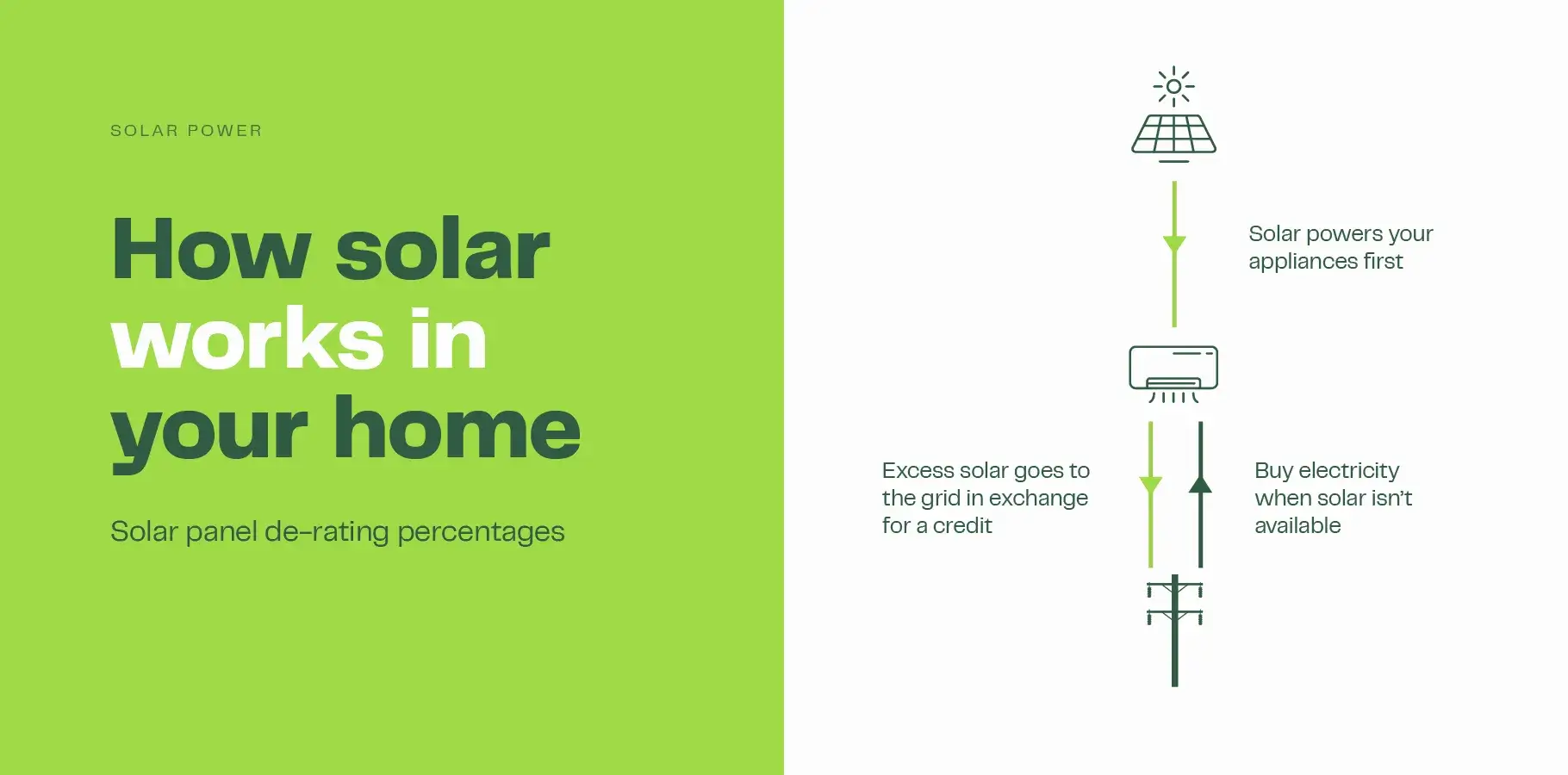
Solar panels only generate electricity during daylight hours, they do not work at night. The solar energy generated by your panels is used to either:
- Power electrical appliances directly, or
- It gets exported back to the grid
If you have a battery, then excess solar energy can be stored in the battery rather than send it back to the grid. Understanding how this process works will help you to lower your electricity bills.
Self consumption
When you use solar energy directly to power electrical appliances, we refer to this as self-consumption, you are using your own solar. If you pay 30c per kWh for electricity, then this is how much you will save when you use your own solar energy.
Further reading: How to use your solar panels for maximum savings.
Grid exports and feed-in tariffs
When you export your excess solar energy, which is bound to happen, you receive a feed-in tariff from your electricity retailer. The tariff varies but is generally somewhere between 5 – 16c. You are far better off using your own solar and saving 30c per kWh, as opposed to receiving 6c to sending it back to the grid.
Will I still need to pay for electricity?
Yes, you’ll still likely have electricity bills, especially in the winter months. Not only do you have to pay a daily supply charge to remain connected to the grid, but at night, or when it’s cloudy, you have to buy your electricity from the grid, just as you do prior to installing solar panels.
Further reading: How solar panels work: function, savings and science
- Are solar panels worth it
- Benefits of solar panels
- A Guide to 3kW Solar Systems
- A Guide to 4kW Solar Systems
- A Guide to 5kW Solar Systems
- A guide to 6.6kW solar systems
- A guide to 8kW solar systems
- A guide to 10kW solar systems
- A guide to 13kW solar systems
- A guide to 20kW solar systems
- A guide to hybrid systems
- A guide to off-grid systems
Popular next steps
Discover the best solar panels for 2024

The cost of solar panels
Solar rebates: What can you claim?
Are you ready to compare solar quotes?
Get 3 free quotes and start your solar journey today.
Get free quotes