


Solar rebates and incentives in Queensland
Last updated: July 2026
Reading time: 5 minutes
The state of Queensland leads the way when it comes to solar adoption in Australia. Well over 1.2 Million systems have been installed in the sunshine state, taking the tally of homes with solar panels to over 54% 1.
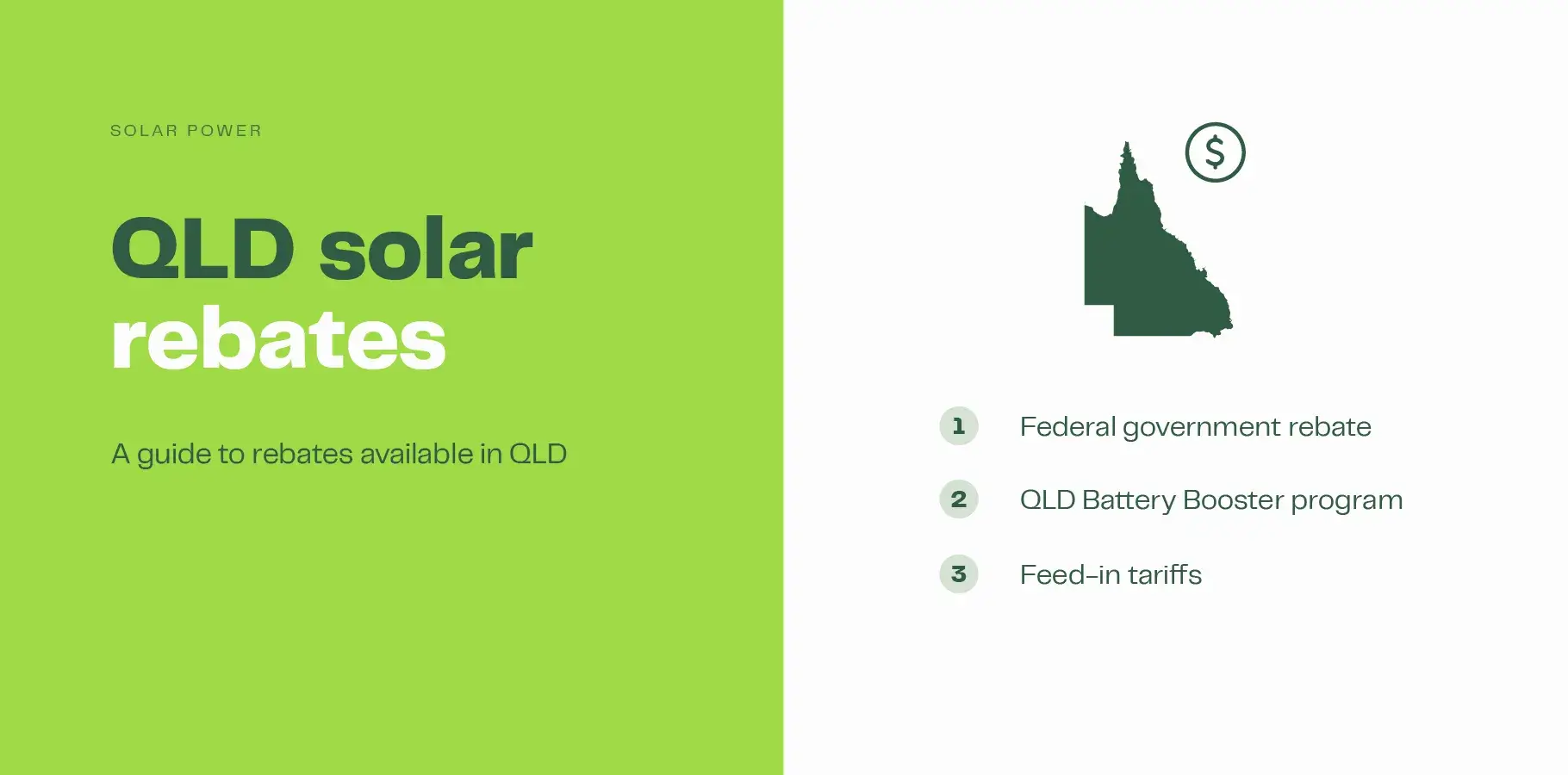
The QLD solar rebate is available to all households and businesses that install new solar panels.
In addition to the incentive for panel installation, we have listed additional rebates available to QLD residents and businesses:
- The federal solar rebate available to QLD residents
- Federal solar battery rebate
- Solar feed-in tariffs
- Supercharged Solar for Renters rebate
- Community solar programs (Townsville and Caloundra)
- Sustainability grants for organisations
The Queensland government battery rebate (Battery Booster Program) has now closed.
In this article we explain the eligibility requirements, value of the rebate and tell you how you can claim it. We also cover all of the other solar and energy incentives available in Queensland.
QLD solar panel rebate
The federal STC rebate, also known as the Small-scale Renewable Energy Scheme, is available in Queensland. Given the nature of how the rebate works, whereby postcodes that receive more sunshine hours get a larger rebate, Queenslanders are well placed to take full advantage of the incentive.
A system installed in Brisbane, will generate a certain number of Small-scale Technology Certificates (STCs). The number of certificates you receive depends on the predicted energy generation of the system up until the end of 2030. The larger the system, the more STCs you get.
Once you install the system, your solar installer will then claim back the solar rebate for you on your behalf. You only pay the net cost of the system.
Queensland solar rebate end date
The solar rebate in Queensland ends on the 31st December 2030. Each year, the rebate diminishes in value, in line with the scheme’s end date.
How much will the scheme save me in QLD?
The federal solar rebate in Queensland can reduce the cost of your solar panels by up to a one quarter.
The exact amount you’ll receive depends on three factors:
- Where you live in Queensland: Different zones receive different solar ratings, but generally, Queensland enjoys high ratings thanks to its sunny weather.
- How soon you install your new system: The STC rebate is based on how much electricity your system will produce until 2030. This means you’ll receive fewer STCs the longer you wait.
- Your system size: A bigger solar system will produce more energy than a smaller one. So, the larger your system, the more STCs it will receive.
The table below shows the rebate value you can expect for different-sized solar systems in south-east Queensland.
Queensland STC solar rebate value:
| System size | STCs | Rebate value |
|---|---|---|
| 3kW | 20 | $800 |
| 5kW | 34 | $1,360 |
| 6kW | 41 | $1,640 |
| 6.6kW | 45 | $1,800 |
| 7kW | 48 | $1,920 |
| 8kW | 55 | $2,200 |
| 8.5kW | 58 | $2,320 |
| 9kW | 62 | $2,480 |
| 10kW | 69 | $2,760 |
| 13kW | 89 | $3,560 |
Solarcalculator.com.au’s STC Calculator can help you estimate the rebate amount for your system size and location.
How do I know if I’m eligible?
Anyone who installs new solar panels can claim the rebate. System upgrades, panel replacements, and even solar hot water pumps are all eligible. According to the Clean Energy Regulator, 81,549 Queensland homes and small businesses benefited from the scheme in 2024 and 69,356 in 2025, with install figures still to be finalised. The total number of homes with rooftop solar in Queensland as at 23rd July 2026 sits at 1,203,203.
To make sure your new solar panels will qualify, follow the steps below:
- Use Clean Energy Council (CEC) approved parts.
- Choose a SAA accredited installer to perform the installation.
- Install your new solar panels within 12 months of creating the STCs.
- Keep your system under 100kW, with a maximum annual production of 250MWh.
How do I apply?
If you meet the criteria, your solar installer will calculate your STC rebate amount and deduct it from your installation cost. You don’t need to do anything extra to claim your incentive!
Secure your rebate. Get quotes from installers we trust.
Reduce your electricity bills. Cut your emissions.
Solar battery rebate in QLD
The Australian government solar battery rebate is available to all Queensland residents that meet the eligibility criteria.
The rebate is estimated to save up to $252 per kWh off the cost of a new solar battery. The rebate for a 10 kWh battery is estimated to be around $2,516.
Some key details about the battery rebate:
- It reduces from January 1 2027
- It is tiered according to the battery's useful capacity

Eligibility for the battery rebate
To receive the rebate you must meet the following criteria:
- Install a battery with useful capacity of up to 100 kWh
- Choose a battery from the CEC Approved Batteries list.
- Use an SAA accredited installer.
- Ensure the battery has VPP capability
How do I apply?
Follow these steps to ensure you receive the rebate:
- Obtain a quote for your solar battery
- Check your installer is SAA accredited
- Check that your battery is approved by the CEC
- Pay your installer the net cost of the battery
For full details, visit our federal government solar battery rebate page.
Solar feed-in tariffs in QLD
Queenslanders that export solar energy to the grid can benefit from ongoing feed-in tariff incentives. Across Queensland, feed-in tariffs compare very favourably to other states. Typically, rates range from 3c – 10c.
The solar energy your system generates, first goes to any power any appliances you are using in your home, the excess is exported back to the grid, unless you have a battery you can store it in. A feed-in tariff is the credit you get paid for every kilowatt-hour (kWh) of electricity your system sends back to the grid.
Feed-in tariffs for south-east Queensland
If you live in south-east Queensland, your feed-in tariff rate is set by your electricity retailer. The state government sets no minimum rate, meaning retailers offer competitive rates. Also referred to as a market feed-in tariff, this system lets you shop for the best deal.
Feed-in Tariffs for regional Queensland
The situation is different if you live in regional Queensland. Instead of retailer-led pricing, regional Queenslanders can access a fixed feed-in tariff rate. For the 2026-27 financial year, this is locked in at 6.006 cents per kilowatt hour.
How do I claim my feed-in tariffs?
To be eligible to receive feed-in tariffs across Queensland, you’ll need to have a grid-connect solar system installed at your home. If you have multiple solar energy systems installed, only one per household is eligible to receive the tariff.
You’ll also need to register with your electricity retailer and give them details of your system, including its size and capacity (max 30kW).
Not all electricity providers offer feed-in tariffs, and some have specific conditions, like limiting eligibility to customers who purchase their solar panels through them.
You’ll receive your feed-in tariffs paid as a credit on your electricity bills.
Supercharged Solar for Renters
The Queensland government's Supercharged Solar for Renters program is an initiative that provides landlords with a rebate worth up to $3,500 for installing solar on a rental property.
The table below outlines the value of the rebate according to the size of the system:
| System size | QLD rental rebate |
|---|---|
| Less than 3kW | $0 |
| 3 - 4kW | $2,500 |
| 4 - 5 kW | $3,000 |
| 5+ kW | $3,500 |
The Queensland government has set aside $26.3 million to fund the program but has given no indication of its likely end date.
Eligibility for the Supercharged Solar for Renters rebate
To receive the Supercharged Solar for Renters rebate, landlords must meet a number of eligibility criteria, including:
- Install a system over 3kW in size
- Rental income must be less than $1,000 / week
- Must reside in Australia
- Rental property must be located in QLD
- System must be installed an NETCC Approved Seller
- Components must be approved by the CEC
- Installer must hold valid Electrical Worker Licence
- The install quote must be dated after 12th December 2025
Far lower system cost for landlords
The Supercharged Solar for Renters incentive dramatically decreases the cost of a 5kW system in QLD. Where prices currently sit between $5,000 - $7,500 after the STC rebate, the landlord rebate can reduce the install cost to between $1,500 - $4,000 for a good quality system.
Additional solar programs in QLD
Often, local governments provide incentives for their residents to install a battery, solar panels or upgrade electrical appliances. It’s worth checking with your local council to see what is available.
Community Solar Bank – Caloundra and Townsville
If you live in Caloundra or Townsville, you may be able to participate in the Queensland government’s Community Solar Bank program. The initiative aims to reduce electricity bills for up to 5,500 households.
The Community Solar Bank program is geared towards apartment owners, renters and low-income households. The battery is not yet operational but the program boasts the potential to reduce electricity bills by up to $800.
You can read the program announcement here.
Former QLD government incentives
If you are searching for the status of former QLD government energy incentives, please see the table below:
| Jurisdiction | Incentive | Status |
|---|---|---|
| QLD government | QLD Battery Booster program | Closed |
| QLD government | Queensland government EV rebate | Closed |
| QLD government | Brisbane City Council sustainability solar grant | Closed |
QLD Battery Booster program
In 2024, the Queensland government launched the Battery Booster program to encourage households install a home battery. The QLD battery rebate closed later in 2024.
It is unlikely the Battery Booster program will reopen anytime soon.
Queensland government EV rebate
The Queensland government’s EV rebate closed in September 2024. The rebate provided up to $6,000 in funding to reduce the cost of a new EV purchase. While the scheme has closed, there are still many benefits to combining an EV with a new solar system.
Despite the closure of the scheme, EV owners can still benefit from reduced registration fees and transfer costs.
Next steps
If you’re keen to take advantage of the solar incentives available to Queenslanders, here are some next steps you can take:
- Use our solar panel and battery calculator to estimate your savings and payback on a new system.
- Learn more about solar system sizes, with our guides to 3kW systems, 5kW systems, 6.6kW systems, and 10kW systems.
- Learn more about choosing the right solar installer for you.
References
- 1,203,203 Queensland households (54.80%) have solar panels, Solar Calculator.
Are you ready to compare solar quotes?
Get 3 free quotes and start your solar journey today.
Get free quotes