


Do solar panels work in winter and cold weather?
Reading time: 5 minutes
Yes, solar panels work in winter and during cold weather. Solar power is generated by converting sunlight into electricity, not heat.

While solar panels do work just as well in winter, their output is typically significantly less than in other seasons. Shorter daylight hours and cloudy weather combine to reduce the number of sunshine hours therefore impacting solar production. Colder winter temperatures do not hinder solar output, they actually enhance performance.
In Australia, the electricity output of solar panels varies considerably by season and location. For the most part though, Australia’s winter conditions receive relatively strong sunlight hours. And, solar systems can deliver good savings during the winter months.
How solar power systems work in winter
Solar power systems operate just as well during winter as they do during other times of the year – it’s just that sunshine hours are typically much lower. Solar panels work by converting sunlight into electricity, heat is not a factor.
The photovoltaic cells in a solar panel typically have two layers of semi conducting material. When sunlight hits the photovoltaic cells, it generates a positive and negative charge between the two layers creating a direct current (DC). The current is then converted to alternate current (AC) for domestic use.
There is no change to the process in winter, though the season brings more challenges.
Winter brings with it more cloudy days
In Australia, winter typically brings more cloudy days. Solar panels generate electricity on cloudy days, though output is lower as there is less direct sunshine.
There are many different types of clouds, each impacting production differently. Clouds can broadly categorised into high-level, middle cloud and low cloud. Australian winters, particularly in the south, experience more low cloud, which reduces output by between 70% - 90%.
Shading is more prevalent in winter
Any solar panel shading issues at property level are likely to be amplified during the winter months, as the lower arc of the sun casts longer shadows. While the panels will still work, more shading means lower production.
Best angle for winter production
Year round, the best angle for solar panels is typically the latitude angle of your location. However, during the winter months, the sun travels on a lower arc, which can impact solar output. Maximum winter production is achieved when the tilt of your panels are perpendicular to the lower arc of the sun.
Winter solar output in Australia
In Australia, solar panels typically produce less electricity in winter than at other times throughout the year due to the lower number of sunshine hours. Exactly how much lower, varies by location as differences in winter solar production can be attributed latitude, sunlight hours and weather conditions.
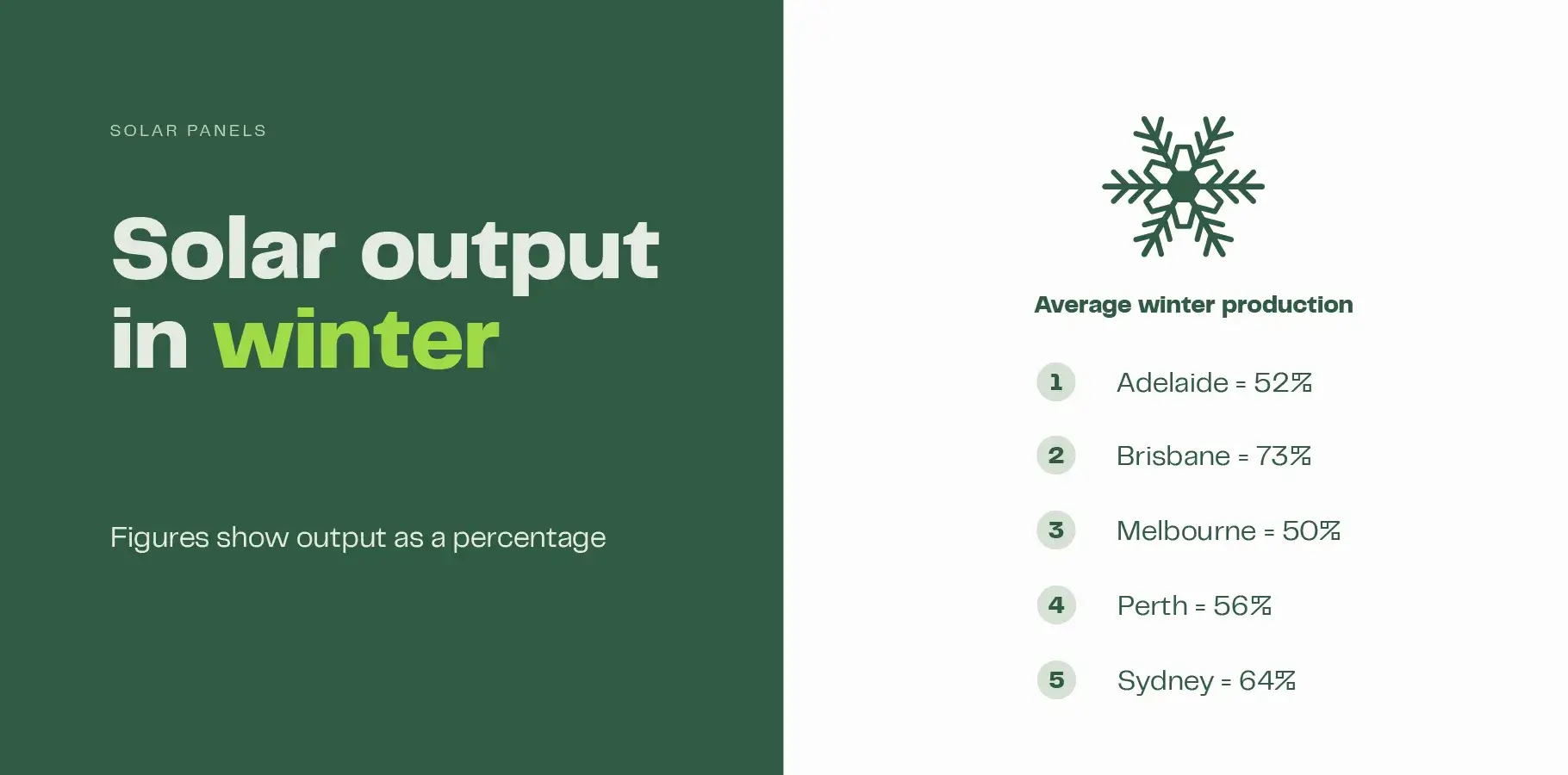
For most of the Australian population, winter solar output ranges between 44% - 73% of average production.
The table below shows winter production as compared to the annual average for a 6.6kW system in major cities around Australia:
Winter output for popular systems in major Australian cities
| City | Average daily (kWh) | Winter daily (kWh) | Winter % |
|---|---|---|---|
| Adelaide | 28.27 | 14.68 | 52% |
| Brisbane | 28.89 | 21.07 | 73% |
| Cairns | 29.05 | 24.53 | 84% |
| Canberra | 28.44 | 15.94 | 56% |
| Darwin | 30.41 | 30.08 | 99% |
| Hobart | 23.53 | 10.31 | 44% |
| Melbourne | 25.24 | 12.62 | 50% |
| Perth | 30.73 | 17.17 | 56% |
| Sydney | 26.69 | 16.99 | 64% |
Of the capital cities, Brisbane has the best winter conditions with solar output at 73% of average production. Contrast this to Melbourne where solar output is only 50% of average annual output. Solar output in Cairns is particularly strong in winter compared to other major Australian cities, solar panels generate 84% of their average output in winter.
Output varies month by month
The graph below shows solar output for a 6.6kW system in Sydney during the winter months versus all other months in the year.
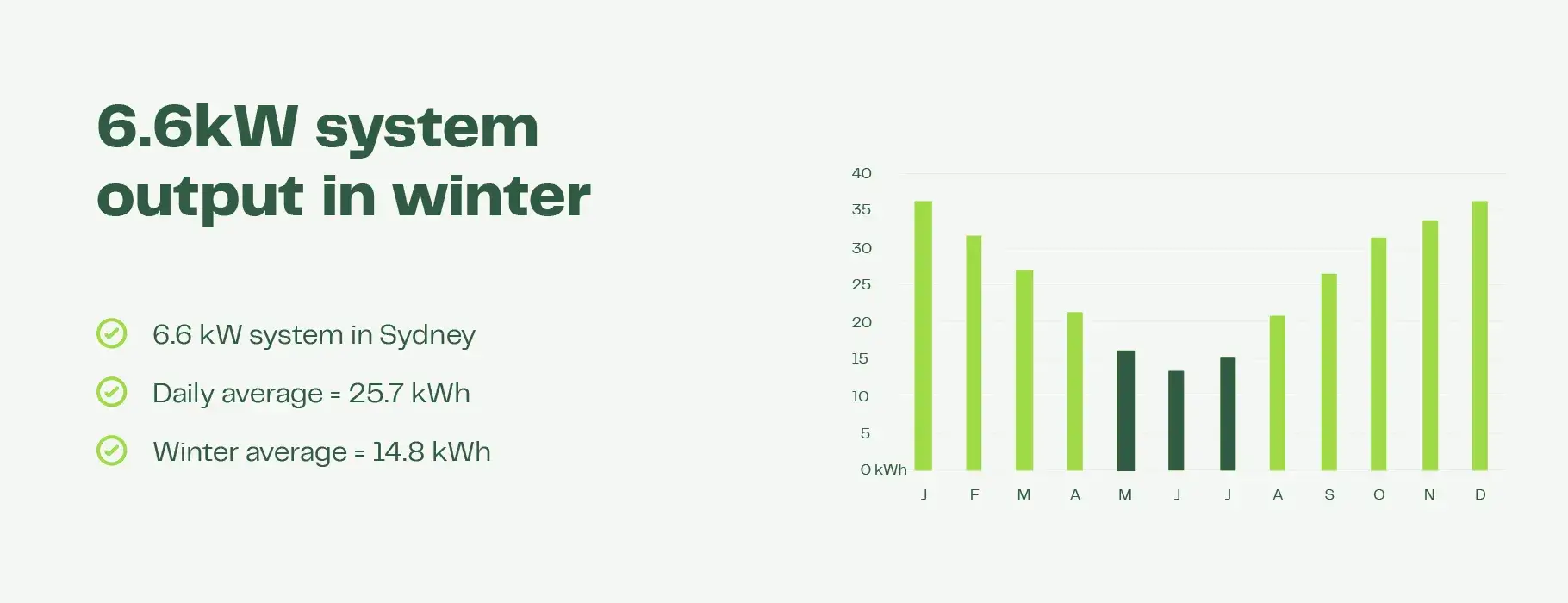
In Sydney, solar panel output during the winter months is around 64% of the average daily production.
Seasonal figures vary even more so
The above figures compare winter solar output against the annual daily average. The differences when comparing winter performance vs summer are even more stark, due to the seasonal high output of solar production in summer.
The table below shows the percentage decrease in solar output from winter to summer:
| City | Winter vs summer decrease |
|---|---|
| Adelaide | 66% |
| Brisbane | 41% |
| Cairns | 22% |
| Canberra | 61% |
| Darwin | -9% |
| Hobart | 73% |
| Melbourne | 68% |
| Perth | 62% |
| Sydney | 53% |
Cold temperatures aid winter production
The lower temperatures experienced in the winter months are actually a plus for generating solar. Solar panels operate more efficiently at lower temperatures. It is not the lack of heat that impacts on solar output in winter, rather it is the reduced sunshine hours.
Do solar panels work in the snow?
Yes, solar panels can even work in the snow. If the panels have enough tilt, snow will simply slide off the modules as it melts. Once the panel is free of snow and receiving sunlight, it will start working to produce electricity again.
It is not even necessary to clean your panels to remove the snow. A study conducted by the Alberta Institute of Technology has found there is little need to clear the snow if your panels have enough tilt, clearing panels after snow events only attributed to a 3% increase in output.
Although snow is less of an issue for solar panels in Australia rather than in Europe or America, it still occurs in parts of Victoria, Tasmania and New South Wales.
Do solar panels reduce winter electricity bills?
While solar output may reduce during the winter months, it is still possible to make good savings and lower your electricity bill.
Winter bills are often higher
In the southern states of Australia, electricity bills are typically higher due to shorter daylight hours and higher energy consumption that is needed to adequately light and heat homes. Winter electricity bills are 27% higher in Melbourne and during winter and 20% higher in Sydney.
Calculating winter solar savings
It’s possible to calculate your solar savings during the winter season. Our solar calculator calculates your new bills with solar for summer, autumn, winter and spring.
The graphic below shows results for an 8kW system in Sydney with a quarterly electricity bill of $750:
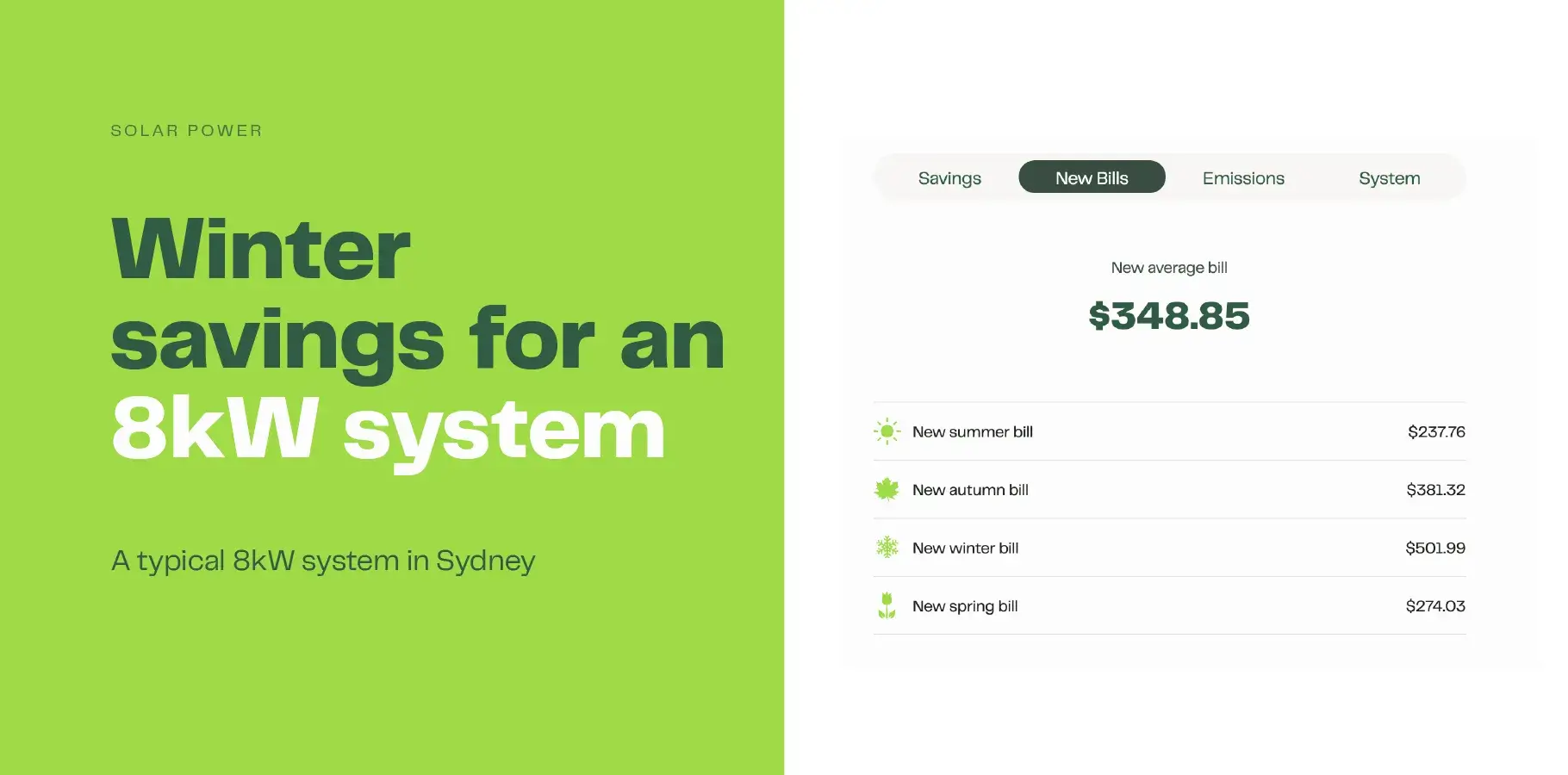
| Season | New bill amount | Bill savings | Bill decrease % |
|---|---|---|---|
| Summer | 237.76 | $512.24 | 70% |
| Autumn | 381.32 | $368.68 | 51% |
| Winter | 501.99 | $248.01 | 34% |
| Spring | 274.03 | $475.97 | 65% |
The new electricity bill in winter is $501.99, a saving of $248.01 (34%).
Adding a battery further reduces electricity bills in winter
Adding a solar battery to solar panels can bring down electricity bills in winter even further. Using the same example in Sydney, the graphic below shows that the new winter bill comes down to $252.40, a saving of $497.60 (68%).
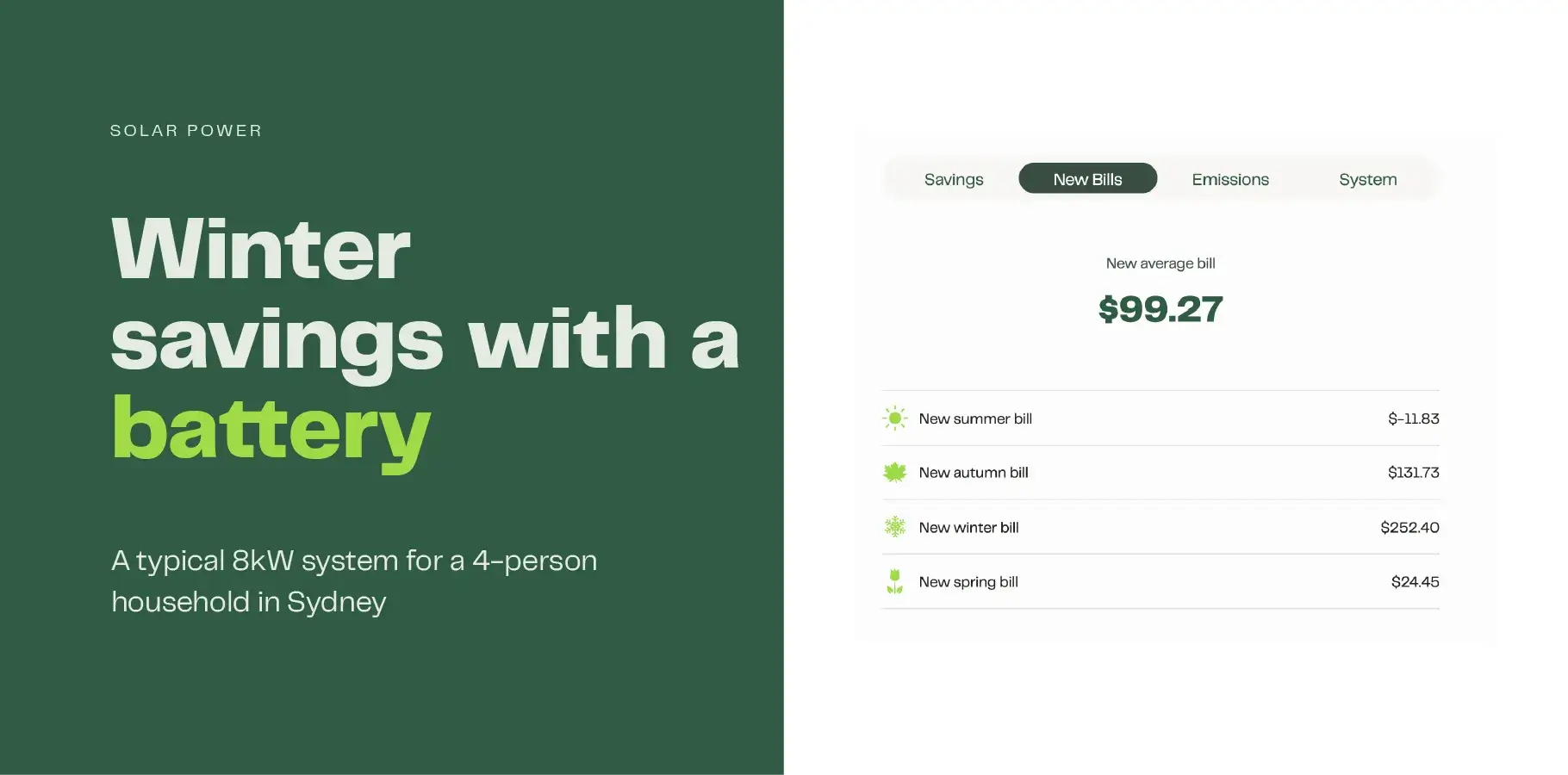
| Season | New bill amount | Bill savings | Bill decrease % |
|---|---|---|---|
| Summer | -11.83 | $761.83 | 104% |
| Autumn | 131.73 | $618.27 | 85% |
| Winter | 252.4 | $497.60 | 68% |
| Spring | 24.45 | $725.55 | 99% |
The battery allows solar power to be used at night, which increases savings during the long winter nights.
Frequently Asked Questions
No FAQs found.
The latest from our blog
See all


Are you ready to compare solar quotes?
Get 3 free quotes and start your solar journey today.
Get free quotes