


Are solar panels worth it in 2026?
Reading time: 5 minutes
There’s a reason over 4.2 Million homes in Australia have solar panels. In every state, no matter your electricity consumption, solar panels are typically worth buying.
While there are many variables that impact the cost, savings and payback of solar panels, the upshot is that in Australia they are a good investment. Typically, solar panel systems will payback within 5 – 6 years and it is not uncommon for systems to pay for themselves within 4 years.
If you buy well, a good solar power system can deliver savings for 25 years.
Key reasons why solar panels are worth installing include:
- Very favourable payback and savings results
- Solar panels last a long time
- The national rebate is still available
- Additional rebates are available in selected states
- Solar panels significantly reduce your household emissions
Savings and payback figures make panels worth it

The best way of determining whether or not solar panels are worth it, is by evaluating the potential savings figures and payback time of the system.
Savings and payback results for solar panels vary considerably based on a number of key factors, including:
- The size of your system
- How much electricity you use
- When you use your electricity
- Your location
There are also property specific variables like the orientation of your house and the tilt of your roof.
Typical results for a 6.6kW system in 2026:
The most common household systems are a 6.6kW solar panel system and an 8kW solar system.
A 6.6kW system costs anywhere between $5,5000 - $8,500, for a good, reliable one. It can deliver savings of between $1,200 - $2,000 (sometimes even more) depending on: where you live, how much electricity you use and when you use it.
- Cost: $5,500 - $8,500
- Savings $1,200 - $2,000
- Payback 4 – 7 years
How much do solar panels save per month?
A typical 6.6kW system, can deliver savings of between $300 - $500 per quarterly bill. Why is there such a big price range you ask? Well, it depends on how much electricity you use and when you use it.
A household that has a larger electricity bill has a greater capacity for savings.
Environmental benefits
Of course, not everyone installs solar panels for the attractive financial returns. For many, the opportunity to reduce household emissions is incentive enough to install solar.
Savings and payback results in Australian states
Along with electricity consumption and the size of the system, location plays a vital role in evaluating the financial viability of solar panels. One reason for this, is that the cost of solar panels varies according to which state you live in.
Your location impacts the value of the solar rebate you receive, which in turn impacts the amount you pay for a system. Sunnier locations receive a higher rebate. In addition, some states offer additional incentives to invest in solar panels.
The table below shows the average cost, savings and payback results for popular size systems in each Australian state.
| System size (kW) | Annual savings | Payback period (years) | ROI | Electricity bill (Qtr) |
|---|---|---|---|---|
| 5 | $790 | 6.8 | 14.6% | $490 |
| 6.6 | $1,001 | 6.5 | 15.5% | $550 |
| 8 | $1,222 | 6.4 | 15.6% | $650 |
| 10 | $1,485 | 6.6 | 15.1% | $750 |
Is solar worth it in Victoria?
While Victoria experiences lower sunshine hours and feed-in tariffs than most other states, the Victorian solar rebate offsets these slight disadvantages. The VIC incentive is means tested so we haven't included it in our analysis above. Combining both the state and federal incentives can reduce the payback period down to around the 5-years.
Victorians also benefit from lower electricity prices compared to many other states which decreases the potential savings from installing solar panels slightly.
| System size (kW) | Annual savings | Payback period (years) | ROI | Electricity bill (Qtr) |
|---|---|---|---|---|
| 5 | $998 | 5.3 | 18.8% | $500 |
| 6.6 | $1,281 | 5 | 20.1% | $600 |
| 8 | $1,544 | 5 | 19.6% | $700 |
| 10 | $1,929 | 5 | 20.0% | $850 |
Is solar worth it in NSW?
With typical payback times around the 5-year mark, it’s a great time buy solar panels in NSW.
Not only is the Australian rebate available on solar panels, but the NSW battery rebate makes buying a hybrid system, or adding a battery to an existing system, a really appealing option.
| System size (kW) | Annual savings | Payback period (years) | ROI | Electricity bill (Qtr) |
|---|---|---|---|---|
| 5 | $1,025 | 5.2 | 19.4% | $525 |
| 6.6 | $1,321 | 4.8 | 20.7% | $625 |
| 8 | $1,624 | 4.8 | 21.0% | $750 |
| 10 | $1,995 | 4.8 | 20.6% | $875 |
Is solar worth it in Queensland
Solar is a very effective investment in Queensland due the state's high electricity rates and abundance of sunshine. Annual savings vary between $1,000 - $2,000 for households of different sizes and electricity consumption levels. The return on investment averages around the 20% mark making the case for solar very compelling.
| System size (kW) | Annual savings | Payback period (years) | ROI | Electricity bill (Qtr) |
|---|---|---|---|---|
| 5 | $1,025 | 5.2 | 19.4% | $525 |
| 6.6 | $1,321 | 4.8 | 20.7% | $625 |
| 8 | $1,624 | 4.8 | 21.0% | $750 |
| 10 | $2,023 | 4.8 | 20.9% | $900 |
Case for solar is very strong in SA
The payback on solar panels systems in South Australia is particularly good. Not only is SA renowned for its sunny weather, it has the highest average electricity rates of any state in the country.
| System size (kW) | Annual savings | Payback period (years) | ROI | Electricity bill (Qtr) |
|---|---|---|---|---|
| 5 | $1,022 | 5.1 | 19.5% | $475 |
| 6.6 | $1,298 | 4.9 | 20.6% | $550 |
| 8 | $1,579 | 4.8 | 20.7% | $650 |
| 10 | $1,960 | 4.9 | 20.5% | $775 |
| System size (kW) | Annual savings | Payback period (years) | ROI | Electricity bill (Qtr) |
|---|---|---|---|---|
| 5 | $923 | 6.1 | 16.0% | $475 |
| 6.6 | $1,201 | 5.7 | 17.6% | $550 |
| 8 | $1,483 | 5.6 | 18.0% | $700 |
| 10 | $1,857 | 5.6 | 18.0% | $850 |
Is solar worth it in Tasmania?
Even in Tasmania, the Australian state that receives the least amount of sunshine, investing in solar is financially worthwhile. An attractive feed-in tariff means that solar panels typically payback within 5 – 6 years in the Apple Isle.
| System size (kW) | Annual savings | Payback period (years) | ROI | Electricity bill (Qtr) |
|---|---|---|---|---|
| 5 | $935 | 5.8 | 17.2% | $450 |
| 6.6 | $1,226 | 5.4 | 18.7% | $550 |
| 8 | $1,494 | 5.3 | 18.8% | $650 |
| 10 | $1,856 | 5.4 | 18.7% | $775 |
| System size (kW) | Annual savings | Payback period (years) | ROI | Electricity bill (Qtr) |
|---|---|---|---|---|
| 5 | $1,215 | 7.5 | 13.4% | $475 |
| 6.6 | $1,568 | 7.2 | 13.8% | $575 |
| 8 | $1,890 | 7.3 | 13.7% | $675 |
| 10 | $2,305 | 7.5 | 13.4% | $775 |
* The above analysis assumes an average (between minimum and maximum) feed-in tariff for each state.
Calculate if solar is worth it
We have used assumptions and average household data to provide the financial results in this article. The best way to determine if solar panels are worth it is to use our solar power calculator. Our calculator factors in all of the variables that impact cost, payback and savings results for your property and electricity usage habits.
Get accurate savings and payback figures for solar panels
Reduce your electricity bills. Cut your emissions.
Considerations when deciding if solar is worth it
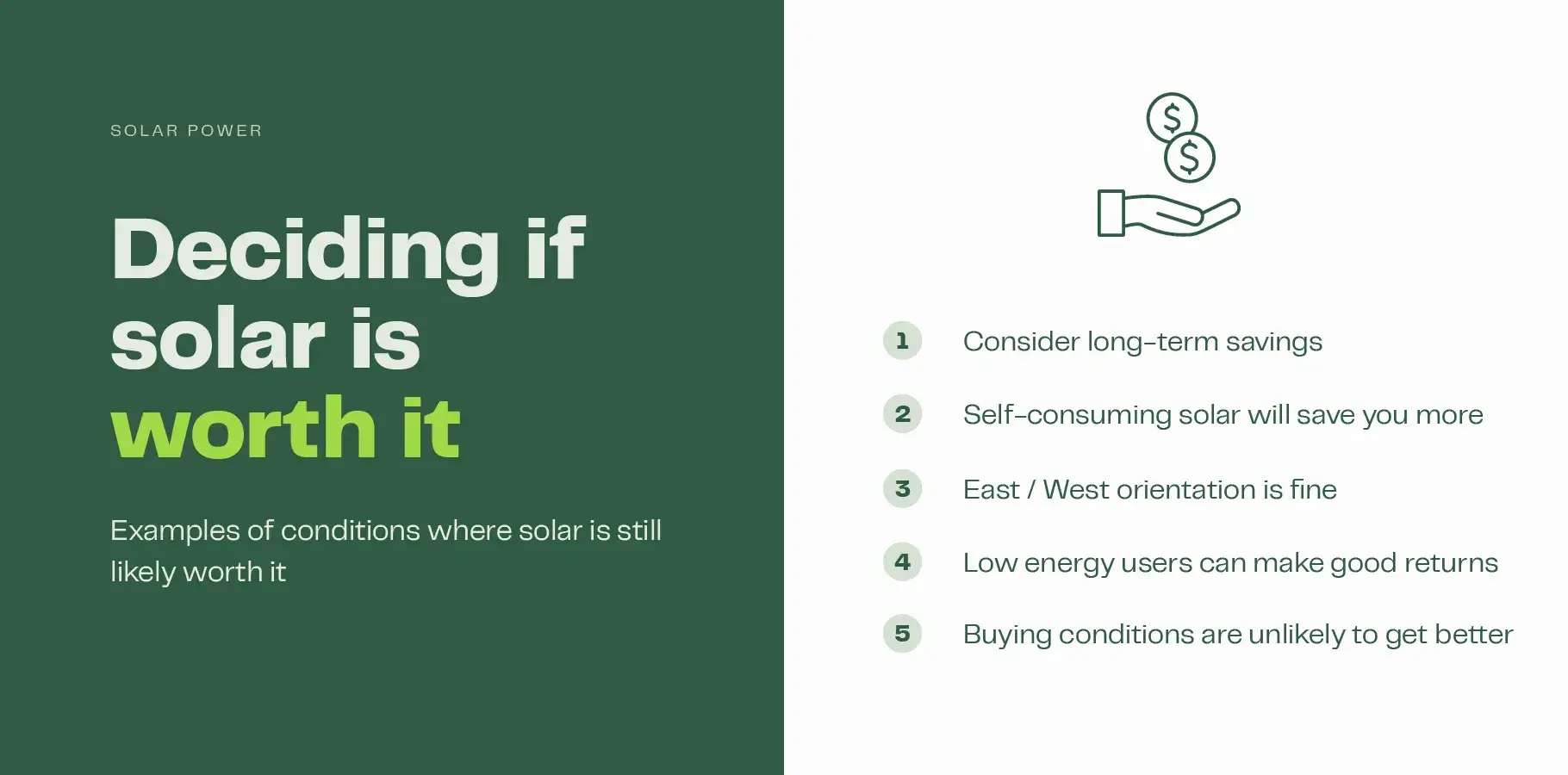
Consider lifetime solar savings
It’s all well and good to look at the short term and weigh up the payback period or the savings you can make off your next electricity bill, but a good system should last you 25 years. Really, you should consider the lifetime savings that your solar panels will deliver. The solar panel prices we publish are based on good quality systems that are designed to last. Cheap solar systems are more likely to fail and need replacing in a much shorter timeframe, they may payback faster (if they last long enough), but are not as good an investment.
Self-consumption will save you more
When you use the solar power that you generate directly from your panels, you effectively save around 33c per kWh, or whatever the rate is you pay for electricity. If your solar energy gets fed back into the grid, you will receive a feed-in-tariff – a credit for your excess power. Feed-in tariffs vary by state and retailer, but typically range between 2 - 10c per kWh.
There is a large variance between the 33c you save by using your solar power and the 7c you receive by selling it back to the grid; this is one reason why savings figures can vary considerably.
Common myth: If I get solar I won’t have to pay any electricity bills
In most cases, going solar will not eliminate your electricity bill entirely. You will still have to pay some portion of your power bill, though it will reduce substantially. This article explains how solar panels work and how you buy and sell electricity to and from the grid.
East / west orientation
If your roof does not point to the north, solar panels can still be a good investment. An east / west orientation can be beneficial because your panels generate power during the morning and afternoon peak period. Not only are you more likely to be at home using your power during these periods, but it is also when electricity is most expensive.
Low energy users
If you are a low energy user, you may wonder if solar panels are still worth it. The answer in most cases is still typically, yes, they are worth it. And, it is better to buy a larger system than you need. Though your ability to make solar savings is slightly reduced, a larger system with give you more options in the future with the push towards electrification.
What about system size?
Our system size calculator indicates that a 5kW or 6.6kW system is suitable for many households. However, with a move towards electrifying homes and charging EVs, electricity use is likely to rise. Consider your future use and opt for a larger size system when deciding how many panels you need.
Should I wait to invest in solar panels?
Is solar going to be a better investment in coming years? We don’t have a crystal ball, but here are the things we do know:
- The federal solar rebate reduces each year.
- If you live in a place like Melbourne, the Victorian rebate is subject to change, whether it be a reduction in the amount or a change to the scheme.
- Solar panels are getting more efficient each year and, their cost is decreasing; though the curve is flattening.
The best reason to invest in solar now is that you can save money off your next bill and reduce your household emissions immediately.
Is it worth getting a battery in 2026?
The payback period for solar batteries has improved dramatically in the past 12 months with the introduction of the federal battery rebate. Where, buying a solar battery used to be a lifestyle choice, now it is about crushing bills and saving money. Payback periods for batteries vary by state but typically fall between 5.8 - 9.6 years. Returns are impacted by whether or not you are adding a battery to an existing system or buying one with new solar panels.
Some generous state incentives available in states like WA, improve the economics of battery storage even further. These incentives, along with the national rebate, make getting a battery now favoured over waiting for prices to decrease.
When solar panels are not worth it

There are very few scenarios in Australia where solar panels are not worth installing. Here are a few examples:
- 1. If you are planning an addition to your home
- 2. If you plan to rework or repair your roof
- 3. If you don’t have enough roof space
- 4. If your house has a heritage overlay restrictions
House extensions and roof renovations
If you are planning an extension to your home, it’s best to wait before installing solar panels. Likewise, if your roof needs repairing, you’re best to do that first before going solar. Any change to your roof, may impact your solar panels.
Not enough roof space
Six efficient solar panels will almost make up a 3kW system and you’ll need about 10.2m2 to house the panels. If you don’t have that amount of roof, solar may not be worth it.
Heritage overlay restrictions
In some cities, heritage overlay restrictions may impact the viability of solar panels. For example, local councils in Sydney have been known to knock-back proposed installations based on heritage grounds.
The problem is exacerbated on small houses, where roof space is already at a premium.
In reality, there are very few reasons not install solar panels. With the available incentives, the financials stack up very favourably in every state in Australia, making solar panels a worthwhile investment.
- A guide to solar for your home
- Benefits of solar panels
- A guide to 3kW solar systems
- A Guide to 4kW solar systems
- A guide to 5kW solar systems
- A guide to 6.6kW solar systems
- A guide to 8kW solar systems
- A guide to 10kW solar systems
- A guide to 13kW solar systems
- A guide to 20kW solar systems
- A guide to hybrid solar systems
- A guide to off-grid solar
Are you ready to compare solar quotes?
Get 3 free quotes and start your solar journey today.
Get free quotes