


Do solar panels work at night?
Reading time: 4 minutes
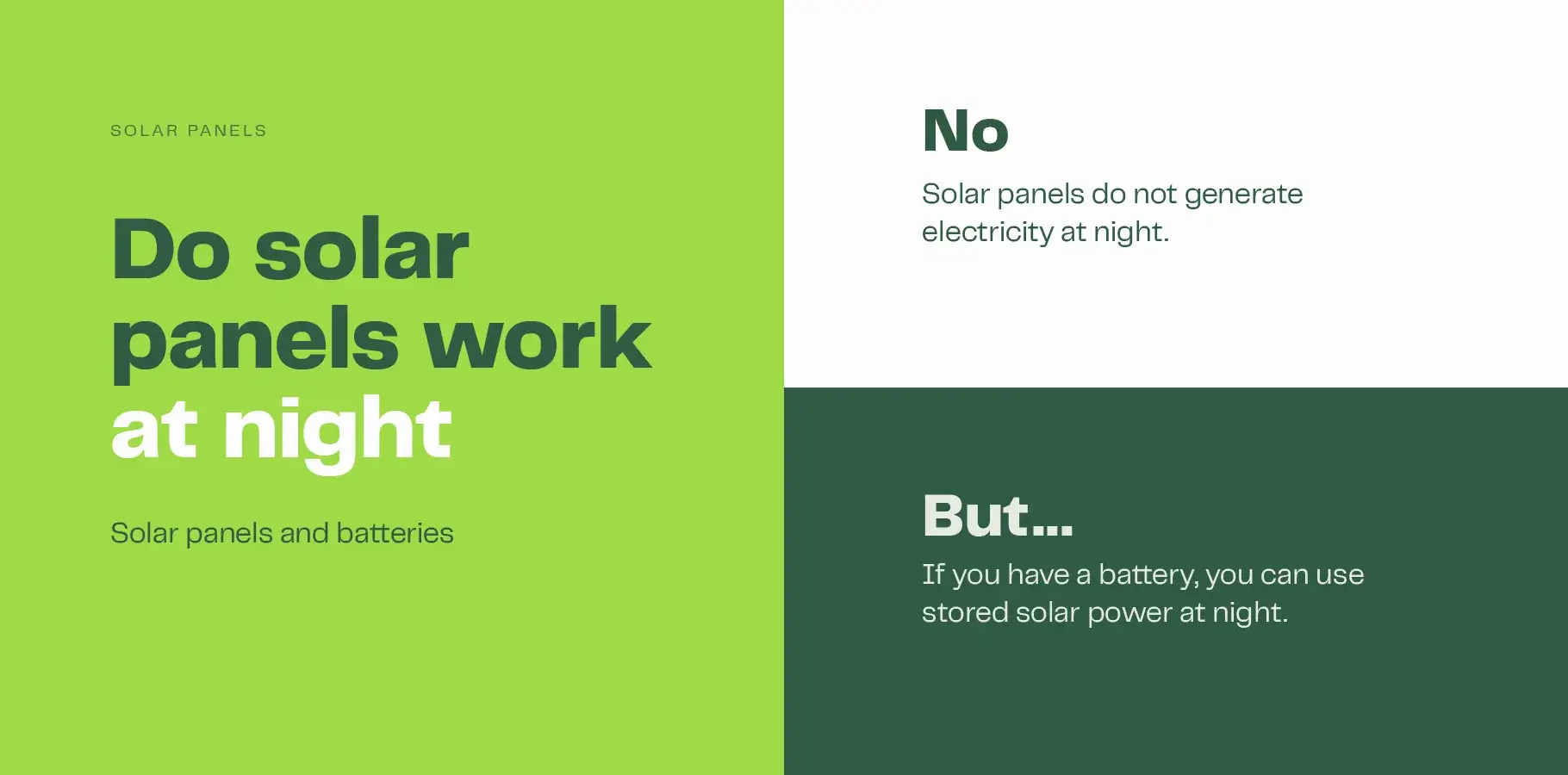
No, solar panels do not work at night because they rely on sunlight to generate electricity. But, solar stored in batteries can be used after dark.
However, it is possible to use solar power at night. Solar panels can charge a battery during the day, then that stored energy can be used to power electricity needs at night.
The fact that solar panels are unable to generate electricity at night, does not dampen their appeal. Nearly 40% of all Australian homes have solar panels. Over the course of a year, they perform extremely well, even in low-light conditions. The advancement of battery storage has opened the door to nighttime use of solar power.
Despite breakthroughs in solar cell technology, generating electricity at night from solar panels is not practical. But, panel and battery systems are changing the way we power our needs at night.
Solar panels need sunlight to work
Solar panels generate electricity when sunlight hits the photovoltaic cells within the panel and generates a current. The direct current (DC) generated by this process is then converted into an alternating current (AC) by a solar inverter, so that the generated energy can be used for electricity needs.
Without sunlight, the photovoltaic process does not work.
For a full explanation of the photovoltaic process and how solar electricity is generated for home use, you can read our guide to how solar panels work.
How solar power does work at night
There are two ways that solar power can be used at night:
- Using a solar battery
- Solar net metering (the electricity grid)
Using a solar battery at night
During daylight hours, solar panels typically generate more electricity than can be used. Home batteries work by storing excess energy, so that it can be used at a later time. For many consumers, the solar power generated by their panels during the day is stored, then used at night to power their electrical appliances.
Solar net metering
The other way a solar system works at night is by allowing you to buy electricity from the grid, just as you would without any solar panels. Net metering allows your solar power system to do three things:
- Use the solar energy you generate for free
- Send excess solar energy to the grid where you receive a feed-in tariff
- Buy electricity from the grid when your solar panels aren’t generating electricity
If you have a solar battery, your system can charge your battery rather than exporting excess energy back to the grid.
When you by electricity at night, the rate is set by your electricity retailer, usually around 25 – 35c per kWh.
The upshot of net metering; the solar panels do not work at night, but the net meter allows your solar system to access electricity from the grid at night.
Solar panels work in low-light conditions
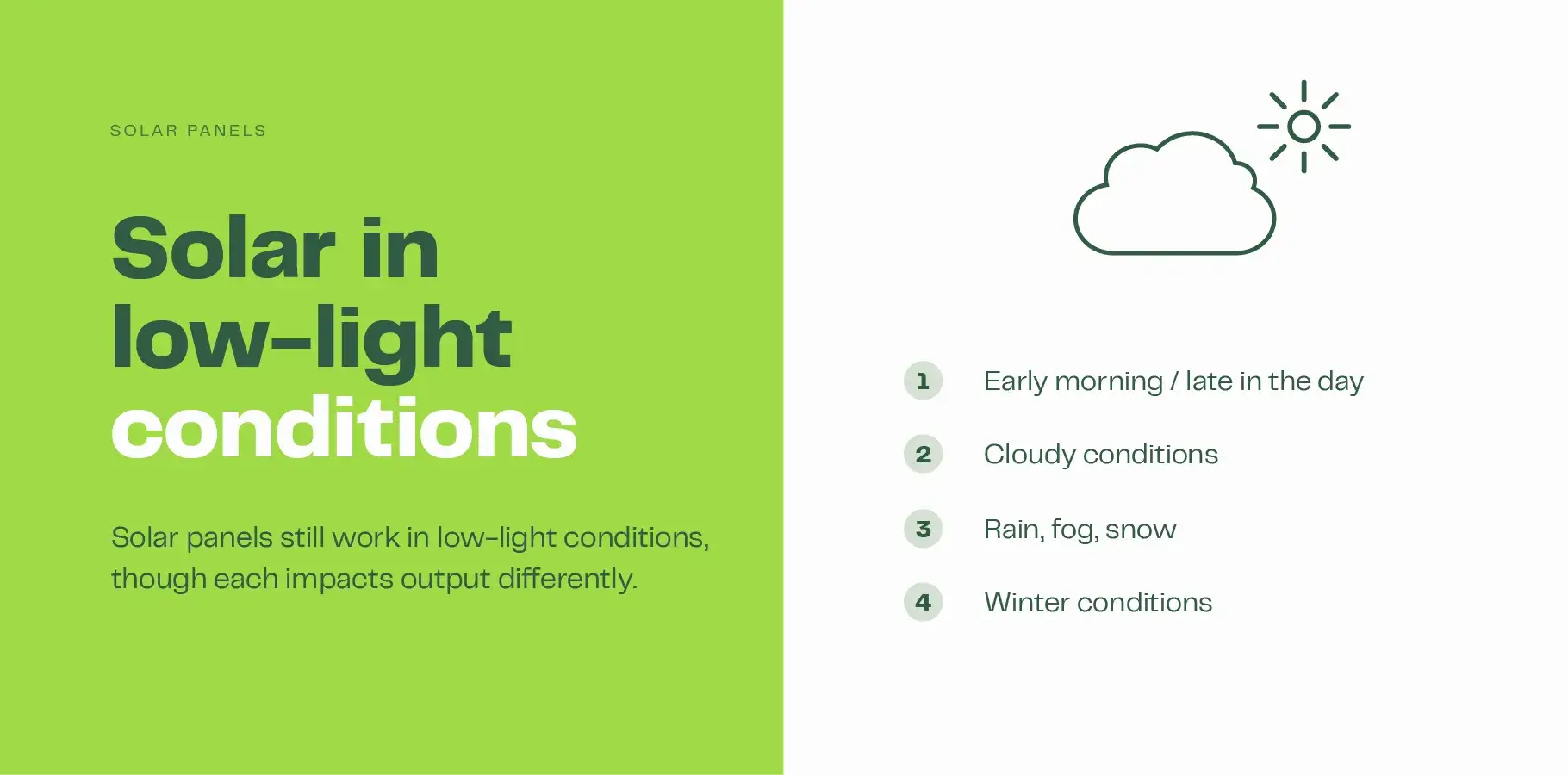
While solar panels do not work to generate electricity at night, they do perform relatively well in low-light conditions. When there is less sunlight available e.g. cloudy conditions, solar panels still generate electricity, just not as much when there is full sunlight.
Solar in cloudy conditions
Solar still works on a cloudy day, though output is reduced. The higher the cloud, the more energy the panels will generate. Conversely, low, or heavy cloud, results in far less output.
Solar in winter
Winter typically brings with it more-low-light conditions. Though, solar panels still function well during the winter months.
On average, solar output is reduced during the winter season. By how much, largely depends on the number of sunshine hours a location receives. Seasonal solar production varies more the further south you are located in Australia.
Future solar panels may work at night
There have been two breakthroughs in the development of solar cells that work at night from the University of California and the University of NSW (UNSW). The new cells that work at night have been referred to as anti-solar cells, because they work in the opposite way to conventional solar cells.
How new solar panels could work at night
Professor Jeremy Munday explains, “A regular solar cell generates power by absorbing sunlight, which causes a voltage to appear across the device and for current to flow. In these new devices, light is instead emitted and the current and voltage go in the opposite direction, but you still generate power”.
Different materials are used to conventional solar panels, but as Munday points out, “the physics is the same”.
While night solar panels are a terrific scientific breakthrough, they are a long way off commercial development. The UNSW team reported that the amount of power generated by their ‘night-time’ cell was 100,000 times less than a typical solar panel.
Is solar still worth it if panels don’t work at night?
Yes, in most instances, solar is worth it even though panels do not generate electricity at night.
Savings and payback times from solar panels and batteries are particularly strong in Australia. Average payback periods for panel and battery systems range between 5.8 – 9.6 years. A system with a battery makes it possible to use solar energy at night.
While solar panels do not work at night at present, one day in the future, we may have panels that produce electricity during the day, and at night.
Are you ready to compare solar quotes?
Get 3 free quotes and start your solar journey today.
Get free quotes