

The potential benefits of solar energy are appealing, saving money while positively impacting the environment is a great thing! However, if your solar power system doesn’t work as it should, it can detract from both your savings and environmental benefits.
The inverter converts Direct Current (DC) to Alternate Current (AC) so that you can use solar electricity in your home. The conversion process is an essential part of how solar works. If the inverter fails, the system won’t work.
Rather than replacing the unit, you might consider inverter repairs as a more cost-effective way of maintaining your system.
What is the lifespan of a solar inverter?
Solar inverters are crucial to the operation of your solar panels, and can usually last anywhere between 10 to 15 years. Inverters generally need to be replaced at least once throughout the lifespan of the panel system due to electro-mechanical wear. Generally speaking, inverters have a shorter lifespan than the panels themselves.
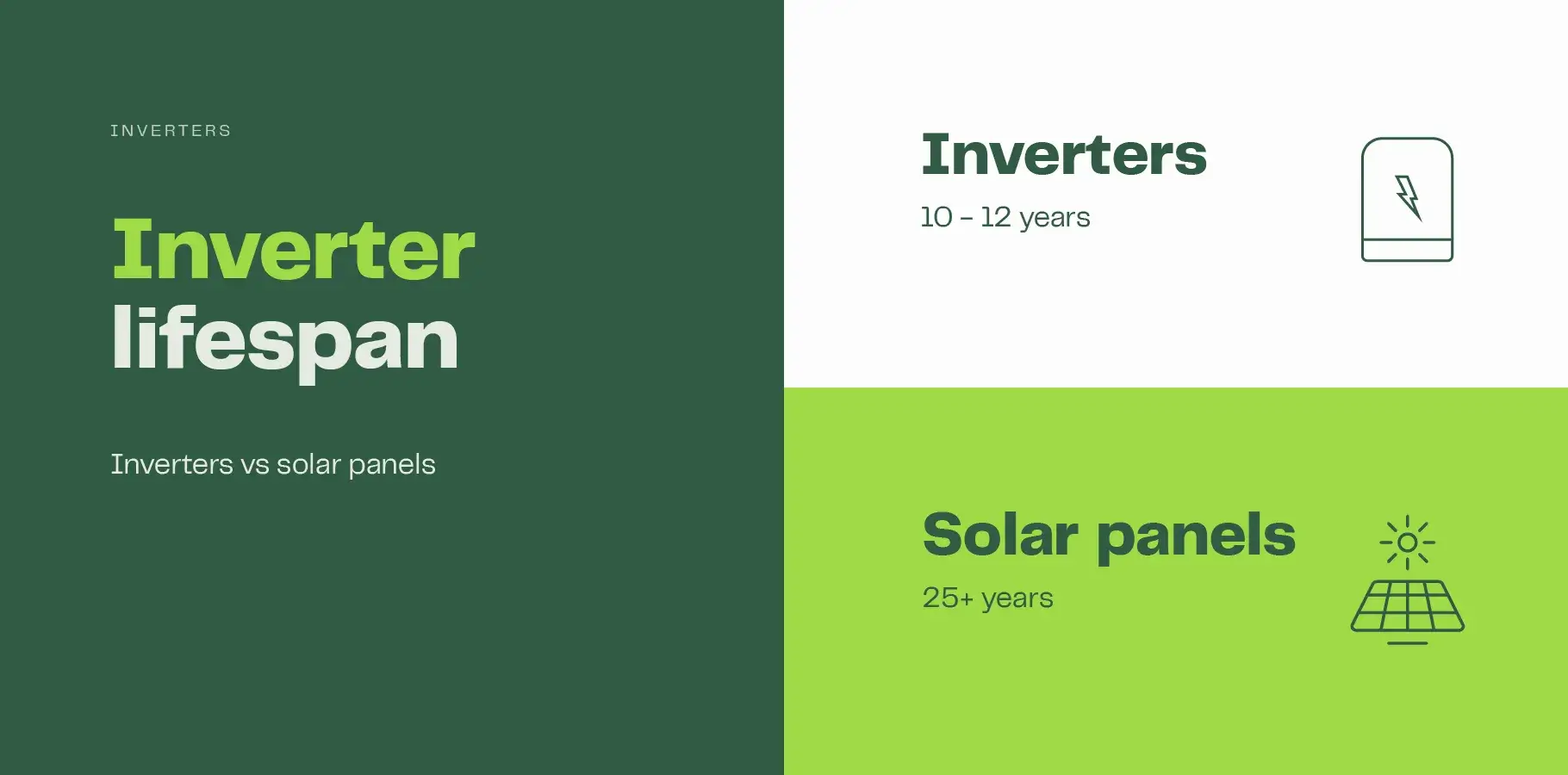
There are two primary types of inverters: string inverters and micro inverters. Some micro inverters come with a 25-year warranty.
It’s important to note that while solar panels can last 25 years, there are environmental factors that can shorten this lifespan significantly. A rooftop solar system is exposed to the elements, debris and falling objects – all of which can impact the performance of the system.
An efficient inverter that’s working as it should is critical; it is how the system converts the DC energy from the panels into AC energy that can be used within your home.
Why do solar inverters fail?
Solar inverters can fail for a wide variety of reasons, and when they do, it’s going to impact your solar panel capacity and how much electricity you’re able to generate in the system as a whole.
We list and expand upon the reasons as to why your solar inverter could be failing:
- Heat
- Faulty installation
- Humidity
- Poor maintenance
Heat
Excessive heat and extended periods of direct sunlight can cause solar inverters to wear out prematurely. It’s best to install your inverter in a cool, dry place with plenty of air ventilation.
Most electronic systems already tend to run several degrees hotter than room temperature with higher heat densities due to today’s smaller circuit sizes; prolonged heat negatively affects the inverter’s functionality. This is especially true in areas that are not temperature-controlled with air conditioning, e.g., outside.
Faulty installation
Your solar panels must be matched with properly sized inverters; solar panel capacity should not exceed 133% of inverter capacity. A poor installation can lead to issues in the future, including grid fault and maximum power point tracking (MPPT) errors. There should also be plenty of clearance in multi-inverter installations, to avoid heat transfer between units.
Humidity
High humidity can degrade solar panels, negatively affecting the inverter’s ability to output proper current and voltage. Because the percentage of water vapour in humid air is higher than usual, incoming radiation from the sun refracts off this water and decreases inverter efficiency, potentially causing inverter failure.
Such water vapour can decrease your inverters’ energy output by as much as 30%.
Poor maintenance
Regular monitoring of your system’s performance, to identify the need for any cleaning, is an important part of being a solar owner. Solar maintenance can preserve your investment, while poor maintenance can cause damage to your panels and potentially cause your solar inverter to fail. Inspect the outside of your inverter regularly for physical damage; clean regularly to ensure that dirt and dust are not clogging their cooling fins and vents as well.
Consider scheduling professional maintenance once every five years, wherein the inside of your inverter is inspected by a professional for corrosion, pests, and other signs of damage.
If your solar battery is failing, it might be a sign that it has come to the end of its lifespan. Battery storage adds a layer of complexity to the system, and battery issues in hybrid inverters are common as well.
Keep your inverter clear of debris as much as possible. A good installer will identify a location free from sunlight and falling debris that can protect your inverter.
Repairing a solar inverter
Repairing a solar inverter will require a CEC trained professional well versed in solar technology, or a representative of the manufacturer.
There are, however, still some troubleshooting measures you can take, including the points outlined below.
Reset inverter
If you have some working knowledge of electrical systems, you can reset the inverter yourself. As this is a detailed process, it’s important to realise that you must be as careful as possible to avoid risking danger to yourself as well as further damaging the system.
Only attempt to reset the inverter if you know the process involved. You can always refer to a professional if you’re uncomfortable doing this yourself; this piece of troubleshooting is completely optional.
Check your fault codes
If your solar panels are not working, it’s a good idea to check your inverter to see if it is displaying any fault codes. Take a photo of these codes or record them and save that information for a professional to review later. Since their job is to maintain solar inverters and other solar equipment, chances are, they’ll be able to use the information to determine what repairs are needed, or if the inverter needs to be replaced completely.
Replacing a solar inverter
Repair is often the first thought homeowners have when it comes to a failing solar inverter, but in many cases you may need to replace it completely. If you find that your item is just plain faulty, it’s time to review your options.
Check your warranty
If your inverter is still under warranty, then you are usually spared from a significant bill to replace it. The manufacturer may not replace it for free, but you typically pay a lot less than the full price for a replacement outside of the warranty period.
Check the paperwork that came with your inverter to see where you are within the warranty period. As you might imagine, the warranties vary between manufacturers, so it’s important to check your specific system.
How much will replacement cost?
The cost of replacing a solar inverter varies depending on the size and brand. A 3-phase inverter will typically cost at least $2,500, while the cost of a micro inverter will vary depending on how many need replacing.
Should you upgrade your system?
If you are looking at replacing a solar inverter, you may even consider a full system upgrade. After all, if the difference in price isn’t significant, committing to an upgrade holds more benefits than just replacing the inverter. Do your calculations before committing an entire new system though, to ensure it is worthwhile.
Will an installer upgrade your system?
Not every installer will agree to upgrade your system, some may have some reservations. There are liability issues at play and the installer may be concerned that they will be held responsible for the original installer’s work.
Depending on the age of your system, it may be difficult, or not viable, to upgrade.
Will you lose your premium FIT?
In some instances, upgrading your system may mean that you lose your premium feed-in tariff (FIT). Whether you lose your premium rate or not depends on the state in which you live as well as the size of your solar panel system and the one you are upgrading to. For example, in Queensland, if you’re on the 44c feed-in tariff rate and want to upgrade your inverter to a larger one and add more panels, you’ll likely lose your premium 44c tariff.
On top of that, the rules around premium feed-in tariffs can change and vary with retailer. We publish the best feed-in tariffs for each state to help you make the best possible decision.
Don’t be wasteful
For many solar enthusiasts, the environment is the prime objective for going solar. Faulty solar inverters end up somewhere, but simply discarding them isn’t always the best idea. It’s best to look for ways to recycle the various solar panel system parts appropriately.
 written byBy Michael Henderson