


The federal government solar battery rebate
Last updated: February 2026
Reading time: 5 minutes
The Australian government solar battery rebate is available to all residents. The federal rebate scheme can deliver savings of up to 30% off the install price of a new solar battery.
The Australian battery rebate can deliver savings of up to $336 per kWh of battery storage installed. For popular household batteries, the scheme can deliver savings of up to $4,500. Greater savings are available for larger installs and multiple batteries can be included under the rebate.
The solar battery rebate is set to end on 31st December 2030. However, the incentive will reduce in value slightly biannually.
In December 2025, the Australian government announced extra $4.9 Billion in funding to ensure the program continues until its slated end date.
Home solar batteries can deliver benefits like backup power, energy independence and reduce electricity bills.
Key notes about the battery rebate
Important details about the solar battery rebate:
- The rebate will decrease on May 2026
- Install date for STCs is when the certificate of compliance is issued
- A per kWh rebate applies to all households and businesses
- All batteries from 5 kWh to 100 kWh are eligible
- The rebate only applies to the first 50 kWh of storage
- The rebate is issued in the form of STCs which fluctuate in price
- Projected savings likely to be from $310 - $336 per kWh
- Rebate applies to new batteries and new panel and battery systems
How the solar battery rebate works

The Australian solar battery rebate is available to all households and businesses that install a new battery storage unit, provided they meet the eligibility criteria. The battery can be added to an existing solar panel system or coupled with new solar panels.
Receive STCs for installing a new battery
Like the government solar panel rebate, the battery incentive is issued in the form of Small-scale Technology Certificates (STCs).
Every kilowatt-hour (kWh) of battery storage will earn 8.4 STCs in the first four months of 2026. In legislation passed on 5th February 2026, the number of STCs will decrease from the 1st May 2026 and then decrease further at 6 month intervals starting from 1st January 2027.
| Year | STCs per kWh |
|---|---|
| 2026 (Jan - April) | 8.4 |
| 2026 (May - Dec) | 6.8 |
| 2027 (Jan - Jun) | 5.7 |
| 2027 (Jul - Dec) | 5.2 |
| 2028 (Jan - Jun) | 4.6 |
| 2028 (Jul - Dec) | 4.1 |
| 2029 (Jan - Jun) | 3.6 |
| 2029 (Jul - Dec) | 3.1 |
| 2030 (Jan - Jun) | 2.6 |
| 2030 (Jul - Dec) | 2.1 |
At this point in time, it is not anticipated that the battery scheme will extend beyond 2030.
The value of the solar battery rebate
Your chosen battery installer will trade your STCs for you to claim your rebate. Typically, STCs trade around the $40 mark. However, administrative costs can reduce the STC value to around $37. To calculate the value of the rebate, we multiply 8.4 by $37 to arrive at $311 per kWh. A 10 kWh battery will attract a rebate of $3,110.
The table below shows the anticipated rebate amount for various size batteries:
| Battery size (kWh) | Approximate rebate |
|---|---|
| 1 | $311 |
| 5 | $1,554 |
| 8 | $2,486 |
| 10 | $3,108 |
| 13.5 | $4,196 |
| 20 | $6,216 |
| 27 | $8,392 |
| 50 | $15,540 |
| 100 | $15,540 |
With the rebate applied, Solar battery prices now average between $800 - $1,000 per kWh of storage. The maximum rebate available under the scheme is around $15,540 as only the first 50 kWh of storage installed is eligible for the rebate under the government's guidelines.
From May 2026, the battery rebate will decrease according to the size of the unit installed:
- The first 14 kWh of storage will not be impacted
- 14 - 28 kWh will receive 60% of the STCs normally allocated
- 28 - 50 kWh will receive 15% of the normal STC allocation
Solar battery rebate eligibility
There are a number of eligibility requirements that need to be met to ensure you receive the solar battery rebate. Importantly, the Cheaper Homes Battery Program does not include any means testing and is open to all Australians.
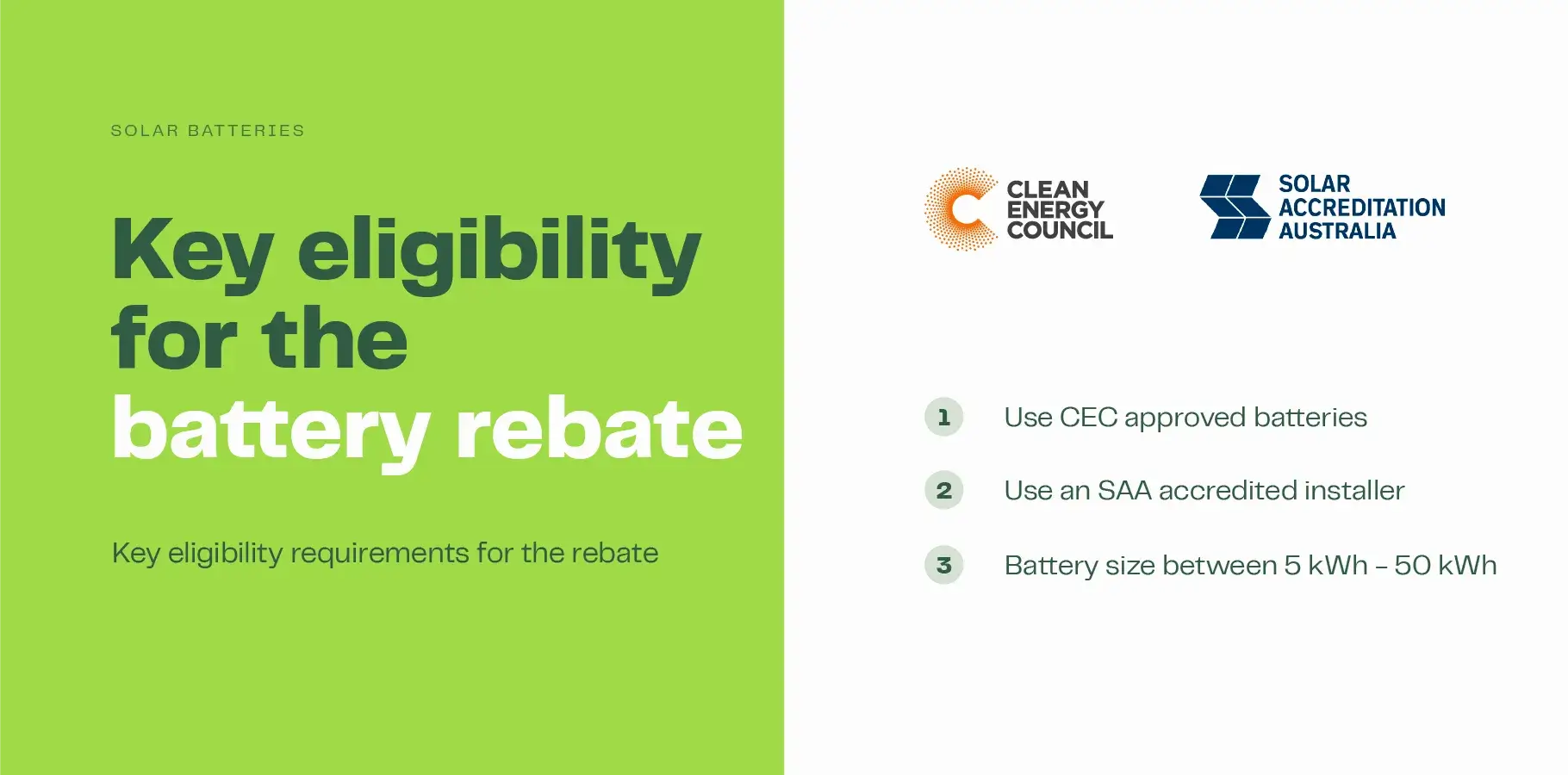
- Battery must be between 5 kWh to 100 kWh in storage capacity
- Only the first 50 kWh of storage is eligible for the subsidy
- The battery system must not have previously received a rebate
- Battery must appear on the CEC’s approved battery list
- Battery must be installed by an SAA accredited battery installer
- Grid-connect and off-grid systems are eligible
- Grid-connect batteries must be capable of joining a VPP
- Multiple modular (stackable) batteries serve as one battery unit
- The battery rebate does not apply to electric vehicle (EV) batteries
Battery and installation compliance
The solar battery must appear on the Clean Energy Council’s (CEC) list of approved batteries, you can view the list here. The battery must also be installed by an SAA accredited (formerly CEC accredited) installer.
Install date for claiming rebate
The 'installed' date for claiming the battery rebate is when the certificate of electrical compliance is issued. To claim the rebate before the May 2026 reduction, the battery must be installed with a certificate of compliance.
VPP capability
To be eligible for the solar battery rebate, the storage unit must have the technical capability to be able to connect to a Virtual Power Plant (VPP). Only the capability to connect is mandatory at this point in time.
Connecting batteries to a VPP is a key objective of the battery rebate so as to assist with the ongoing stabilisation of the electricity grid.
Stackable modular batteries
Multiple stackable modular batteries e.g. BYD and SunGrow, will count as one battery storage system provided they are installed at the same time. For example, two SunGrow 9.6 kWh modular units can be combined into one 19.2 kWh system. The battery rebate can be applied to full 19.2 kWh unit.
Popular batteries included in the rebate
Many popular batteries like the Tesla Powerwall 3 will be eligible under the rebate. Popular Tesla alternatives like: BYD, SunGrow, Sigenergy, SolarEdge, Enphase, Alpha ESS and Sonnen are also available.
State-by-state solar battery rebates
In addition to the Australian solar battery rebate, many states offer additional rebates and incentives.
The table and description below shows which states currently support solar battery incentives or rebates.
| Federal battery rebate | State battery incentives |
|---|---|
| Yes | Ceased |
Solar battery rebate in Queensland
Queensland residents can receive the solar battery rebate like all Australians.
The Queensland initiative known as the Battery Booster Program, has now closed.
The program allowed Queenslanders to install a battery for a new or existing home solar system.
Click here to read more about the solar rebate in QLD.
| Federal battery rebate | State battery incentives |
|---|---|
| Yes | Yes |
Solar battery rebates in New South Wales
The New South Wales government is offering a further battery incentive in addition to the federal solar battery rebate for connecting to a VPP. The NSW incentive is available to all residents as follows:
- A rebate of up to $1,500 for connecting an existing battery (or new one) to a VPP
You can read our guide to the eligibility requirements for the NSW VPP rebate.
In addition to the battery incentives, the solar panel rebate is also available in NSW.
| Federal battery rebate | State battery incentives |
|---|---|
| Yes | No |
Solar battery rebate in Victoria
Victorians can access the federal home battery rebate but the Victorian government has scrapped the $8,800 interest-free loan that was available for new battery installations.
In addition to the battery incentive, the VIC solar panel rebate can reduce the cost of a new hybrid system by $1,400.
To qualify, you need to meet the criteria below:
- Have a combined household income of less than $210,000
- The value of your home is under $3 million
| National battery rebate | State battery incentives |
|---|---|
| Yes | Not statewide |
Solar battery rebates in South Australia
South Australian households and businesses can receive the Australian solar battery rebate provided they meet the scheme's eligibility guidelines.
At the time of writing, there are no further state battery storage incentives available. The former City of Adelaide 50% discount on net battery installations has now closed.
South Australians can receive the SA solar rebate on the installation of new panels provided they meet the eligibility requirements.
| Australian battery rebate | State battery incentive |
|---|---|
| Yes | Yes |
Solar battery rebate in Western Australia
The Western Australian government has launched the WA Residential Battery Scheme to provide an upfront rebate and no-interest loans for solar batteries. The scheme works in conjunction with the Australian battery rebate.
In addition to the national battery incentive, the WA battery rebate provides additional savings of up to $1,300 for Synergy customers and up to $3,800 for Horizon Energy customers.
- Synergy - $130 rebate per kWh of storage
- Horizon - $380 rebate per kWh of storage
Find out all there is to know about the solar rebate in WA.
| Australian battery rebate | State battery zero interest loans |
|---|---|
| Yes | Yes |
Solar battery rebates in Tasmania
As well as participating in the federal battery scheme, Tasmanians can receive interest-free loans to help with their battery system purchase.
Under the Energy Saver Loan scheme, Tasmanian residents can access interest-free loans of up to $10,000 to help with a range of energy-efficient investments, including home solar battery storage.
The loans require fortnightly or monthly repayments over a one to three year term.
| Australian battery rebate | State battery zero interest loans |
|---|---|
| Yes | Yes |
Solar battery rebates in the Australian Capital Territory
Under the Sustainable Household Scheme, homeowners in the ACT can access low-interest loans of up to $15,000 to help with a range of energy-efficient investments, including home solar battery storage.
The loans can be paid off over 10 years.
| Australian battery rebate | State battery rebate |
|---|---|
| Yes | No |
Solar battery rebates in the Northern Territory
Northern Territory residents can apply for the national solar battery rebate.
The NT's Home and Business Battery Scheme has now closed for the time being as the $6 Million funding cap has been reached.
This program offered grants of up to $5,000 to install an inverter and battery with a new solar system or to add a battery and inverter to an existing system.
Combining rebates
It's possible to combine multiple rebates when purchasing a new solar panel and battery system. For example, you can receive rebates for:
- Solar panels (federal government)
- Solar batteries (federal government)
- State government battery incentives
The state and territory incentives work in unison with the federal battery subsidy. Most incentives revolve around interest-free finance. The NSW government provides a rebate for connecting to a VPP while the WA government provides an additional saving for installing a new battery.
Battery rebates, system costs, and payback periods
Purchasing a solar battery is not always necessarily a financial decision, batteries have many other benefits like battery backup power.
The solar battery rebate has fundamentally changed the economics of installing a battery.
Where solar panels are a worthwhile financial investment, the case for batteries was always marginal.
The new national battery subsidy now helps to deliver far better financial results. The payback period for a new hybrid system now ranges between 5 - 10 years. While adding a battery to an existing system may take longer to pay back, the new rebate has significantly improved the economics.
Our solar and battery calculator can tell you the savings and payback figures for your desired system.
Next steps
If you’re planning the finances of a new panel and battery system, you might find these tools and guides helpful:
- STC calculator: Find out how much the federal rebate can shave off your solar panels cost.
- Lifespan of batteries: Learn about the longevity and warranties that comes with batteries.
- Best solar batteries: We list the best solar batteries
Are you ready to compare solar quotes?
Get 3 free quotes and start your solar journey today.
Get free quotes