


Solar feed-in tariff
rates
A complete guide to understanding and comparing the best feed-in tariff rates.
Last updated: July 2026
Reading time: 5 minutes
Solar feed-in tariffs are essential to the operation of any solar panel system that is connected to the grid.
There are many solar rebates and loans available that reduce the upfront cost of solar panels. The feed-in tariff is an ongoing incentive that helps to offset the cost of solar and reduce the payback times of a system.
In this article, we’ll cover everything you need to know about the solar feed-in tariff and help you compare rates in your location.
What is a solar feed-in tariff?
A solar feed-in tariff is a financial credit paid by your electricity retailer for every kWh unit of energy you export to the grid. Feed-in tariffs are sometimes referred to as FiTs, buy-back rates, or the solar bonus scheme.
Feed-in tariff rates vary by state and retailer.
Often electricity retailers will offer a maximum or bonus feed-in tariff for the first 12 months of a contract, before reverting back to the normal rate. It’s best to read the fine print on these deals, and compare the normal feed-in tariff to other retailers in the market.
How feed-in tariffs work

When solar panels generate electricity, it first goes to directly power electrical appliances, any excess energy either gets stored in a battery, or is sent back to the grid. Each kilowatt-hour unit of excess energy sent to the grid triggers a financial credit called a solar feed-in tariff. This flow of energy is the basic concept of net metering and is how solar panels are set up to work in your home.
The best part is, you get paid for exporting this excess unit of energy by your electricity retailer. Feed-in tariffs credits are an important component in calculating the financial payback of solar panels.
It’s not uncommon for a large amount of the energy produced by a solar system to be exported as a feed-in tariff. Therefore, getting the best feed-in rate, is important to your solar savings, system payback time and return on investment.
Calculate and compare the best solar feed-in tariff
Feed-in tariff rates differ from state to state. Some state governments regulate the rates, while in other states, it’s up to the energy retailers to set a competitive market price.
The feed-in tariff calculator below shows the best rates for each Australian state and territory. Click on your state to view the best tariffs:
| State | Retailer | Min FiT | Max FiT |
|---|---|---|---|
| VIC | CovaU | 4.9 | 4.9 |
| VIC | EnergyAustralia | 1.5 | 8 |
| VIC | ENGIE | 1 | 8 |
| VIC | AGL | 0 | 8 |
| VIC | Alinta Energy | 0 | 8 |
| VIC | Origin Energy | 1 | 5 |
| VIC | Diamond Energy | 3 | 3 |
| VIC | Arcline by RACV | 1.5 | 1.5 |
| VIC | Powershop | 1 | 1 |
| VIC | Lumo Energy | 1 | 1 |
| VIC | Red Energy | 1 | 1 |
| VIC | Nectr | 1 | 1 |
| VIC | Kogan Energy | 1 | 1 |
| VIC | Flow Power | 0 | 2 |
| VIC | Next Business Energy | 1 | 1 |
| VIC | Blue NRG | 1 | 1 |
| VIC | OVO Energy | 0 | 1 |
| VIC | 1st Energy | 0.5 | 0.5 |
| VIC | Sumo | 0 | 1 |
| VIC | Momentum Energy | 0 | 0.9 |
| VIC | Energy Locals | 0 | 0 |
| VIC | Dodo | 0 | 0 |
| VIC | Tango Energy | 0 | 0 |
| VIC | GloBird Energy | 0 | 0 |
| VIC | Amber | 0 | 0 |
Victoria
Feed-in tariffs in Victoria used to be regulated by the Essential Services Commission (ESC). Since July 2025, the electricity retailers decide the rates they offer consumers. However, they must not set rates below 0.0c / kWh.
For more information, we recommend you read our guide to find the best solar feed-in tariff in Victoria.
| State | Retailer | Min FiT | Max FiT |
|---|---|---|---|
| NSW | Alinta Energy | 3 | 8 |
| NSW | EnergyAustralia | 3 | 8 |
| NSW | Engie | 3 | 8 |
| NSW | Origin Energy | 3 | 8 |
| NSW | GloBird Energy | 0 | 10 |
| NSW | Sumo | 0 | 8.8 |
| NSW | AGL | 0 | 8 |
| NSW | Future X Power | 3 | 3 |
| NSW | CovaU | 0 | 5.5 |
| NSW | Energy Locals | 1 | 3 |
| NSW | Next Business Energy | 2 | 2 |
| NSW | Flipped Energy | 2 | 2 |
| NSW | Amber | 0 | 3.1 |
| NSW | Diamond Energy | 0 | 3.1 |
| NSW | Momentum Energy | 0 | 3 |
| NSW | OVO Energy | 0 | 3 |
| NSW | ActewAGL | 0 | 2.5 |
| NSW | Red Energy | 0 | 2.5 |
| NSW | Dodo | 1 | 1 |
| NSW | Kogan Energy | 1 | 1 |
| NSW | Flow Power | 0 | 2 |
| NSW | Powershop | 0.5 | 1 |
| NSW | 1st Energy | 0.1 | 1 |
| NSW | Nectr | 0 | 0 |
| NSW | Tango Energy | 0 | 0 |
| NSW | ERC Energy | 0 | 0 |
| NSW | GEE Energy | 0 | 0 |
| NSW | Arc Energy Group | 0 | 0 |
New South Wales
There is no minimum feed-in tariff in New South Wales; rates vary depending on your electricity provider and typically range between 4c – 10c. Some of the biggest electricity retailers offer the best feed-in tariff rates in NSW.
| State | Retailer | Min FiT | Max FiT |
|---|---|---|---|
| QLD | Ergon Energy | 6.006 | 6.006 |
| QLD | EnergyAustralia | 4 | 8 |
| QLD | Alinta Energy | 2 | 8 |
| QLD | AGL | 2 | 8 |
| QLD | GloBird Energy | 0 | 10 |
| QLD | ENGIE | 1 | 8 |
| QLD | Sumo | 0 | 8.8 |
| QLD | Origin Energy | 0 | 8.7 |
| QLD | Future X Power | 3 | 3 |
| QLD | Red Energy | 1 | 5 |
| QLD | CovaU | 0 | 5.5 |
| QLD | Next Business Energy | 2 | 2 |
| QLD | Flipped Energy | 2 | 2 |
| QLD | Energy Locals | 1 | 3 |
| QLD | Diamond Energy | 0 | 3.1 |
| QLD | Dodo | 1 | 1 |
| QLD | Kogan Energy | 1 | 1 |
| QLD | Momentum Energy | 0 | 2 |
| QLD | OVO Energy | 0 | 2 |
| QLD | Flow Power | 0 | 2 |
| QLD | Powershop | 0.5 | 1 |
| QLD | 1st Energy | 0.1 | 1 |
| QLD | Amber | 0 | 0.4 |
| QLD | Nectr | 0 | 0 |
| QLD | Tango Energy | 0 | 0 |
| QLD | ERC Energy | 0 | 0 |
| QLD | GEE Energy | 0 | 0 |
Queensland
Feed-in tariff rates in Queensland vary depending on where you live. For those in regional QLD whose electricity distributor is Ergon, a minimum rate is set as part of the Solar Bonus Scheme, an initiative run by the Queensland government.
For those in greater Brisbane, including the Sunshine Coast and the Gold Coast, feed-in rates are set by electricity retailers. There is no minimum feed-in tariff.
For a full explanation of minimum rates, you can read our guide to securing the best feed-in tariff in QLD.
| State | Retailer | Min FiT | Max FiT |
|---|---|---|---|
| SA | EnergyAustralia | 3 | 8 |
| SA | Origin Energy | 2 | 8 |
| SA | Engie | 1 | 8 |
| SA | AGL | 0 | 8 |
| SA | Future X Power | 3 | 3 |
| SA | Alinta Energy | 0 | 5 |
| SA | CovaU | 0 | 5 |
| SA | Energy Locals | 1 | 3 |
| SA | Red Energy | 2 | 2 |
| SA | Next Business Energy | 2 | 2 |
| SA | Flipped Energy | 2 | 2 |
| SA | Diamond Energy | 0 | 3.1 |
| SA | Lumo Energy | 1 | 2 |
| SA | Dodo | 1 | 1 |
| SA | Kogan Energy | 1 | 1 |
| SA | Flow Power | 0 | 2 |
| SA | Powershop | 0.5 | 1 |
| SA | 1st Energy | 0.1 | 1 |
| SA | OVO Energy | 0 | 1 |
| SA | GloBird Energy | 0 | 1 |
| SA | Momentum Energy | 0 | 0.8 |
| SA | Amber | 0 | 0 |
| SA | Sumo | 0 | 0 |
| SA | Nectr | 0 | 0 |
| SA | Tango Energy | 0 | 0 |
| SA | iO Energy | -2 | 0 |
South Australia
South Australian feed-in rates are set by electricity retailers and, there is no minimum rate. Typically, rates vary between 2c – 8c. Some retailers offer higher tariffs for 12-month sign-on deals.
While SA feed-in tariffs are relatively competitive, residents also pay more for their electricity.
| State | Retailer | Min FiT | Max FiT |
|---|---|---|---|
| WA | Horizon Power | 3.0c (Off peak) | 10.0c (Peak) |
| WA | Synergy | 2.0c (Off peak) | 10.0c (Peak) |
Western Australia
In Western Australia, feed-in tariffs are available under the Distributed Energy Buyback Scheme (DEBS).
The feed-in tariff in Perth varies between 2.0c per kWh during off-peak times and 10.0c during peak periods. Residents living in regional areas typically receive better feed-in tariffs. Exact rates vary according to location.
You can learn about the available solar rebates and incentives available in Western Australia, as getting solar panels in the west is typically a great investment.
| State | Retailer | Min FiT | Max FiT |
|---|---|---|---|
| TAS | Aurora Energy | 9.276c | 9.276c |
| TAS | Not listed | 9.276c | 9.276c |
Tasmania
The Tasmanian Economic Regulator sets the feed-in tariff in the Apple Isle. From July 1 2026, the feed-in rate is 9.276c / kWh, up 5.6% from the previous year.
The rate is reviewed annually.
| State | Retailer | Min FiT | Max FiT |
|---|---|---|---|
| ACT | Origin Energy | 5 | 10 |
| ACT | EnergyAustralia | 4 | 8 |
| ACT | CovaU | 5.5 | 5.5 |
| ACT | ActewAGL | 2.5 | 3 |
| ACT | Red Energy | 2.5 | 2.5 |
| ACT | Energy Locals | 1 | 3 |
| ACT | Next Business Energy | 2 | 2 |
| ACT | Amber | 0 | 2.4 |
| ACT | Nectr | 0 | 0 |
Australian Capital Territory
Feed-in tariffs in Canberra vary with each electricity retailer. Rates are typically between 4.0c – 10c per kWh.
| State | Retailer | Min FiT | Max FiT |
|---|---|---|---|
| NT | Rimfire Energy | 9.33c | 12.1c |
| NT | Jacana Energy | 9.33c | 18.66c (3pm - 9pm) |
Northern Territory feed-in tariff
The Northern Territory boasts some of the most competitive feed-in tariffs in the country, with rates ranging between 9.33c – 18.66c per kWh.
Feed-in tariffs offered by top retailers
Australia’s retail electricity market is dominated by three major players: Origin Energy, AGL and Energy Australia. The three top retailers combined account for over 62% of the market. Origin Energy has the largest share at 26.38% 1.
| Retailer | Market share % |
|---|---|
| Origin Energy | 26.38% |
| AGL | 21.89% |
| Energy Australia | 14.22% |
For ease of comparison, we have collated their feed-in tariffs across each state into tables.
Origin Energy feed-in tariff
Origin Energy’s feed-in tariff varies in each of the five states it operates in. Maximum rates typically come with export limits. Click on the state below to show Origin’s feed-in tariffs:
| Retailer | Standard FiT (c / kWh) | Maximum FiT (c / kWh) |
|---|---|---|
| Origin Energy | 3 | 8 |
| Retailer | Standard FiT (c / kWh) | Maximum FiT (c / kWh) |
|---|---|---|
| Origin Energy | 1.0 | 5 |
| Retailer | Standard FiT (c / kWh) | Maximum FiT (c / kWh) |
|---|---|---|
| Origin Energy | 0 | 8.7 |
| Retailer | Standard FiT (c / kWh) | Maximum FiT (c / kWh) |
|---|---|---|
| Origin Energy | 2 | 8 |
| Retailer | Standard FiT (c / kWh) | Maximum FiT (c / kWh) |
|---|---|---|
| Origin Energy | 5 | 10 |
AGL feed-in tariff
AGL only operates in four Australian states, despite this, it boasts a market share in Australia of 21.89%. The table below shows the standard and maximum AGL feed-in tariff in each state:
| Retailer | Standard FiT (c / kWh) | Maximum FiT (c / kWh) |
|---|---|---|
| AGL | 0 | 8 |
| Retailer | Standard FiT (c / kWh) | Maximum FiT (c / kWh) |
|---|---|---|
| AGL | 0 | 8 |
| Retailer | Standard FiT (c / kWh) | Maximum FiT (c / kWh) |
|---|---|---|
| AGL | 2 | 8 |
| Retailer | Standard FiT (c / kWh) | Maximum FiT (c / kWh) |
|---|---|---|
| AGL | 0 | 8 |
Energy Australia feed-in tariff
Like Origin, Energy Australia also operates in five states. It has the third largest market share in the country at 14.22%. The table below shows the Energy Australia feed-in tariff in each of the states it operates in:
| Retailer | Standard FiT (c / kWh) | Maximum FiT (c / kWh) |
|---|---|---|
| Energy Australia | 3 | 8 |
| Retailer | Standard FiT (c / kWh) | Maximum FiT (c / kWh) |
|---|---|---|
| Energy Australia | 1.5 | 8 |
| Retailer | Standard FiT (c / kWh) | Maximum FiT (c / kWh) |
|---|---|---|
| Energy Australia | 4 | 8 |
| Retailer | Standard FiT (c / kWh) | Maximum FiT (c / kWh) |
|---|---|---|
| Energy Australia | 3 | 8 |
| Retailer | Standard FiT (c / kWh) | Maximum FiT (c / kWh) |
|---|---|---|
| Energy Australia | 4 | 8 |
When does the 44c feed-in tariff end?
In years gone by, solar panel owners were rewarded with a premium feed-in tariff in the vicinity of 44c, but sometimes even as generous as 66c. These incentives are no longer available to new customers.
The Queensland Solar Bonus Scheme offering a 44c / kWh feed-in tariff ends on July 1 2028.
The South Australian premium feed-in tariff ends the day before on the 30th June 2028.
The Victorian 44c premium feed-in tariff ended on November 1 2024.
While the days of the premium feed-in tariffs may be over for new customers, it is possible to take advantage of solar incentives in the form of the solar panel rebate.
How do current rates compare to historical rates?
The value of feed-in tariffs has decreased over the years.
Typically, feed-in tariff rates reflect wholesale electricity prices and the demand for energy at a particular time of day. Most solar energy is exported to the grid during the middle hours of the day when energy demand are low, therefore resulting in lower wholesale prices. Only 0.67% of solar energy is exported after 5pm when energy demand is high2.
This large difference between solar exports and wholesale prices – illustrated on the graph below – explains why feed-in tariff rates are lower than they used to be.
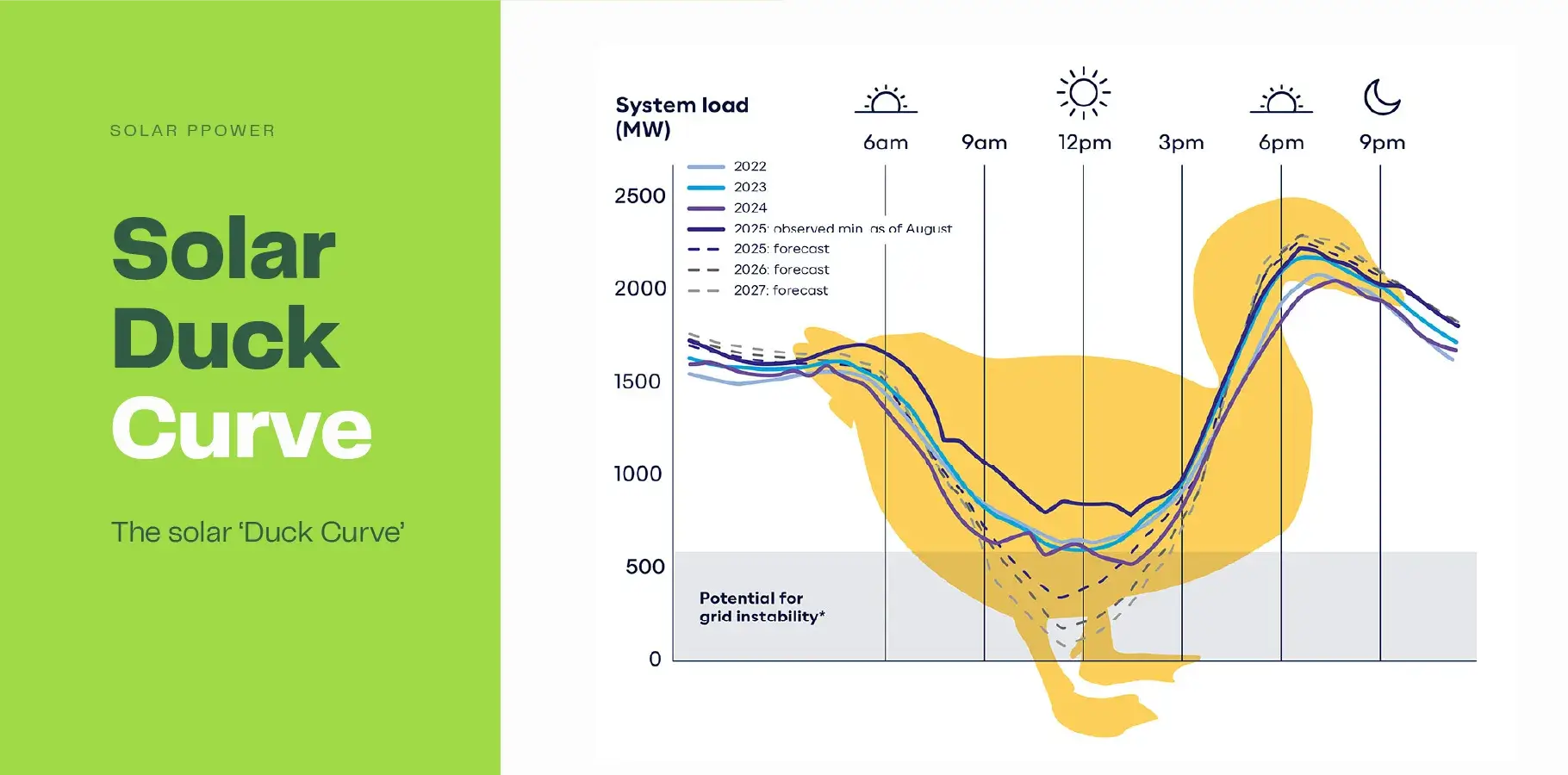
The solar 'Duck Curve' graph showing electricity demand from 2022 to 2027 (forecast) 3
To overcome the problem, the Australian Energy Regulator has approved two-way pricing proposals from various distributors in some states. The charge on solar exports during the middle hours of the day is referred to as the "Sun Tax". The objective of two-way pricing is try and even out the Duck Curve.
Not every state is adopting the Sun Tax, but it's likely that the trend of lower feed-in tariffs during the middle of day will continue
Residents of NSW, SA and south east Queensland can now access three free hours of power from July 1 2026. The initiative is aiming to increase electricity demand during peak sunlight hours to use up all of the excess solar.
The high uptake of solar batteries is also helping to flatten out the Duck Curve.
Why self-consumption is important
With this gradual reduction in feed-in tariff rates, two factors have become increasingly important: battery storage and solar self-consumption.
It is much better to self-consume your solar power rather than export it back to the grid in return for a feed-in tariff. You pay a much higher rate when you buy electricity from the grid than you receive for exporting your clean energy. Therefore, feed-in tariffs play a major role in the economics of determining the suitability of solar power for your home.
Improved battery economics
Lower feed-in rates, together with the battery rebate, have improved the viability of solar batteries. The greater the gap between the feed-in tariff and cost of electricity, the more savings a battery will generate. If you have a low rate of self-consumption, or don’t use much electricity during the day, then a solar battery can help to reduce your bills and make additional savings above those available with just solar panels.
How feed-in tariffs impact savings
The rate to buy electricity from the grid is typically much higher than the feed-in rates for sending excess electricity back into the grid.
Typically, your solar power system will generate more power during the day than you use in your home. Imagine you receive an average feed-in tariff of 8c whilst paying your retailer 30c for every kWh you buy from the grid.
The difference between the two rates is 22c; this is how much you will save if you self-consume your solar power during daylight hours, or store it in a battery.
You can increase your daytime usage by scheduling appliances like dishwashers, washing machines and pool pumps to run during the day.
Next steps
Learn more about the rebates and incentives available in your state to help you make the switch:
References
- Australia electricity residential market share
- IPART paper on value of solar exports, Independent Pricing and Regulatory Tribunal.
- Duck Curve image supplied by Synergy, data sourced from Australian Energy Market Operator (AEMO).
Popular next steps
A complete guide to all solar rebates

How many panels do you need?
Are solar batteries worth it?
Are you ready to compare solar quotes?
Get 3 free quotes and start your solar journey today.
Get free quotes