


Solar panel rebate
in NSW
Last updated: January 2026
Reading time: 6 minutes
Well over 1.1 Million households in NSW have installed solar panels and have taken positive action to reduce their electricity bills and carbon emissions.
There has never been a better time to invest in solar power in New South Wales, with several government rebates on offer to residents for solar panels, batteries and household upgrades.
On this page, we explain how you can claim the solar panel rebate in NSW, how much it will save you and help you discover additional incentives that will reduce your electricity bills.
Solar incentives available in NSW
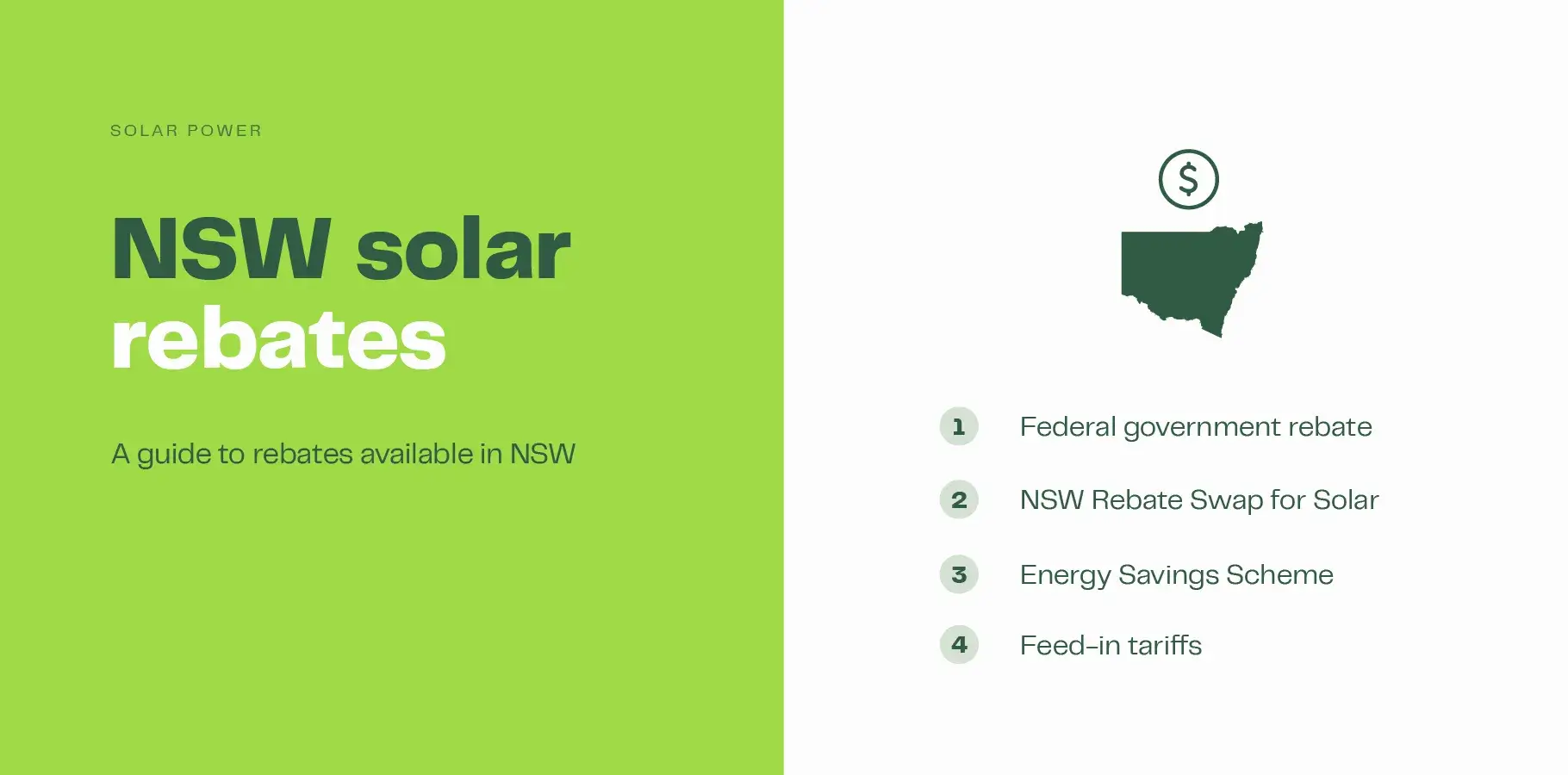
There are four key solar incentives available to all NSW residents:
- 1. The NSW solar panel rebate
- 2. The solar battery rebate for NSW residents
- 3. The NSW VPP battery rebate
- 4. Ongoing incentives in the form of feed-in tariffs
In addition to these solar rebates, there are a number of energy saving offers available with the NSW government for eligible residents, these include:
- NSW Low-income electricity bill rebate
- Local government solar rebates e.g. Randwick Council
- NSW government energy saving upgrades rebates
In this article, we explain each of the rebates available with the NSW government in detail below, starting with the STC panel rebate.
How the solar panel rebate in NSW works
The solar panel rebate available in NSW is the federal government’s Small-scale Renewable Energy Scheme, often referred to as the STC rebate. It reduces the upfront purchase cost of solar panels.
The government rebate varies according to the size of the system you install and your location in New South Wales. It can save you as much as up to 25% off the cost of a new system.
Eligibility criteria for the NSW solar rebate
When you install a new solar panel system in NSW, you qualify for the federal STC rebate provided you meet the following eligibility criteria:
- Your solar panels are installed by a Solar Accreditation Australia (SAA) accredited installer
- Your solar panels appear on the CEC’s approved modules list
These two key criteria are easily met if you select a reputable installer company.
How much the solar panel rebate in NSW will save you
The NSW solar panel rebate can save you between $1,500 - $2,200 off the price of a standard size solar system (6kW - 8kW).
The value of the solar panel rebate varies depending on where you live in NSW and the size of the system you install. The state of NSW is split into zones for the purpose of allowing rebate certificates. The more sunshine hours your zone receives, the more certificates you receive. The greater New South Wales population falls into rebate Zone 2.
The certificates are then traded at market price, typically between $37 - $40 (per certificate), the sum of which makes up your rebate. While this process may seem complicated, it is typically all handled by your installer.
The table below shows the rebate amount you will receive according to the system size you install in Zone 2, assuming a certificate value of $40:
| System size | NSW solar panel rebate |
|---|---|
| 3kW | $800 |
| 5kW | $1,360 |
| 6.6kW | $1,800 |
| 8kW | $2,200 |
| 10kW | $2,760 |
| 13kW | $3,560 |
| 20kW | $5,520 |
Solar rebate for a 6.6kW system in NSW
The solar panel rebate in NSW can reduce the cost of new system by up to 30%. The table below shows the impact the rebate has on the gross cost of the panels:
| Details | $ |
|---|---|
| Gross system cost | $8,554 |
| Solar panel rebate | $2,160 |
| Net system cost | $6,394 |
You can calculate the exact amount of your NSW incentive using our free STC rebate calculator.
Tip: Most advertised and quoted prices for solar panels already factor in the rebate. When you request a quote from an installer, get them to itemise the rebate amount.
The rebate reduces every year
The solar panel rebate in NSW reduces in size every year. By the end of 2030, it will no longer be available. The level of reduction in percentage terms increases with each year.
The table below shows the current rebate value for a 6.6kW system in NSW and in future years until it is fully phased out in 2030:
| Year | Rebate amount |
|---|---|
| 2025 | $2,160 |
| 2026 | $1,800 |
| 2027 | $1,440 |
| 2028 | $1,080 |
| 2029 | $720 |
| 2030 | $360 |
How to claim the NSW solar rebate
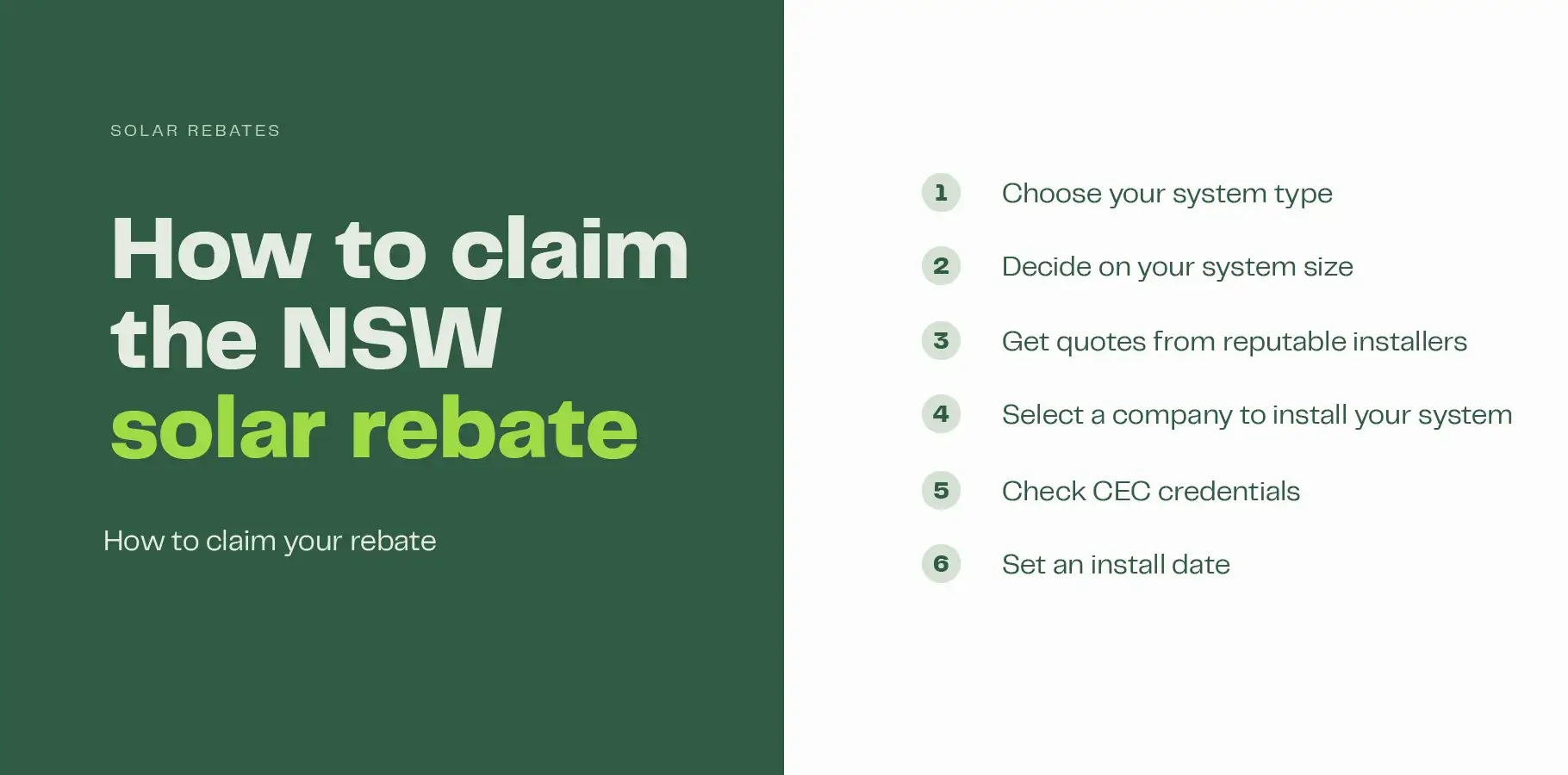
Claiming the STC rebate in NSW is straightforward. All of the paperwork is typically handled by your chosen installer. To ensure you receive the rebate, we recommend following this process:
- 1. Decide on the type of system you want, solar panels or panels and battery
- 2. Get some idea of the size of the system you want
- 3. Request quotes from up to three reputable solar installers
- 4. Select a company to install your system
- 5. Check that the company is SAA accredited and is using approved solar panels
- 6. Set a date for the system install
Once the system is installed, you will have likely paid your installer for the net cost of the system. Your solar company will then handle the rebate claim on your behalf.
Our Solar System Size Calculator can help you determine the right system size for your needs.
Getting quotes
We make accessing the rebate easier by arranging quotes from reputable installers in your location. All of the NSW installers in our network are SAA accredited and use approved solar modules.
Get quotes from installers that will guarantee your rebate
Reduce your electricity bills. Cut your emissions.
NSW government battery rebate
The NSW government wound back its battery rebate as the Australian battery rebate commenced.
The solar battery rebate in NSW only applies to Virtual Power Plant (VPP) connection from July 1 2025. In-effect, the federal battery rebate replaces the NSW battery incentive.
It is possible for NSW residents to claim the solar panel rebate, and the national battery rebate in the one purchase.
NSW Virtual Power Plant (VPP) incentive
A further incentive is provided by the NSW government for connecting a battery (new or existing) to a Virtual Power Plant (VPP). The VPP rebate amount varies according to the battery capacity:
- Up to $550 for a 10 kWh battery
- Up to $1,500 for a 27 kWh battery
To claim the VPP rebate, NSW residents must connect their battery to a Virtual Power Plant. The connection allows the operator of the electricity grid to draw electricity from the battery in times of peak demand.
The VPP is an initiative of the NSW Peak Demand Reduction Scheme to stabilise the grid and even out electricity demand.
NSW feed-in tariffs: Ongoing incentives
The solar-feed-in tariff is another form of incentive available to NSW residents. Unlike in some other states, the NSW government does not regulate the incentive. Instead, the prices are set by electricity retailers.
The feed-in tariff is the name given to the credit you receive when your solar panel system exports excess solar energy back to the grid. If you don’t have a battery to store the excess energy, it’s likely you will export a fair amount back to the grid, so finding the best feed-in tariff in NSW is important to maximising savings from your system.
Feed-in rates typically vary between 4c – 10c in NSW.
You don’t need to apply for the feed-in incentives. They will form part of the agreement you have with your electricity retailer.
Additional energy incentives available in NSW
There are a number of additional energy saving incentives available in NSW, to compliment the solar rebates.
- NSW government energy saving upgrades rebates
- NSW Low-Income electricity bill rebate
- Local government solar rebates e.g. Randwick Council
NSW household energy saving upgrades

As part of a greater drive to reduce energy costs under the Energy Savings Scheme (ESS), the NSW government is offering additional incentives for household upgrades.
The grants available include:
- Lighting upgrades: Replace halogen downlights with LED downlights.
- Air-conditioning upgrades: Switch to a more energy-efficient air conditioning system.
- Hot water system upgrades: Upgrade to a more energy-efficient hot water system.
The amount of each incentive varies according to the size of the appliance. There are also some eligibility requirements that must be met in order to receive the rebates. For more information on these additional incentives, please visit the NSW government’s energy saving upgrades page.
NSW low-income electricity bill rebate
An electricity bill rebate is available to low-income households in NSW up to the value of $313.50 per year.
Eligibility criteria for the electricity bill rebate
To claim the NSW low-income electricity bill rebate, you must meet the following criteria:
- 1. Live in NSW on a property connected to the electricity grid
- 2. Have an electricity account in your name
- 3. Hold a current concession card
The concession cards eligible for the rebate are:
- Health Care Card
- Low-Income Health Card
- Pensioner Concession Card
- Department of Veterans Affairs (DVA) Gold Card
How to claim the NSW electricity rebate
Applying for the Low-Income Rebate is relatively straightforward:
- Contact your electricity retailer
- Provide your Services Australia Customer Reference Number (CRN) or DVA number
The rebate will be credited to your electricity bill. The maximum you can receive per financial year is $285. You can view the full details of the subsidy here.
Local NSW government rebates
In addition to the federal STC rebate and the NSW solar battery incentives, it may be possible to access a rebate with your local council.
Randwick City Council sustainability rebates
The Randwick City Council is offering a suite of rebates for sustainability upgrades to its residents. The initiatives seek to build on the 18% of households that currently have solar in the area. We’ve summarised the list of solar rebates available with the Randwick Council below:
- Solar panels – 10% rebate up to $500
- Solar battery – 10% rebate up to $1,000
- Solar health check – 50% rebate up to $100
The rebates further drive down the cost of solar panel prices in Sydney.
Former NSW government incentives
While the NSW government has been proactive by offering a range of incentives and grants for solar and energy upgrades, many programs have either ceased or changed.
We have provided a quick summary of former programs that are no longer available.
Rebate Swap for Solar incentive
The NSW government’s Rebate Swap for Solar initiative has now closed. The incentive was available to low-income households and allowed them to effectively install a 3kW system for free.
The program ceased in June 2024.
The $7,000 solar rebate NSW
In 2019, the NSW government created a new rebate to encourage the uptake of solar panels in the state. Under the program, eligible residents could apply for a $7,000 rebate on the installation of a new solar system.
The incentive was only available to households from selected postcodes whose electricity consumption was over 3,000 kWh per year.
Initially, the NSW government set aside a $15 Million budget for the program. The subsidy proved so popular that they extended the offer. The NSW $7,000 solar rebate ended in 2024 and is no longer available.
NSW government Empowering Homes Program
The NSW government also created a scheme to provide interest-free loans for new solar batteries and new panel and battery systems. The loans ranged between $9,000 - $14,000 to households that met the eligibility criteria.
The interest-free loan program with NSW government has now closed.
The NSW EV Ready Building Grant
The NSW government’s rebate for EV ready buildings has now ceased. Under the scheme, eligible buildings were able to apply for funding of up to $80,000 to install EV charging infrastructure to enable apartment residents to easily install an EV charger.
Popular next steps
Calculate your solar savings

Should you get a battery?
The best solar panels
Are you ready to compare solar quotes?
Get 3 free quotes and start your solar journey today.
Get free quotes