

- Blog
- Solar Power
- Seasonal Solar Production Australia
Seasonal solar production in Australia: Summer vs winter performance
- Solar Power
- 5 min read
Solar panels help to lower power bills by generating electricity for use in the home or business. Solar production correlates strongly with sunlight hours.
But what happens in the cooler months when the days are a little shorter, colder, and the sunlight isn’t ever-present?
There is a common belief that solar panels don’t work in winter. And while it’s fair to say that solar production tends to dip through the cooler months, panels still generate a decent amount of electricity.
Understanding the difference between summer and winter performance of solar panels is useful when determining how many panels to install. Find out how seasonal changes affect solar production and what to expect from your solar system during the cooler months in Australia.
Do solar panels produce less energy in winter?
Solar panels in Australia produce on average 27 – 56% less electricity during winter compared to the annual average output.
In Australia, location has a huge impact on the winter performance of solar panels. Darwin for example, only suffers a 1% decrease in solar production during winter months compared to its average. Hobart though, suffers a 56% decrease. On the whole, solar panels produce less energy in winter throughout Australia.
The table below shows the decrease in winter solar production for an 8kW system from the annual average for major Australian cities:
| City | Annual daily (kWh) | Winter daily (kWh) | Winter decrease |
|---|---|---|---|
| Adelaide | 34.26 | 17.80 | 48% |
| Brisbane | 35.02 | 25.55 | 27% |
| Cairns | 35.22 | 29.74 | 16% |
| Canberra | 34.47 | 19.33 | 44% |
| Darwin | 36.87 | 36.46 | 1% |
| Hobart | 28.53 | 12.49 | 56% |
| Melbourne | 30.59 | 15.29 | 50% |
| Perth | 37.25 | 20.81 | 44% |
| Sydney | 32.36 | 20.59 | 36% |
It is a common misconception that cooler weather leads to lower solar energy production. While it is true that seasonal changes affect electricity production, it isn’t the lower temperatures that cause winter output to drop.
Solar panels turn sunlight into electricity – not heat. Even when the days are cooler, solar panels can still produce electricity so long as they are getting enough direct sunlight.
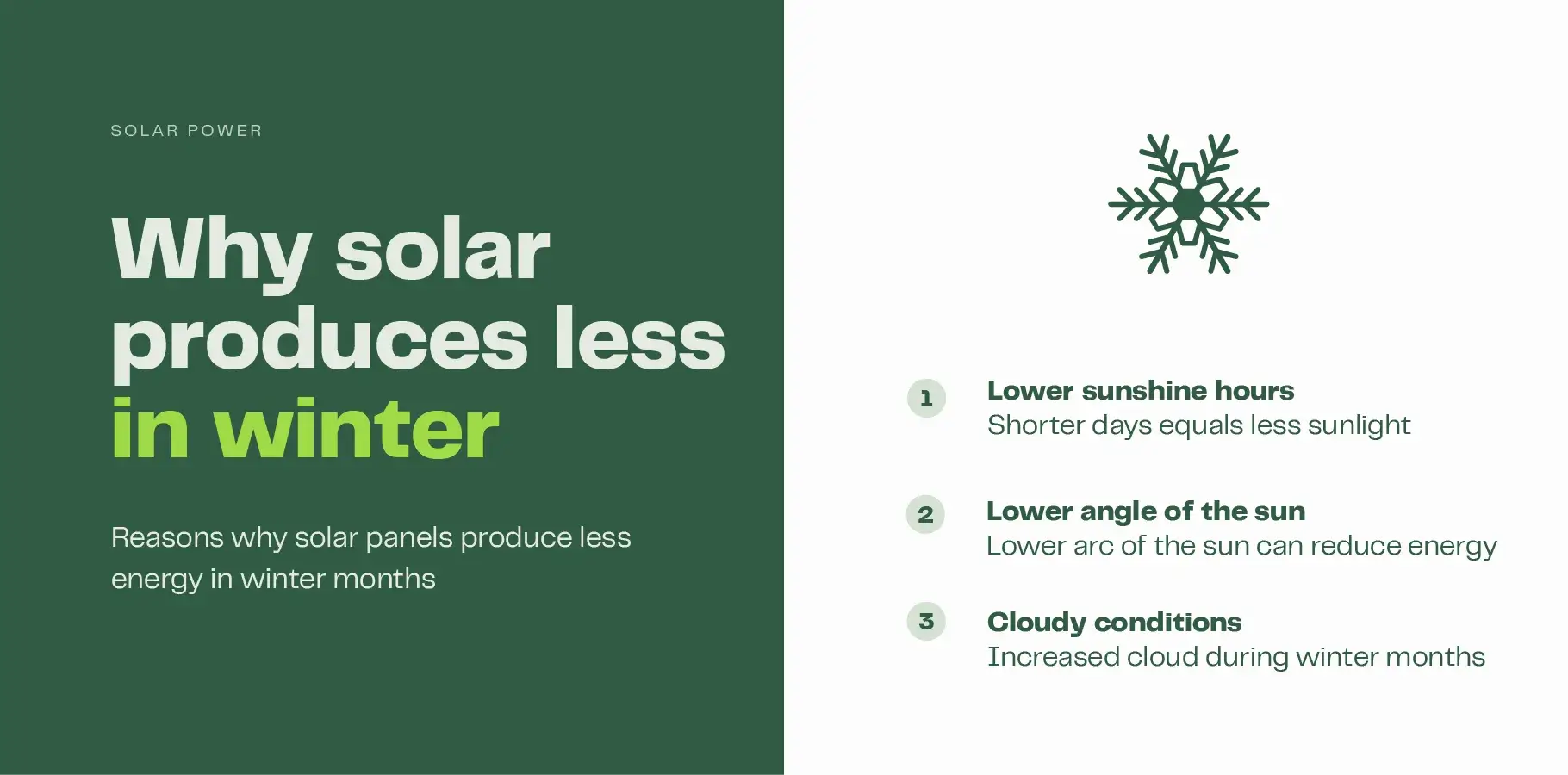
Solar panels produce less energy in winter due to a number of factors – not just the amount of sunlight.
Reasons why solar panels produce less energy in winter
There are several reasons why solar panels don’t perform as well during the winter months.
1. Shorter days equals less sunlight hours
Australia experiences less sunshine in winter due to the lower number of daylight hours as compared to summer. The table below shows the daylight hours for each major city in Australia at both the summer and winter solstices. The decrease in winter daylight hours varies between 11% – 41%.
The table below shows the daylight hours for the summer and winter solstice in major Australian cities:
| City | Summer solstice | Winter solstice | Winter decrease |
|---|---|---|---|
| Adelaide | 14:31 | 9:48 | 32% |
| Brisbane | 13:53 | 10:24 | 25% |
| Cairns | 13:09 | 11:07 | 15% |
| Canberra | 14:33 | 9:47 | 33% |
| Darwin | 12:51 | 11:24 | 11% |
| Hobart | 15:21 | 9:01 | 41% |
| Melbourne | 14:58 | 9:33 | 36% |
| Perth | 14:15 | 10:04 | 29% |
| Sydney | 14:24 | 9:54 | 31% |
Daylight hours are only a guide, solar output generated by solar panels is calculated using the mean daily solar exposure figures per location. But, the shorter winter days impact solar production, as solar panels do not generate electricity at night.
2. Lower sun angle
The lower arc of the winter sun can cause a decrease in solar production in winter months. However, it all depends on the angle of your rooftop and how it relates to the angle of the sun. Steep roofs can be an advantage in Melbourne and Hobart during the winter months as the panel angle is more perpendicular to the angle of the sun.
3. Cloudy conditions
Australia typically experiences increased cloud cover during the winter season. Solar panels still work on cloudy days though production decreases as there is less direct exposure to sunlight.
Solar production – summer vs winter comparison
On average, solar panels produce between 41% to 73% less energy in winter than in summer across Australia.
Summer is the highest producing season for solar production in Australia, while winter is the lowest. The outlier in these figures is Darwin, which actually performs better in winter than it does in Summer! Cairns, in tropical north Queensland, performs very well in winter in comparison to its cities much further south of it – there is far less discrepancy between summer and winter solar output.
The table below shows the average daily solar production in summer vs winter for 8kW solar systems in major Australia cities:
| City | Summer daily (kWh) | Winter daily (kWh) | Winter decrease |
|---|---|---|---|
| Adelaide | 51.75 | 17.80 | 66% |
| Brisbane | 43.12 | 25.55 | 41% |
| Cairns | 38.18 | 29.74 | 22% |
| Canberra | 49.31 | 19.33 | 61% |
| Darwin | 33.52 | 36.46 | -9% |
| Hobart | 45.99 | 12.49 | 73% |
| Melbourne | 47.37 | 15.29 | 68% |
| Perth | 54.84 | 20.81 | 62% |
| Sydney | 43.56 | 20.59 | 53% |
Cities which experience a greater difference in daylight hours between summer and winter seasons have a larger decrease in winter performance. Solar panels in Hobart produce nearly four times as much solar in summer as compared to winter. Solar production in Brisbane, where winters are milder, suffers a 41% decrease.
Seasonal solar panel efficiency comparison between major Australian cities
The table below shows the average daily solar output for an 8kW system across all four seasons in major Australian cities:
| City | Summer (kWh) | Autumn (kWh) | Winter (kWh) | Spring (kWh) |
|---|---|---|---|---|
| Adelaide | 51.75 | 27.62 | 17.80 | 39.88 |
| Brisbane | 43.12 | 30.69 | 25.55 | 40.73 |
| Cairns | 38.18 | 31.88 | 29.74 | 41.09 |
| Canberra | 49.31 | 28.39 | 19.33 | 40.85 |
| Darwin | 33.52 | 36.69 | 36.46 | 40.79 |
| Hobart | 45.99 | 20.59 | 12.49 | 35.03 |
| Melbourne | 47.37 | 23.99 | 15.29 | 35.71 |
| Perth | 54.84 | 30.54 | 20.81 | 42.79 |
| Sydney | 43.56 | 26.98 | 20.59 | 38.29 |
Note: Production will vary according to site specific conditions.
Winter performance impacts electricity generation
The impact of the lower-performing winter months isn’t just experienced at household level, the impact is evident in Australia’s electricity generation figures. Solar power now accounts for 18.1% of all electricity generation in Australia.
In AEMO’s (Australian Energy Market Operator) last quarterly update of the National Electricity Market (NEM), the longer spring and summer sunshine hours brought solar generation up to 28.8% as opposed to the 16.9% reported during Quarter 2 of 2025.
| Solar energy source | Q2 2025 | Q4 2025 |
|---|---|---|
| Distributed PV | 9.5% | 18% |
| Grid solar | 6.7% | 10% |
| Battery | 0.7% | 1% |
| Total | 16.9% | 28.8% |
* Figures only represent the NEM area, not the whole of Australia
Which month is best for solar panels in Australia?
While there is no “best” month for solar panel production in Australia, it is accurate to say that most solar panels will typically reach peak efficiency during the summer months of December, January, and February, with the exception of Darwin, NT.
Australia’s summer weather can be inherently unpredictable. Some years, summer can be an unbroken boulevard of sunshine with 100% solar efficiency. Other years, the weather can be marred by persistent storm and cloud cover – both factors which can significantly reduce solar panel efficiency on a year-to-year basis.
The figures used in this article are all average figures using Bureau of Meteorology data collected over a number of years.
How to maximise solar panel performance during winter
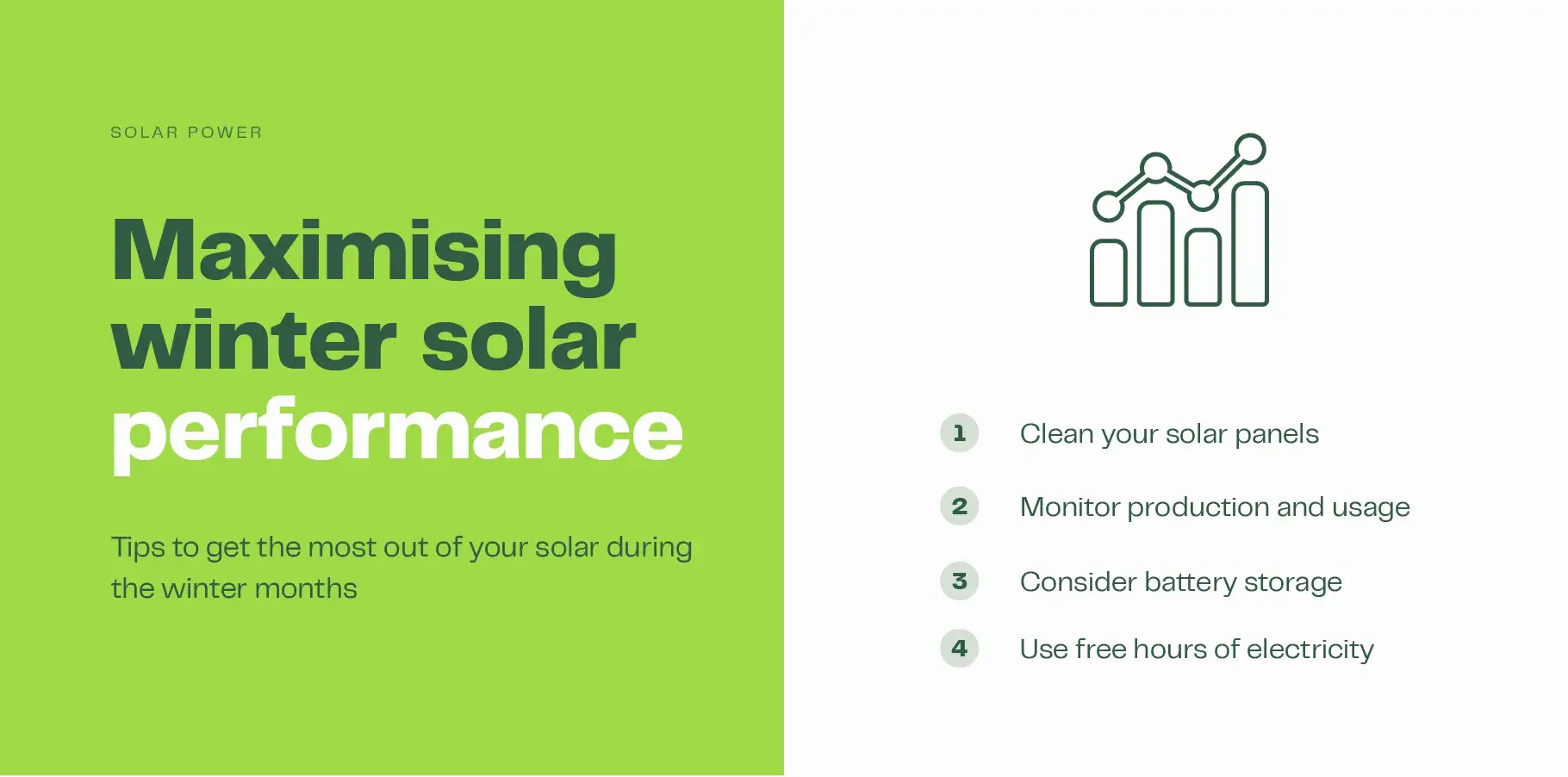
Solar panels produce less energy during the winter months when days are shorter and there is less available sunlight. While you can’t change the weather, there are a number of things that you can do to ensure you’re getting the most out of your solar system on those days with reduced sunlight, including:
1. Clean your solar panels
Keeping your solar panels clean and clear of debris is one of the easiest ways to maintain your solar panels and ensure you’re getting the most out of your system through the cooler months. Boosting solar performance in winter is important for maximising savings, you can regularly inspect and clean solar panels to ensure they are free of dirt and debris.
2. Monitor production & usage
Stay on top of your solar production and usage through the winter season to ensure you’re making the most of the (reduced) energy production. Monitoring production and consumption becomes a lot easier once you have a year-on-year comparison to fall back on.
3. Consider battery storage
Adding a battery to your solar setup allows you to make the most of your excess solar energy when you need it most. Solar batteries are now more accessible than ever before thanks to advancing technology, competition in the market, and Australia’s generous federal solar battery rebate which is set to continue through to the end of 2030.
4. Use free hours of electricity
Taking advantage of free electricity periods during the winter months can lead to some big savings on your electricity bills. By shifting electricity use to the middle hours of the day when electricity is set to be free in NSW, SA and south east QLD, you can instead store the solar that you generate during this period in a battery.
 written byBy Michael Henderson