


Tesla Powerwall 3
buying guide
A Tesla Powerwall 3 buying guide.
The Tesla Powerwall 3 is available for install in Australia and is the long-awaited successor to the popular Powerwall 2 battery.
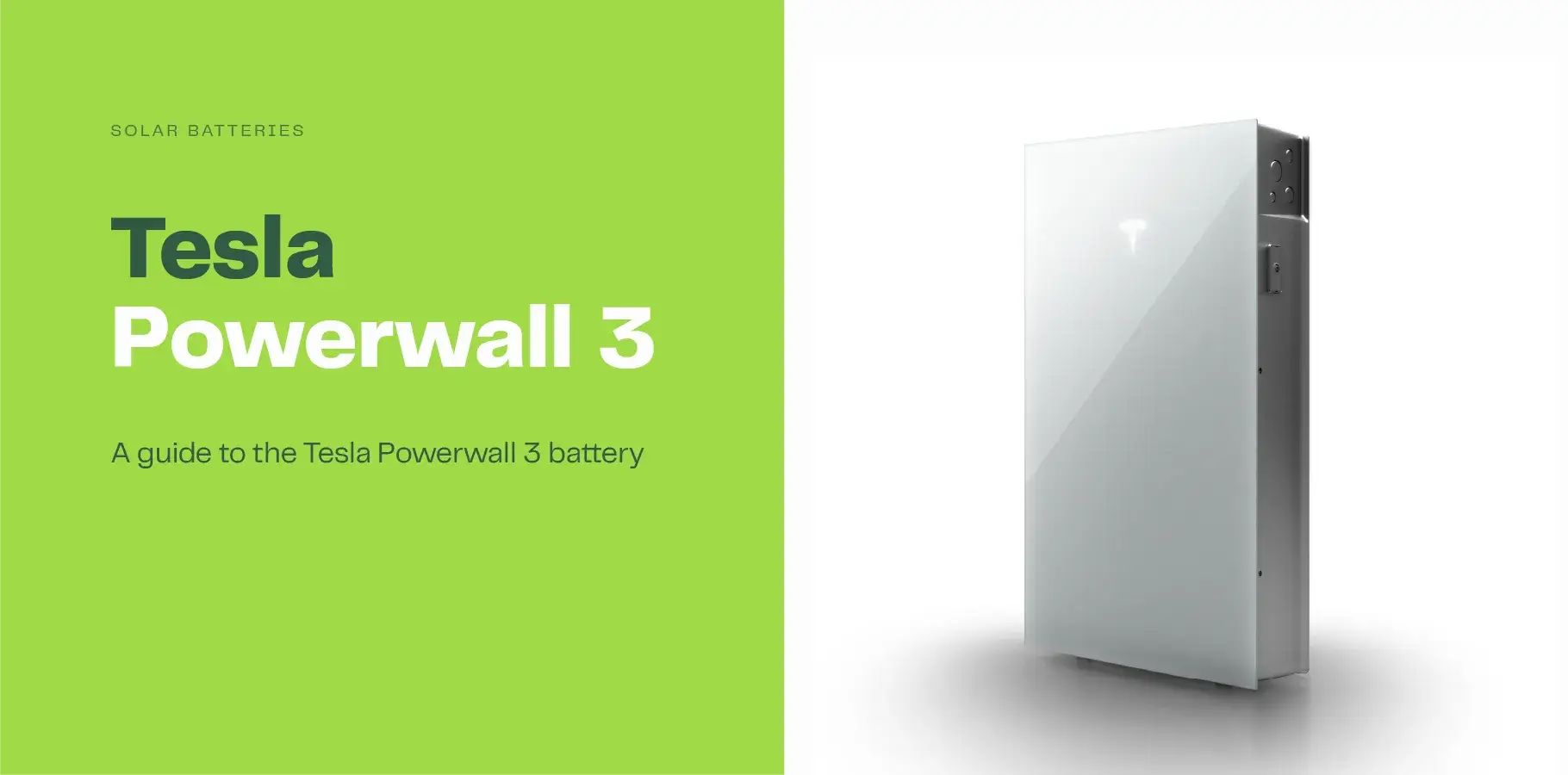
Tesla boasts its Powerwall home batteries have surpassed 1 Million installs worldwide, with an estimated 100,000 of these in Australia.
While the Powerwall 3 offers significant improvements in power output, it’s the addition of an integrated solar inverter that sets it apart from its predecessor. The in-built inverter eliminates the need to buy a separate inverter, therefore effectively reducing the installation price of the Powerwall battery when adding a battery to an existing system.
The Powerwall 3 checks plenty of boxes for potential buyers – but is it the right battery for you? To help you decide if the Powerwall 3 is the best battery for your home, we’ve compiled a list of its features, expected installation price and its eligibility for claiming battery rebates.
Powerwall 3 features
The Powerwall 3 is an integrated solar and battery system intended to meet the usage requirements of most residential customers in Australia.

The Tesla Powerwall 3 features many benefits that make it appealing for Australian homeowners, these include:
- All-in-one unit with in-built inverter
- Ability to provide backup power
- Can use Storm Watch to charge battery during severe weather
- Can provide up to 11.04 kW of continuous power
- Can be expandable to provide up to 40.5 kWh of storage
- Can be combined with up to 20kW of solar panels
- Uses safer LFP cells
- 10-year warranty
At a glance, the Powerwall 3 would seem to be a direct replacement for the Powerwall 2, however, the addition of an integrated solar inverter means that the Powerwall 3 can now function as a standalone battery and inverter. For existing solar panel owners, this makes the Powerwall 3 a compelling option as most other batteries require the addition of a hybrid inverter at extra cost.
The Tesla Powerwall 3 delivers more than twice the continuous power output than the Powerwall 2. The Powerwall 3 provides 11.04 kW Continuous Power Output (AC) and 11.04 kW Peak Power Output – up from 5 kW and 7 kW respectively in the Powerwall 2.
The Powerwall 3 can also handle up to 20kW of solar DC input and be combined with two additional Powerwall 3’s to create 40.5 kWh of storage. Note: The Powerwall 3 can now be added to a system that has a Powerwall 2 battery thanks to a recent software update from Tesla.
Most solar batteries are warranted to last 10 years but are expected to perform beyond this period. In line with industry expectations, Tesla provides a 10-year warranty on the battery.
Tesla Powerwall 3 price
The federal government solar battery rebate has dramatically reduced the price of new home batteries. The average price for the supply and installation of the Tesla Powerwall 3 is now between $12,500 - $14,500. Unlike other batteries, the Powerwall 3 price doesn’t vary if you install it with solar panels vs adding it to your existing system.
| Battery | Capacity (Size) | Average price (installed) | Cost per kWh |
|---|---|---|---|
| Powerwall 3 | 13.5 kWh | $13,643 | $1,011 |
The cost to install a Powerwall 3 is estimated at $1,011 per kWh, marginally above the average battery price range of $800 - $1,000 per kWh.
The table below shows the average price of a Powerwall 3 battery with different install options:
| Battery capacity (Size) | Battery price | Total system cost |
|---|---|---|
| 13.5 kWh | $13,643 | $18,523 |
| Battery capacity (Size) | Battery price | Total system cost |
|---|---|---|
| 13.5 kWh | $13,643 | $19,533 |
| Battery capacity (Size) | Battery price | Total system cost |
|---|---|---|
| 13.5 kWh | $13,643 | $20,823 |
| Battery capacity (Size) | Battery price | Total system cost |
|---|---|---|
| 13.5 kWh | $13,643 | $22,663 |
| Battery capacity (Size) | Battery price | Total system cost |
|---|---|---|
| 13.5 kWh | $13,643 | $25,233 |
| Battery capacity (Size) | Battery price | Total system cost |
|---|---|---|
| 13.5 kWh | $13,643 | $13,643 |
The prices in the table above reflect the Australian average. Pricing will vary based on your individual circumstances including: location and ease of install.
Powerwall 3 price breakdown pre-installation
Australian pricing for the Tesla Powerwall 3 unit starts at $11,200 which includes the 13.5 kWh battery and integrated inverter. This price does not include the compulsory Tesla Backup Gateway unit which costs an additional $1,950, nor the cost of installation.
- Powerwall cost: $11,200
- Battery rebate: ($3,367)
- Gateway cost: $1,950
- Installation cost: $3,860
- Total price: $13,643*
* Price represents the estimated cost to install the battery with associated costs and fees. When comparing pricing, it’s important to review what is included.
Tesla Powerwall 3 rebates
The Telsa Powerwall 3 is among the Clean Energy Council’s list of approved batteries and is eligible for installation under the national Cheaper Home Batteries scheme. It comes with Virtual Power Plant (VPP) compatibility, a key requirement of the federal scheme.
Federal rebate reduces the Powerwall 3 cost
As of May 2026, the Australian government battery rebate reduces the cost of a single Powerwall 3 unit by around $3,367.
The federal rebate is tiered, the first 14 kWh of useful capacity receives the full amount. Installations between 14 kWh - 28 kWh will receive 60% of the rebate amount. For customers buying an expansion pack with a second Powerwall 3, they will receive a tiered rebate worth $5,476.
The rebate amount is set to decrease in January 2027 and every 6 months thereafter.
State rebates
New South Wales residents that connect their Tesla battery to a Virtual Power Plant (VPP) can apply for the NSW VPP rebate and receive up to $550 off the upfront cost of the Tesla Powerwall 3. The installation of two Powerwall 3's can qualify for an incentive worth up to $1,500.
The Powerwall 3 is also eligible for the WA battery rebate. The WA incentive can be combined with the federal rebate to save an extra $1,300 (Synergy customers) or, $3,800 (Horizon customers) off the install cost of a new Tesla.
Residents of the ACT can apply for a low-interest loan (3%) up to $15,000 to help pay for the Powerwall 3.
Tesla Powerwall 3 rebate
In late 2025, Tesla launched its own rebate to celebrate 1 Million installations worldwide. The Tesla rebate is expected to end 30th June 2026.
The Tesla rebate is worth up to $1,500 or, $750 per Powerwall 3 unit.
Powerwall 3 rebate details
The Tesla Powerwall 3 rebate works as follows:
- You must order the Powerwall before 30th June 2026
- The battery must be installed before 31st December 2026
- The reward is applied to a Visa Rewards Card
- Rebate is worth $750 per Powerwall up to $1,500
For full details, visit the Tesla website.
Tesla Powerwall 3 specifications
The specifications of the Tesla Powerwall 3 battery are published below:
- Release date: August 16, 2024 (Australia)
- Type: All-in-one solar and battery system (DC-coupled)
- Capacity: 13.5 kWh usable energy storage
- Continuous power output: Up to 11.04 kW AC per unit
- Weight: ~132 kg
- Warranty: 10-year limited warranty
- Compatibility: Compatible with new and existing solar systems and can now be added to a Tesla Powerwall 2 battery via a software update.
- VPP capability: The Powerwall 3 unit can be connected to a Virtual Power Plant (VPP).
- Round trip efficiency: 97.5%
- Solar input: Up to 20 kW DC of solar input
- Price: From $11,900. This price does not include the required Tesla Gateway unit
Powerwall 3 dimensions
The Tesla Powerwall 3 is 1.05m tall x 60.9cm wide with a depth of 19.3 cm. The Powerwall 3 unit weighs 124kg, but when installed with the glass protector sheet and wall brackets it weighs a total of 132kg.
| Dimension | Measurement |
|---|---|
| Height | 1105mm |
| Width | 609mm |
| Depth | 193mm |
| Weight (battery only) | 124kg |
| Weight (installed) | 132kg |
Powerwall 3 capacity

With a storage capacity of 13.5 kWh, the Powerwall 3 can typically store enough energy to power the average Australian home’s night time electricity needs. It can be a suitable battery solution for 5kW, 6.6kW, 8kW and 10kW systems.
Additional Powerwall 3 units can be combined to generate even more storage capacity, up to a maximum of 40.5 kWh (3 units in total). The maximum solar panel system it can be paired with is a 20kW system.
Powerwall 2 vs. 3 – side by side comparison
Our Tesla Powerwall 2 vs 3 – Side by side comparison article can provide you with a full breakdown of the key differences between the Powerwall 2 and 3 units. At a glance, here are the key differences between the units.
| Feature | Tesla Powerwall 2 | Tesla Powerwall 3 |
|---|---|---|
| Battery type: | Lithium-ion | LFP (Lithium Iron Phosphate) |
| Dimensions (mm): | 1150 x 753 x 147 mm | 1105 x 609 x 193 mm |
| Weight: | 114 kg | 124 kg |
| Total capacity: | 13.5 kWh | 13.5 kWh |
| Continuous output: | 5 kW | 11.5 kW |
| Scalable: | Supports up to 10 units in parallel | Supports up to 3 units in parallel |
| Blackout protection: | Yes | Yes |
| Depth of discharge: | Maximum 100% DOD (adjustable) | Maximum 100% DOD (adjustable) |
| Warranty: | 10-year warranty | 10-year warranty |
| Maximum solar input: | 0 kW | 20 kW |
| Integrated inverter: | No | Yes |
In a side-by-side comparison, the Tesla Powerwall 3 is the clear winner in almost all aspects bar one - modularity. Whereas Powerwall 3 allows for 3 batteries to be installed for a total energy storage capacity of 40.5 kWh, the Powerwall 2 allows for up to 10 batteries to be installed for a total (usable) storage capacity of 135 kWh.
When we consider the average Australian household uses around 15.3 kWh of electricity per day, it’s fair to say that the potential 135 kWh storage capacity offered by the Powerwall 2 will appeal to a very small portion of the market.
For buyers tossing up between the Powerwall 2 and Powerwall 3 – the decision is likely to come down to one key factor – whether you need an integrated inverter. The Powerwall 3 comes with a built-in solar inverter, allowing for direct solar integration, while the Powerwall 2 requires a separate inverter, making it better suited for homes that already have an existing solar setup.
Powerwall 3 and Powerwall 2 compatibility
The Tesla Powerwall 3 is now able to be added to an existing system which has a Powerwall 2 battery through the latest software update. The Powerwall must have software version 26.26 or later.
System can now be configured to support up to four Powerwall 2 batteries, a Powerwall 3 battery and up to three Powerwall 3 expansions packs. This means up to 54 kWh of storage can be added to an existing Powerwall 2 system.
The Powerwall 2 battery will keep its existing warranty, while the Powerwall 3 unit will come with its own new 10-year warranty.
Should you consider the Tesla Powerwall 3?
Specs, pricing, and Powerwall 2 comparisons to one side – is the Tesla Powerwall 3 worth buying?
Well, just like most things solar – it depends on your circumstances and your needs. The circumstances are different depending on:
- Is buying a battery purely a financial decision?
- Do you need backup power?
- Do you already own solar panels?
Purely a financial decision
If your motivations for installing a solar battery are purely financial, then the new rebate will be music to your ears. Payback periods have dropped considerably and now average between 5.8 to 9.6 years in Australia. These shorter paybacks make the financial case for installing a Powerwall 3 more compelling than ever.
If you are considering a new panel and battery system, you can use our solar panel and battery calculator to weigh up the financial return.
If you are adding a Tesla Powerwall to an existing solar panel system, try our solar battery calculator.
Interested in backup power
If providing backup power during a blackout is your prime motivation for installing a battery, then the Tesla Powerwall 3 is one of the best options available in Australia. The battery can be configured to provide full or partial backup of your home’s circuits.
Already own solar panels
If you are an existing solar panel owner, then the Powerwall 3 is one of the more appealing battery options because it comes with a built-in inverter, meaning you don’t need to buy a separate hybrid inverter. Our analysis of solar battery prices shows that the Powerwall 3 is competitive with many leading brands.
Our verdict
The Tesla Powerwall 3 is a high-quality, versatile home battery. It is a great value unit that can provide backup power and is one of the best batteries available in Australia. Although, there are many good alternatives to the Powerwall 3 available in Australia.
For existing solar panel owners, the Powerwall 3 is an even more compelling option.
However, it may not be a good battery option, if:
- You have 3 phase power
- You have a complex roof layout
- You want to add more storage in smaller increments
Are you ready to compare solar quotes?
Get 3 free quotes and start your solar journey today.
Get free quotes