


Federal government solar panel rebate 2026
Last updated: July 2026
Reading time: 7 minutes
The Australian federal government solar panel rebate was introduced in 2011 to boost the uptake of solar energy. The scheme continues to deliver savings to households and businesses, now over 4.4 Million Australian households have solar panels on their rooftops.
The national solar panel rebate is still available up until its slated end date at the end of 2030.
Provided you meet the eligibility requirements, any new purchase of solar panels can receive the rebate. For a typical 6.6kW system, the rebate can reduce the price of going solar by between $1,500 - $2,000. While larger systems attract a bigger rebate.
In addition to the solar panel rebate, the Australian government provides a solar battery rebate that can reduce the cost of a 13.5 kWh home battery by around $3,367. It is possible to claim both the national solar panel and battery rebates in one installation.
The savings don't end with these two federal incentives, there are also a number of state government subsidies available for solar panels, batteries and energy upgrades. We summarise all of this information for you, explain how the solar panel rebate works and tell you how you can claim it.
If you want to find out exactly how you can receive in your postcode, you can jump to our STC rebate calculator.
How the solar rebate works
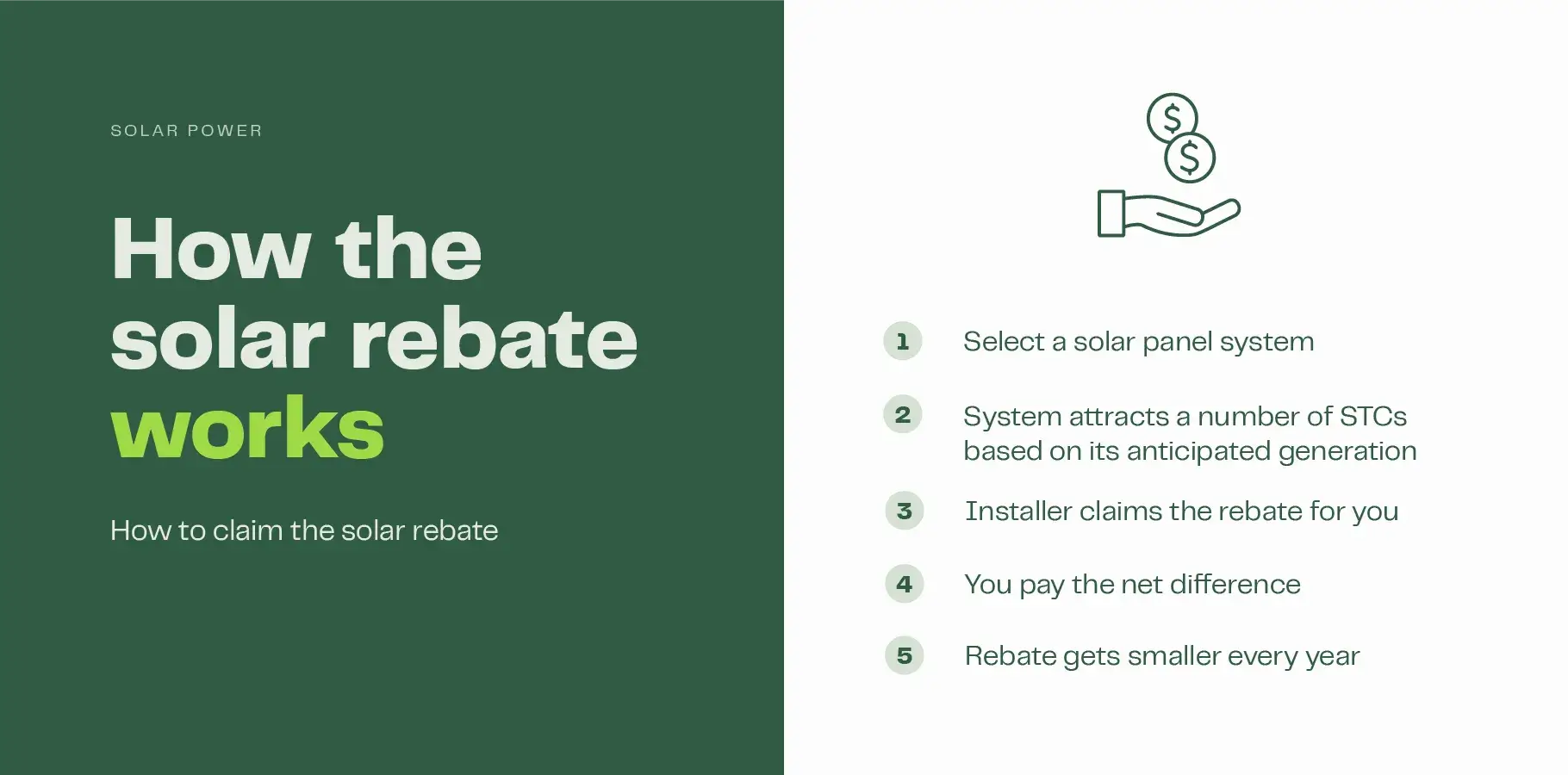
The national solar panel rebate is part of the federal government’s Small-scale Renewable Energy Scheme. It is an incentive program to reduce the upfront cost of solar panels.
Technically, it is not a rebate! When you purchase new solar panels, the government estimates how much solar electricity your system will generate. It issues you with Small-scale Technology Certificates (STCs) based on the anticipated energy production of the system up until 2030.
The size of your system and your location, are critical to working out how many STCs you qualify for. Areas of Australia that receive more sunshine hours, qualify for more STCs. For this purpose, the Australian continent is split into four rebate zones.
Queensland benefits from more sunshine hours than Victoria, and so they receive more STCs for the same size system, and get a larger rebate.
STCs are traded
The Australian government doesn’t buy your STCs, instead they are traded on an open market. The STC price for each certificate is relatively stable, typically varying anywhere between $37 - $40. The solar panel rebate is then calculated by multiplying the number of STCs by the market price.
Installers handle the STC rebate for you
As a new solar owner, you don’t need to worry about trading certificates or any paperwork. Your installer company will handle the solar panel rebate for you. It is automatically taken off the purchase price of the system, you pay the installer the net price and they then sell the certificates and claim the rebate.
The rebate ends in 2030
The solar panel rebate ends on the 31st December 2030. Each year, the value of the rebate decreases. To ensure you get the highest rebate, it's best to purchase a new solar system before the end of the calendar year, if possible.
Annual reduction in the solar rebate
At the time of writing, there are just under four and a half years left before the scheme closes. If you plan to install solar panels in Brisbane for example, waiting one more year will reduce the rebate by $360 for a 6.6kW system.
Feed-in tariffs are not part of the rebate
A solar feed-in tariff, is a different form of incentive and is not part of the solar panel rebate. Feed-in tariffs are a financial credit you receive for each unit (kWh) of electricity your system generates and sends back to the grid.
Feed-in rates vary by state. Some state governments regulate them, while others don’t. If they are not regulated, the rate is set by your electricity retailer.
The value of the solar panel rebate
The solar rebate value varies according to your location, the size of the system you install and the current STC price. The table below provides a quick guide to the average rebate value for different system sizes in each state:
| System size | Average rebate |
|---|---|
| 3kW | $800 |
| 5kW | $1,360 |
| 6.6kW | $1,800 |
| 8kW | $2,200 |
| 10kW | $2,760 |
| 13kW | $3,560 |
| 20kW | $5,520 |
| System size | Average rebate |
|---|---|
| 3kW | $680 |
| 5kW | $1,160 |
| 6.6kW | $1,560 |
| 8kW | $1,880 |
| 10kW | $2,360 |
| 13kW | $3,080 |
| 20kW | $4,720 |
| System size | Average rebate |
|---|---|
| 3kW | $800 |
| 5kW | $1,360 |
| 6.6kW | $1,800 |
| 8kW | $2,200 |
| 10kW | $2,760 |
| 13kW | $3,560 |
| 20kW | $5,520 |
| System size | Average rebate |
|---|---|
| 3kW | $800 |
| 5kW | $1,360 |
| 6.6kW | $1,800 |
| 8kW | $2,200 |
| 10kW | $2,760 |
| 13kW | $3,560 |
| 20kW | $5,520 |
| System size | Average rebate |
|---|---|
| 3kW | $800 |
| 5kW | $1,360 |
| 6.6kW | $1,800 |
| 8kW | $2,200 |
| 10kW | $2,760 |
| 13kW | $3,560 |
| 20kW | $5,520 |
| System size | Average rebate |
|---|---|
| 3kW | $800 |
| 5kW | $1,360 |
| 6.6kW | $1,800 |
| 8kW | $2,200 |
| 10kW | $2,760 |
| 13kW | $3,560 |
| 20kW | $5,520 |
| System size | Average rebate |
|---|---|
| 3kW | $680 |
| 5kW | $1,160 |
| 6.6kW | $1,560 |
| 8kW | $1,880 |
| 10kW | $2,360 |
| 13kW | $3,080 |
| 20kW | $4,720 |
| System size | Average rebate |
|---|---|
| 3kW | $920 |
| 5kW | $1,520 |
| 6.6kW | $2,000 |
| 8kW | $2,440 |
| 10kW | $3,040 |
| 13kW | $3,960 |
| 20kW | $6,120 |
*Assumes a $40 STC price
Solar rebate eligibility requirements
Claiming the solar panel rebate is relatively simple, but there is some important eligibility criteria that needs to be met. We list the eligibility requirements for the rebate below:
- The system must be under 100kW
- The system needs to be designed by a Solar Accreditation Australia (SAA) accredited designer
- The system needs to be installed by a SAA accredited installer
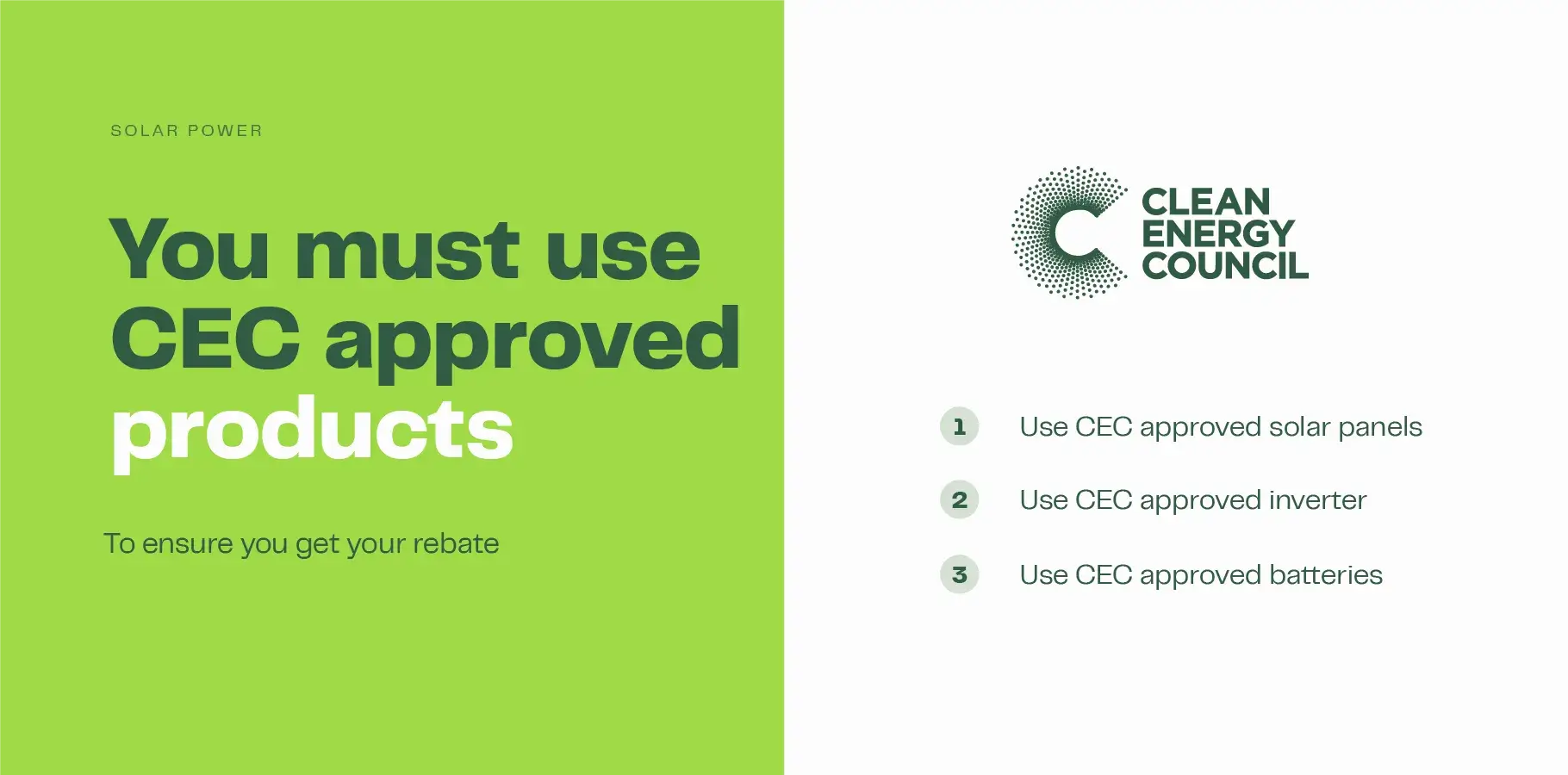
- The panels appear on the Clean Energy Council’s (CEC) list of approved modules
- The inverter must appear on the CEC’s list of approved inverters
- The STCs must be claimed within 12 months of the date of installation
- The system must meet Australian and New Zealand standards
- The system must comply with all local, state and federal requirements
All of the above eligibility requirements can be met with little hassle, if you choose a good installer. The solar companies that we arrange to provide quotes to customers are all pre-vetted and comply with all of the above criteria.
How to claim the rebate
If you engage a good installer, they can help answer your questions and ensure you meet the eligibility requirements.
Start by getting a rough idea of the type and size of system you want, then get some quotes from different solar companies.
Once you select an installer and decide on a system, you will pay them the net cost of the system and they will handle the claim process for you.
Solar battery rebate
The federal government battery rebate is available in addition to the incentive on solar panels. The solar battery rebate works slightly differently:
- There is no zoning based on sunshine hours
- It is tiered based on the usable battery capacity
- It reduces in value more frequently
The battery rebate is rounded down to the nearest whole STC number. Therefore, the per kWh value of the rebate varies slightly with different battery sizes.
Administrative costs typically bring down the average STC price to around $37.
Battery rebate value
The table below shows how the federal battery rebate amount changes based on the per kWh usable capacity of the unit:
| Battery usable capacity (kWh) | Approximate rebate per kWh |
|---|---|
| 0 - 14 kWh | $252 |
| 14 - 28 kWh | $151 |
| 28 - 50 kWh | $38 |
The battery subsidy changes frequently
The national battery subsidy is set to decrease from January 1 2027, as the number of STCs per kWh reduces from 6.8 to 5.7.
It will then reduce again in July 2027 and every 6 months thereafter until its scheduled end date at the end of 2030.
State-by-state solar and energy rebates
| Incentive | Type | Value | Status |
|---|---|---|---|
| Federal solar panel rebate | Rebate | ~$1,800 for 6.6kW | Active |
| Federal battery rebate | Rebate | ~$252/kWh, up to ~$3,367 for 13.5kWh | Active |
| NSW VPP battery rebate | Rebate | ~$36–$37/kWh, up to ~$490 for 13.5kWh | Active |
| Feed-in tariffs in NSW | Bill credit | 4c – 10c per kWh | Active |
| Low income electricity rebate | Rebate | Up to $285 ($313.50 embedded network) | Active |
| NSW Energy Savings Scheme | Discount | Varies by upgrade | Active |
New South Wales
It's a great time to be investing in solar power in NSW with two federal and state-based rebate for connecting to a VPP.
For full information on all of the initiatives, visit our solar panel rebate NSW page.
| Incentive | Type | Value | Status |
|---|---|---|---|
| Federal solar panel rebate | Rebate | ~$1,880 for an 8kW system | Active |
| Federal battery rebate | Rebate | ~$252/kWh, approx. $3,367 for 13.5kWh | Active |
| Victorian solar panel rebate | Rebate | $1,400 | Active |
| Solar rebate for rental providers | Rebate | $1,400 (max 2 per financial year) | Active |
| Community housing rebate | Rebate | Up to $1,400 (50% of install cost) | Active |
| Solar panel interest-free loan | Loan | Up to $1,400 (payable over 4 years) | Active |
| Battery interest-free loan | Loan | Up to $8,800 | Ceased |
| Victorian Energy Upgrades (VEU) | Discount | Up to $2,800 heating/cooling, $840 hot water, $140 cooktops | Active |
| Feed-in tariff | Bill credit | 1c – 8c per kWh | Active |
Victoria
On top of the two federal rebates, the Victorian government provides a further $1,400 means-tested rebate on solar panels. An interest-free loan is available and other $1,400 rebates.
Read our comprehensive guide on how to claim all of the solar rebates in Victoria.
| Incentive | Type | Value | Status |
|---|---|---|---|
| Federal solar panel rebate | Rebate | ~$2,760 for 10kW system (SEQ) | Active |
| Federal battery rebate | Rebate | ~$252/kWh, around $2,516 for 10 kWh | Active |
| Supercharged Solar for Renters | Rebate | $2,500 – $3,500 (landlords, by system size) | Active |
| Battery Booster Program | Rebate | — | Closed |
| Feed-in tariff (SEQ) | Bill credit | 3 - 10c per kWh | Active |
| Feed-in tariff (regional) | Bill credit | 6.006c per kWh | Active |
| Community Solar Banks | Bill credit | Reduces bills by up to ~$800 | Active |
Queensland
The two major rebates available in Queensland are the two federal incentives for solar panels and batteries. The Supercharged Solar for Renters program provides a great incentive for landlords to install solar on their investment properties.
Read our guide for further information on the solar rebate in Queensland.
| Incentive | Type | Value | Status |
|---|---|---|---|
| Federal solar panel rebate | Rebate | ~$3,560 for a 13kW system | Active |
| Federal battery rebate | Rebate | Approximately $252/kWh | Active |
| City of Adelaide — Solar PV | Rebate | 20% up to $1,000 – $5,000 by system size | Active |
| City of Adelaide — Commercial solar | Rebate | 20% up to $2,500 | Active |
| City of Adelaide — Battery | Rebate | 50% up to $1,000 (businesses) | Active |
| City of Adelaide — Appliance electrification | Rebate | 50% up to $2,000 | Active |
| City of Adelaide — EV charging | Rebate | Up to $2,000 | Active |
| City of Adelaide funding 2026/27 | — | Reopened July 2026 | Active |
| SA Home Battery Scheme | Rebate | — | Closed |
| Feed-in tariff | Bill credit | 2c – 9c per kWh | Active |
South Australia
South Australian residents can access both the federal solar panel rebate and the home battery subsidy. Residents in the City of Adelaide local government area can access some additional incentives for solar installs and energy upgrades.
Read about all the details of the SA solar rebate.
| Incentive | Type | Value | Status |
|---|---|---|---|
| Federal solar panel rebate | Rebate | ~$1,800 for a 6.6kW system | Active |
| Federal battery rebate | Rebate | ~$252 / kWh, up to ~$2,516 for 10 kWh | Active |
| WA battery rebate — Synergy | Rebate | $130 / kWh, up to $1,300 (10 kWh max) | Active |
| WA battery rebate — Horizon | Rebate | $380 / kWh, up to $3,800 (10 kWh max) | Active |
| WA battery interest-free loan | Loan | Up to $10,000 (income under $210K) | Active |
| Switch Your Thinking local rebates | Rebate | $150 – $750 (select councils only) | Active |
| Feed-in tariff — Perth / Synergy | Bill credit | 2c off-peak / 10c peak (3pm–9pm) | Active |
| Feed-in tariff — regional / Horizon | Bill credit | 3c off-peak / 10c peak (3pm–9pm) | Active |
Western Australia
In addition to claiming the WA solar rebate on panels, residents can now also benefit from two battery rebates. The first is the federal battery rebate, the second is the WA residential solar battery rebate.
The two battery rebates can be combined leading to $3,816 in savings (10 kWh battery) for Synergy customers and $6,316 for Horizon customers.
| Incentive | Type | Value | Status |
|---|---|---|---|
| Federal solar panel rebate | Rebate | ~$1,560 for a 6.6kW system | Active |
| Federal battery rebate | Rebate | ~$252 / kWh, averages $3,367 for 13.5 kWh | Active |
| Energy Saver Loan Scheme | Loan | Up to $10,000 interest-free | Active |
| Feed-in tariff | Bill credit | 9.276c per kWh | Active |
Tasmania
In addition to the two federal solar incentives, the Tasmanian government provides an interest-free loan up to $10,000 to help pay for the system.
| Incentive | Type | Value | Status |
|---|---|---|---|
| Federal solar panel rebate | Rebate | ~$2,200 for a 8kW system | Active |
| Federal battery rebate | Rebate | Approximately ~$252 / kWh | Active |
| Home Energy Support rebate | Rebate | Up to $2,500 (concession card holders) | Active |
| Sustainable Household Scheme | Loan | Up to $15,000 at 3% interest | Active |
| EV incentives | Exemption | 2 years free rego + no stamp duty | Active |
| Feed-in tariff | Bill credit | 4c – 10c per kWh | Active |
Australian Capital Territory
The ACT government is particularly active when it comes to incentivising solar and energy upgrades. Some more information on their key incentives is provided below:
- Home Energy Support rebate: Get up to $2,500 off the installation cost of a new solar system, reverse cycle heating and cooling, hot water heat pump, electric stove and oven, or ceiling insulation. This rebate is available only to holders of an Australian Government Pensioner Concession Card, a Department of Veterans’ Affairs Gold Card, or an Australian Government Health Care Card. The details can be found here.
- Sustainable Household Scheme loans: Get a low-interest loan (3%) of up to $15,000 for a range of projects, including new household battery storage, home energy upgrades, and electric vehicles. Further information is available in our ACT Sustainable Household Scheme guide.
- Electric vehicle incentives: Enjoy two years of free registration and no stamp duty on different low- and zero-emission vehicles. View all the details at the Access Canberra website.
| Incentive | Type | Value | Status |
|---|---|---|---|
| Federal solar panel rebate | Rebate | ~$2,000 for a 6.6kW system | Active |
| Federal battery rebate | Rebate | ~$252 / kWh, averages $2,516 for 10 kWh | Active |
| Home and Business Battery Scheme | Grant | Up to $5,000 | Closed |
| EV free registration | Exemption | Free rego for new and used EVs | Active |
| EV stamp duty concession | Concession | Up to $1,500 | Active |
| EV home charger grant | Grant | Up to $1,000 | Active |
| Feed-in tariff | Bill credit | 9.33c – 18.66c per kWh | Active |
Northern Territory
On top of their high solar feed-in rates, Northern Territory residents can benefit from a stamp duty concession for EV purchases and a $1,000 rebate when installing a new home EV charger.
Next steps
If learning about these rebates has made your solar dream seem more achievable, here are the next steps you can take:
- Use our tool to calculate how many panels you need.
- Read our tips for choosing the best solar installer.
- Learn about financing your solar system.
Are you ready to compare solar quotes?
Get 3 free quotes and start your solar journey today.
Get free quotes