


How do solar batteries work?
Learn how solar batteries work in your home.
Home battery storage can increase savings and reduce the amount of electricity sourced from the grid.
A solar panel system is great for generating electricity from the sun during the day. Solar panels help lower your electricity bills and reduce household emissions.
However, Australian households typically use the majority of their electricity in the early morning and late afternoon / early evening peak times, when solar panels are generating little energy. Adding a solar battery to a system can help store the excess energy generated during the day, to use when the sun isn’t shining.
We explain how solar batteries work in your home or business, the different functionality available and how they generate savings.
What is a solar battery?
A solar battery is a device that can store excess energy generated by solar panels to power electrical appliances at a later point in time.
A solar battery can be added to an existing solar panel system or, purchased with new solar panels. Solar batteries can:
- Store excess solar energy for later use
- Provide power in the event of blackout
- Connect to a Virtual Power Plant (VPP)
- Reduce reliance on grid energy
- Lower household emissions
- Significantly reduce electricity bills
Solar battery systems consist of solar panels, an inverter, a solar battery and a battery inverter.
Solar batteries can work in a blackout
Solar batteries are able to provide electricity in the event of a blackout. However, solar battery blackout protection is only possible if the battery system is configured to provide backup power. If backup power is available, it is normally setup to power critical electrical appliances rather than the whole house.
Virtual Power Plant (VPP)
A solar battery system can be connected to a Virtual Power Plant (VPP). A VPP is an energy sharing network that helps to even out energy inflows and outflows between participants while helping to stabilise the electricity grid.
VPPs benefit households by increasing savings. They also indirectly help to lower wholesale electricity prices for other users during times of peak demand.
How a battery works in a solar system
Solar panels work by harvesting sunlight and converting it into electricity via a process known as the photovoltaic effect. During the day, electrical appliances can be powered directly from the energy produced by the solar panels. If the system does not have a battery, the excess solar power gets sent back to the grid and the system owner is credited with a solar feed-in tariff.
Solar batteries work at night
Adding battery storage to a system allows you to store the excess solar energy generated by the panels for later use, instead of sending it back to the grid. At night, or when your solar panels are not producing power, you can use the solar power stored in your battery to provide the electricity you need for your home appliances.
Solar battery diagram
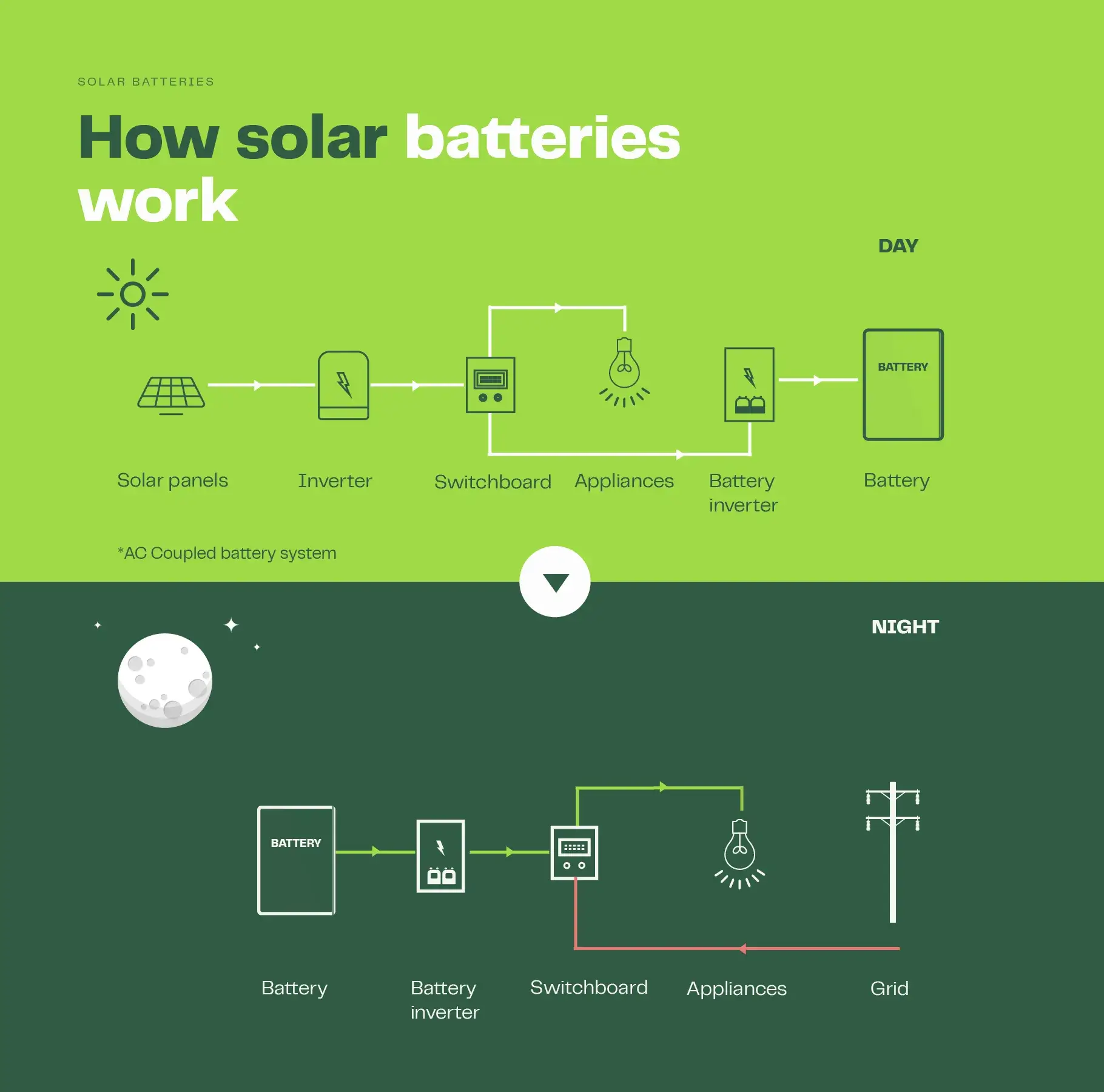
A step-by-step guide to storing solar energy
We explain step-by-step how sunlight can be turned into electricity and stored in a battery for use at any time.
During daylight hours
- Solar cells harvest the suns energy and convert it into DC electricity
- An inverter converts the current from DC to AC
- If electrical appliances are being used, a switchboard directs electricity to power them
- Excess solar energy is sent from the inverter to the battery inverter so that it can be stored in a battery
Stored solar energy is used at night
- When called upon, the battery sends energy through to the battery inverter
- The battery inverter converts it from DC to AC for use in the home
- The switchboard directs the stored solar energy to power your electrical appliances
- If the battery fully discharges, you buy electricity from the grid
Battery size, life cycles and discharge rates
A solar battery can typically last between 5 – 15 years, depending on how they are used. The best solar batteries can handle upwards of 4,000 cycles and normally come with a 10-year warranty, though their lifespan may be shorter, or longer, depending on how often they are cycled.
Depth of discharge
Over time, solar batteries slowly degrade and don’t discharge to their full capacity. Effectively, the storage capacity of the battery decreases over time as the depth of discharge decreases. If a battery is regularly discharged beyond the depth of discharge, it will shorten its life.
Battery capacity
Battery size is measured in kWh units. A 10 kWh battery’s useful capacity starts at close to 10 kWh before decreasing slowly over time. For many Australian households, a larger 13.5 kWh battery is a good size to pair with an existing panel system.
For new systems, it’s best to size the battery in accordance with the number of panels and your electricity usage habits.
AC and DC batteries
The configuration of your solar panel and battery system may differ depending on the type of battery you buy. An AC battery can be retrofitted to any existing system. Many DC batteries can be fitted to systems too but, you will likely need to install an accompanying hybrid inverter with the new battery.
How a solar battery generates savings
A solar battery stores solar energy for later use, rather than exporting excess energy back to the grid. Savings are generated by using the stored solar energy as opposed to having to buy electricity from the grid.
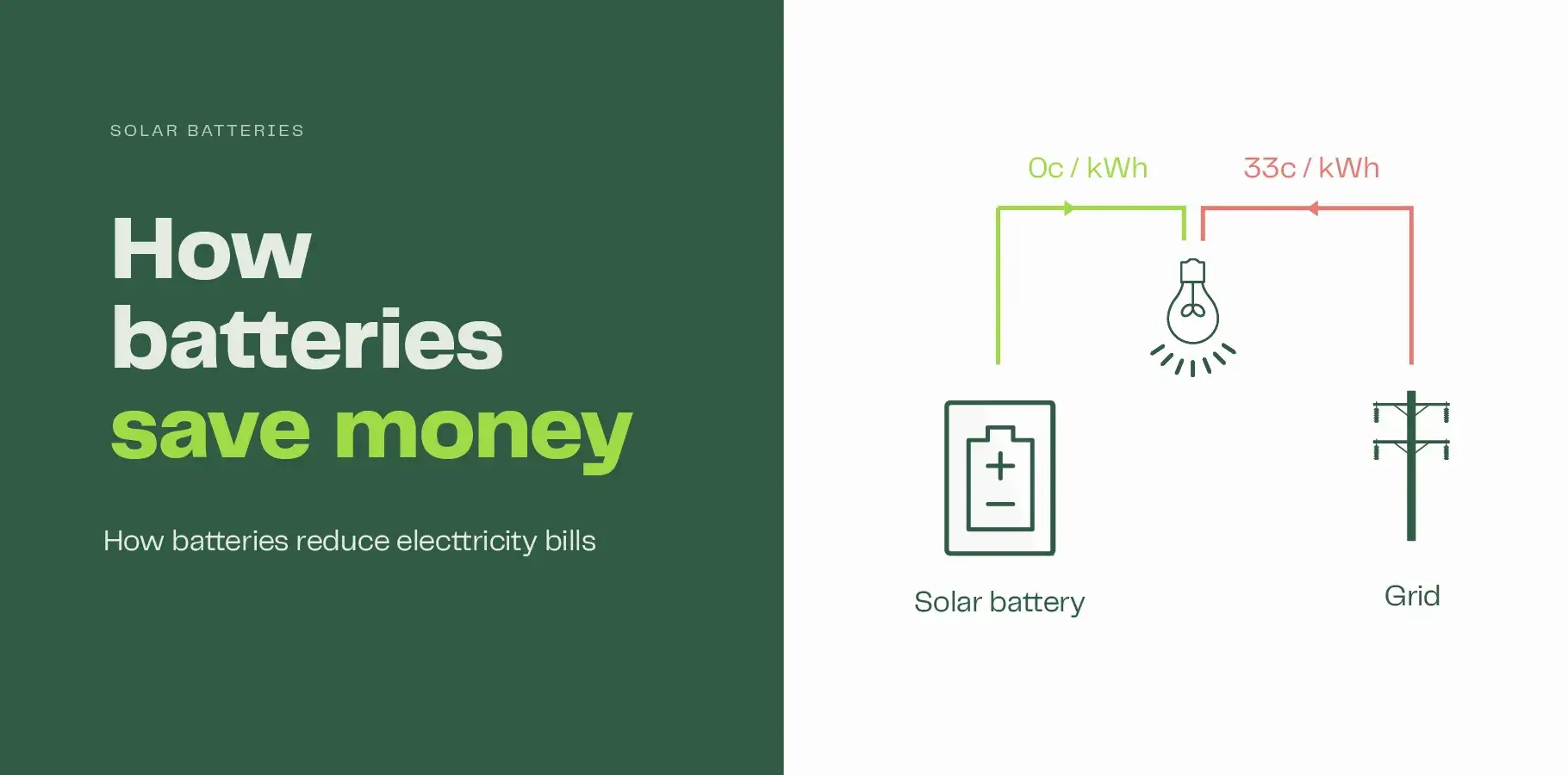
A solar power system without a battery, sends excess electricity back to the grid and the system owner receives a feed-in tariff - normally around 4 – 10c per kWh of energy exported. The feed-in credit amount varies depending on where you live and the type of plan you have agreed to with your electricity retailer.
Without a solar battery, you have to buy electricity from the grid at night. Depending on your plan and provider, you may be paying up around 33c per kWh to buy this electricity.
Battery savings
If you have a solar battery, you forgo the feed-in tariff (let’s assume 7c) but, save by not having to pay the 33c per kWh to buy electricity from the grid.
The battery savings in this instance, work out to be 26c per kWh.
In recent years, feed-in tariffs have decreased while electricity prices have increased, therefore increasing the savings delivered by a home battery.
Battery prices and rebates
Solar battery prices have decreased significantly with the federal government’s battery rebate. For many households, a new panel and battery system can payback in around 7 – 8 years.
Prices and rebates vary depending on the size, brand and functionality of the battery. For example, the price of a Tesla Powerwall 3 is around $12,400 with the rebate – slightly more than similar sized batteries.
Solar batteries can be an effective investment for Australian homes. The ability to store solar energy and use it when the sun isn’t shining reduces household emissions and can significantly lower electricity bills. The financial savings vary by household, so it’s best to perform your own calculations.
Are you ready to compare solar quotes?
Get 3 free quotes and start your solar journey today.
Get free quotes