


Benefits of
solar energy
Last updated: May 2026
Reading time: 5 minutes
Solar panels deliver many financial, environmental and energy security benefits.
The benefits associated with solar energy in Australia are amplified by a combination of: high solar radiation, technological advancements, lower installation costs and a swathe of valuable government incentives.
The stats don’t lie. More than 4.3 Million Australian households now have solar panels installed, representing over 40% of the population – underlining the benefits of solar panels. In May 2026, the rapid uptake of solar batteries is helping to increase savings, lower carbon emissions and future proof Australian homes. Solar generates 18.3% of the nation's electricity, making it the second largest generation source in the country.
However, the benefits of solar’s cost-effective, renewable energy supply don’t apply evenly to every home.
Our guide to the benefits of solar panels unpacks all of the advantages, myths and considerations when installing a solar energy system.
The main pros and cons of solar energy
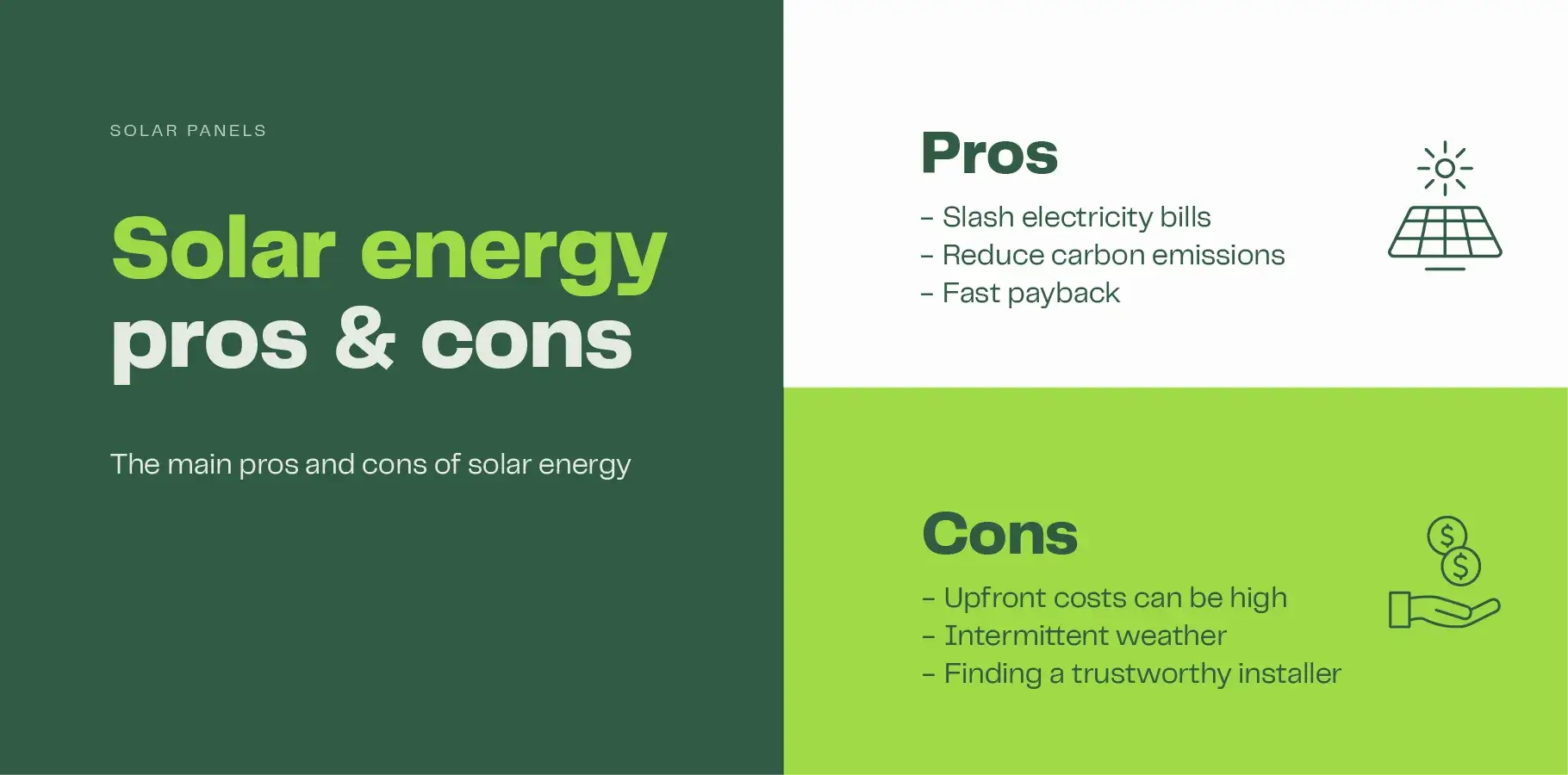
The table below highlights the common advantages and disadvantages of solar energy:
Pros and cons of solar
| Pros: Top reasons to go solar | Cons: Worth consideration |
|---|---|
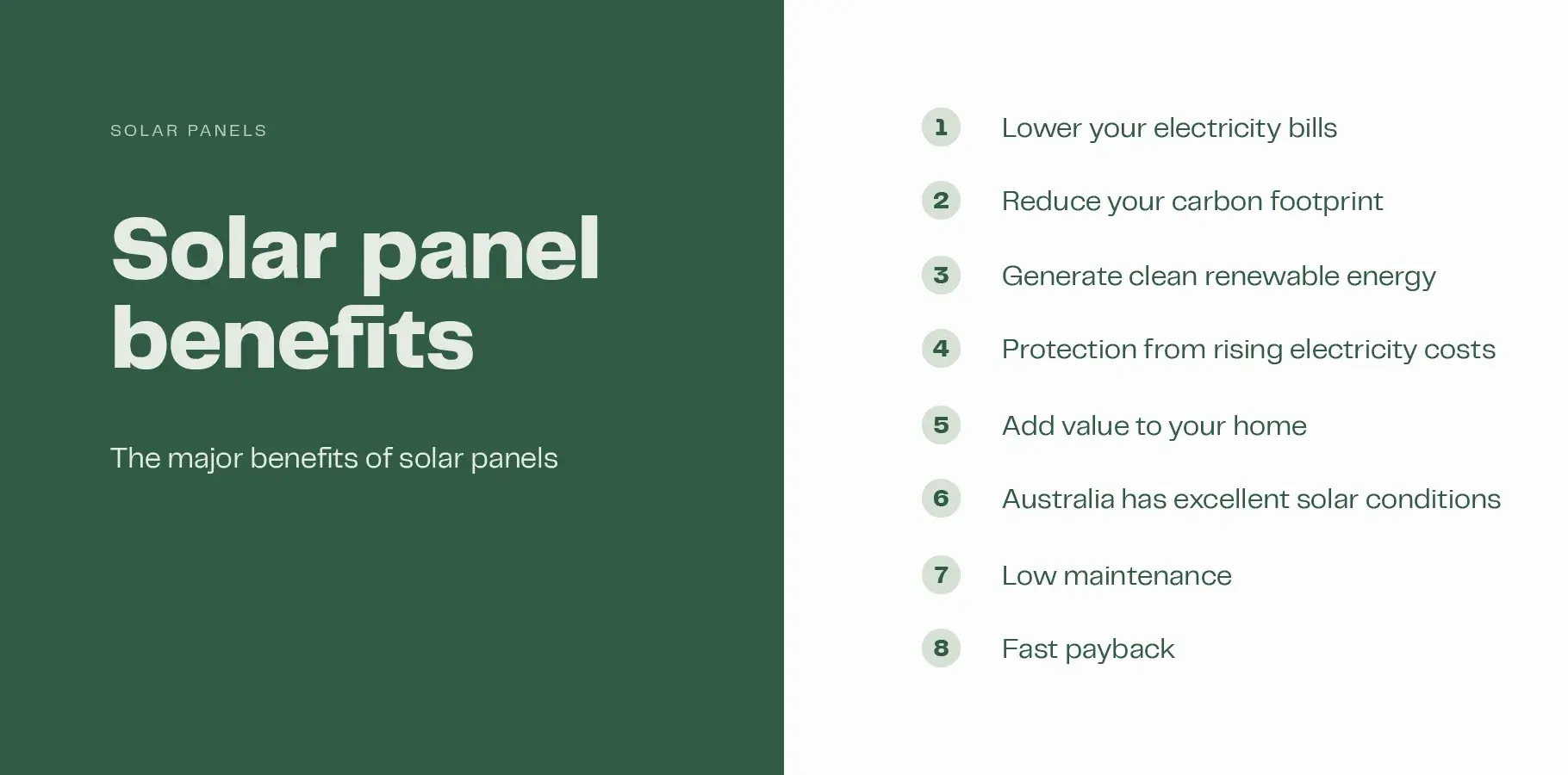
| 1. Save money on your household bills | 1. Relatively expensive upfront costs |
| 2. Reduce your carbon footprint | 2. Solar panels don’t work for every roof |
| 3. Generate clean, renewable energy | 3. Your system will rely on sunshine |
| 4. Protect yourself against rising electricity costs | 4. Your panels will not work at night |
| 5. Increase the value of your home | 5. It can be challenging to find the right installer |
| 6. Take advantage of Australia’s excellent solar conditions | 6. Solar batteries are expensive |
| 7. Solar panels require little maintenance | |
| 8. Enjoy fast payback plus a long system lifespan | |
| 9. Claim generous government rebates |
Advantages of solar energy
1. Solar can drastically cut your electricity bills
One of the top reasons for going solar is to reduce your electricity bills. As soon as you install your panels, you will reap the savings on your next electricity bill.
A typical 6.6kW system can deliver savings of around $1,500 annually. Installing a battery can see that figure almost double to around $3,000 per year,
2. Solar reduces your carbon footprint
When you switch to solar, you'll lower your environmental impact by using less electricity from the grid, which comes from a mix of sources – mainly fossil fuels.
For example, a 6.6kW solar system can reduce greenhouse gas emissions by over 250 tonnes in its lifetime.
3. Solar generates clean, renewable energy
Solar power is a form of renewable energy that is inexhaustible. The sun generates enough energy in one hour to power the whole planet for a year.
Better yet, solar panels don’t produce any emissions or pollutants while generating energy for your home. This helps improve air and water quality, leading to better public health outcomes.
4. Solar can protect you from rising electricity costs
Electricity bills have risen consistently in Australia over the past few years. Solar panels can help to protect you from rising electricity prices.
By generating your own solar energy, you can mitigate against the impact of higher electricity rates and safeguard against future rate increases.
Solar panel and battery systems take energy independence one step further. Solar batteries allow you to store your excess solar energy for later use, so you don’t have to buy from the grid at peak times.
5. Solar panels add value to your home
Multiple studies conclude that solar panels add value to your home. Our own calculations suggest that a typical 8kW system can increase the value of your property by over $30,000.
6. Take advantage of Australia’s excellent solar conditions
Australia benefits from an abundance of sunlight, providing a huge natural advantage for generating solar energy. We boast the highest solar radiation per square metre of any continent.
7. Solar panels require little maintenance
Once you’ve installed your solar system, it typically doesn't require much in the way of maintenance. Depending on your rooftop, your solar panels will likely require little cleaning.
The inverter may need to be replaced after 10 – 15 years, but for many owners, this is the only additional cost they incur throughout the life of their system.
8. Enjoy fast payback and a long lifespan
In Australia, most solar systems will payback within 4 – 7 years through savings on electricity bills.
If you buy a good quality system from a reputable installer, your solar panels will last 25 years or more. For peace of mind, the best solar panels now come with a 25-year product warranty, while one manufacturer boasts a 40-year warranty.
9. Claim generous government incentives
The Australian government is currently providing incentives on the installation of both solar panels and batteries.
The rebate on solar panels can reduce the upfront cost by between 25 - 30%.
The national battery subsidy also reduces the cost of solar batteries by around 25%.
Disadvantages of solar energy
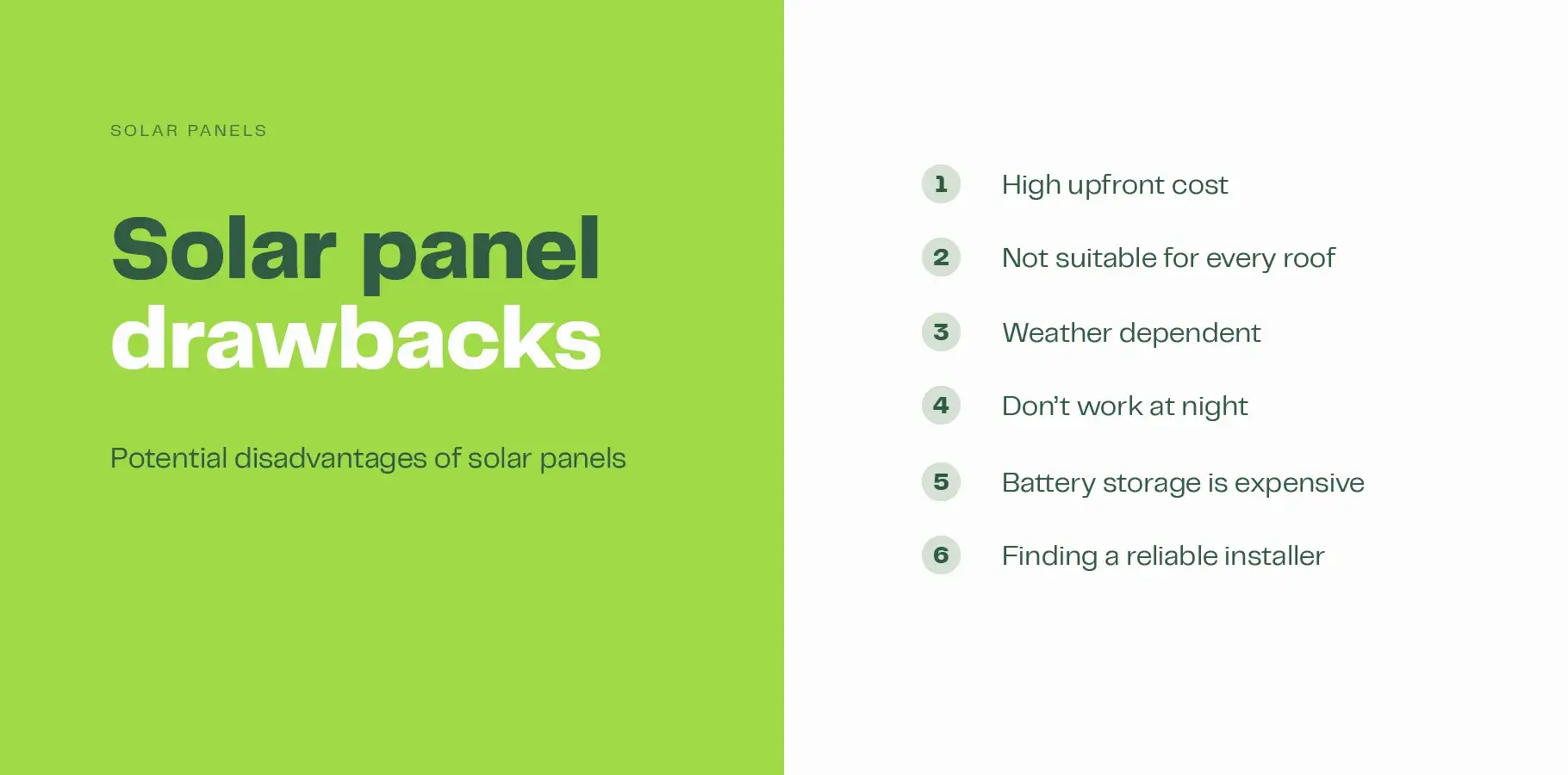
Installing solar panels is typically a straightforward financial and environmental decision. However, for some, it can have its drawbacks. We discuss all of the disadvantages associated with solar energy:
1. Solar has a high upfront cost
The upfront cost of purchasing solar panels can be substantial for Australian homeowners.
A 6.6kW system typically costs between $5,000 – $8,000 depending on several factors, including the quality of the components.
It is possible to avoid any upfront costs but still enjoy all the benefits of solar, by financing your system purchase. Our Solar loan calculator will help you understand your monthly repayments and total interest cost.
Weigh up the cost vs savings
It's likely that the savings a solar system can bring will far outweigh the cost.
Our Solar calculator can help you work out the payback period, lifetime savings, return on investment and show you how much your electricity bills will be with solar.
2. Solar panels do not work equally well on every roof
Solar energy output is largely determined by the direction, angle, and orientation of the panels.
In Australia, rooftops that face north perform the best. A roof pitch equal to the latitude angle of your location will yield the best results.
In truth though, very few rooftops are unsuitable. Even south-facing solar panels can deliver good savings.
3. Solar panels rely on sunshine
Solar panels won’t perform as well when the sun is not shining. While panels do still work when it’s cloudy, their output is significantly reduced.
4. Solar panels don’t work at night
Solar panels rely on sunshine to produce energy and therefore, they don’t work at night.
However, if you want to avoid buying energy from the grid, you can install a panel and battery system that stores the energy produced by your panels during the day, so that you can use it at night.
5. Solar batteries are a large investment
Battery storage has many advantages, including the ability to provide backup power, lead to an increase in energy independence and lower electricity bills. While batteries are typically a worthwhile investment in most cases, they are relatively expensive.
The Australian government battery rebate has helped to reduce prices, as the average price for a 10 kWh battery now ranges between $8,000 - $10,000.
6. Finding the right installer can be difficult
One of the difficulties of going solar is finding a trustworthy company to supply and install your system. Selecting a company with a proven track record, high accreditation, and first-rate install practices is important for the longevity, safety and performance of your system.
Our expertise in vetting installers can ensure you get a failsafe install. We carefully evaluate every company we collaborate with to make sure we connect you with companies that can meet your needs. You can compare three free solar quotes from reputable companies.
Benefits outweigh the drawbacks
For most Australian homeowners, the benefits of solar panels far outweigh the disadvantages.
There are a number of good reasons why you should consider installing solar panels including, saving on your electricity bills and reducing your carbon footprint.
The common barriers associated with getting solar panels can be overcome. While the upfront cost is the major drawback for most homeowners, it is hard to ignore the return on investment that solar energy can deliver.
- A guide to solar for your home
- Are solar panels worth it
- A guide to 3kW solar systems
- A Guide to 4kW solar systems
- A guide to 5kW solar systems
- A guide to 6.6kW solar systems
- A guide to 8kW solar systems
- A guide to 10kW solar systems
- A guide to 13kW solar systems
- A guide to 20kW solar systems
- A guide to hybrid solar systems
- A guide to off-grid solar
Are you ready to compare solar quotes?
Get 3 free quotes and start your solar journey today.
Get free quotes